like_a_moth_to_a_flame_by_deskridge-d9r0r35

In reading the Prologue to Giorgio Agamben’s The Use of Bodies (Stanford, 2016; originally L’uso dei corpi, 2014), I now more fully understand why Tom McDonough, in his prepared comments for the recent roundtable discussion of my book The Decision Between Us, turned to Guy Debord’s last film, In girum imus note et consumimur igni (1978) and juxtaposed Debord with Roland Barthes, and Barthes’ essay, “Leaving the Movie Theatre” (1975).  Debord’s title, which translates as “We turn in the night, consumed by fire” is, in its Latin inscription, a palindrome. More specifically, it is a palindrome that—as Agamben points out—in turning on itself performs what it says. Namely: loss and death as the result of a fatal desirous attraction to a luminous light in the night. I am not sure if this was part of Tom’s unspoken intention, but I wonder whether one of the reasons he referred to Debord’s last—and what he describes as Debord’s greatest—film, was not only because Debord has been so central to his own work for the past several decades, but perhaps also because the theoretical argument that I present in the first chapter of my book is equally structured by a palindrome that also serves as its title: “Name No One Man.” My title, like Debord’s, also palindromically performs what it says: in this case, the multiplicty of anonymity. An anonymous multiplicity that is here enacted by erasure as its own aesthetic-erotic praxis of withdrawal and loss (e.g. Rauschenberg’s Erased de Kooning Drawing, 1953—which is the focus of that chapter).

As Agamben goes on to explain, Debord’s title functions like an emblem (impression/phrase/motto) + image, of moths (the “we” that is speaking in the Latin) drawn to the flame of a candle that will consume them in its heat. The moths then, are sort of like moviegoers going to the cinema, in which an equal attraction to a bright light in the night represented for Debord one of the principal (although perhaps not ultimately fatal)  forms of alienation within what he called the society of the spectacle.

But as McDonough points out, for Barthes, it is not so much a matter of “going” to the movie theatre and of being attracted to the light that shines in its cinematic darkness (one might say that the diurnal time of the cinema is always nighttime), but precisely of “leaving” the movie theatre—yet without forfeiting an experience of pleasure. Indeed, as I have argued in both The Logic of the Lure, and in The Decision Between Us, there is an art to (and ethics of) “leaving” (departure, withdrawal, retreat), and in this way is its own source of pleasure for both the leave-taker and the one who is left. I think here for instance of Foucault telling us, in one of his last interviews, that the most erotically intense moment is when—presumably after a one-night stand— the boy leaves in a taxi. In turn, there is another sense of pleasure that is derived from the implication that in leaving, there is yet another place to go and where, in departing, one might be headed. As we know, this was exactly Barthes’ modus operandi: of“taking off” (as he himself puts it) from the gallery opening, the dinner party, the opera, the theatre or the cafe, and then going to the club, the drugstore, the bar, the park or, simply wandering the streets at night on the way back home, and along the way cruising and sometimes picking up hustlers.

For Barthes, the cinema is defined by its darkness, one that he describes as “the very substance of [a twilight] reverie” and “the ‘colour’ of a diffused eroticism.” Such that, as he goes on to say, the movie house “is a site of availability (even more than cruising), the inoccupation of bodies, which best defines modern eroticism—not that of advertising or striptease, but that of the big city.”
6944699206_d4a4ac1459_b

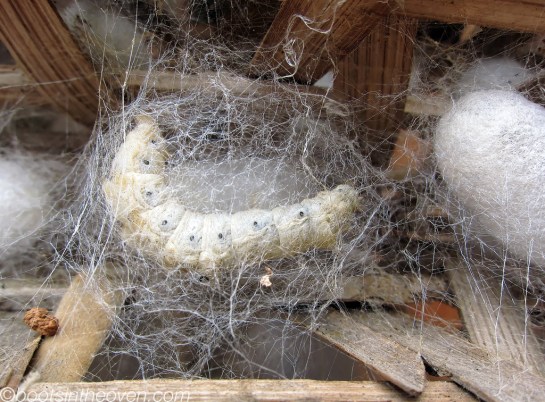
In his essay from 1975, Barthes draws upon another Latin motto, emblem and figure. In this case, that of the silkworm that weaves its cocoon and, once encased inside there, glows in the night, as though enveloped—like the moviegoer—by the bright light of its own desirous attraction. Inclusum labor illustrat: “It is because I am enclosed, that I work and glow with all my desire.” And at the same time, like a moth, the moviegoer is attracted to the light of the movie projector: “that dancing cone which pierces the darkness like a laser beam” as Barthes describes it.

As McDonough notes, the tactic for Barthes is not to break the fascination of the lure, but to exacerbate it, “to be fascinated by the image twice over” (Barthes). That is, to be fascinated by the image and by its surroundings, and hence to have something of a perverse relation to the cinema that is contingent more so upon “leaving” rather than going to the movie theatre.
Thus in seeking a figure (or emblem) for the specific pleasure that is derived from that form of desiring that is leaving at night, and into the night, neither Debord’s moth nor Barthes’ silkworm will suffice. Instead, it is none other than Marx who provides us with the most apt image for any number of those nocturnal creatures who, once the sun has set, set out into the night in search of that source of attraction—that light in the night—that always stands the chance of being fatal, or exhilarating in the risk that is the intimacy of the outside. As Agamben notes, it is in The German Ideology that Marx writes: “and it is thus that nocturnal moths, when the sun of the universal has set, seek the light of the lamp of the particular.” It is the clandestinity (at once secret and illicit) of this move from the universal to the particular, that Agamben will focus on as the means of rethinking the political by reviving the political’s attachment to that register of the everyday that otherwise goes unremarked and unnoticed—which includes that which remains unremarkable and unnoticeable. In turn, it is Stacey D’Erasmo who, in her response to my book, arrived at a sense of the importance of noticing precisely those things that are not readymade but that often seem to be (or are) unmade and perhaps even un-makeable (including as what might be legible as politics).
This move from the universal to the particular is the move from generic form—including something simply called “life”—to a form-of-life that, in its essential clandestinity, promiscuity and inoperativity, might be described as queer.

This is the remarkable text that Stacey D’Erasmo presented at “Of Queer Neutrality: Apartness, Erasure, Intimacy,” the symposium and public roundtable on my book, The Decision Between Us, that was held on April 1, 2016 at the University of Toronto. 

I am deeply moved by Stacey’s words and thrilled by the deep resonance between her thinking and writing and my own. Her book on intimacy and its written form in various works of literature and poetry is a revelation, and is its own guide towards an ethics of the nearly impossible-to-occupy space between. Many who attended the symposium have expressed their own appreciation and excitement of this text, and thanks to Stacey’s generosity, I am happy and honoured to be able to publish it here. The title is not hers, but one that I have given the essay, drawing from its own language and argument. 


Thank you to John and to the Jackman Humanitites Institute for inviting me to this discussion. It’s a pleasure to be here. I have to admit that I was a bit surprised to be asked—I’m primarily a novelist, and I speak theory about as well as I speak French, which is to say enough to get around, order breakfast, ask for directions (take a left at Ranciere…), but I’m not fluent. The reason John asked me is that I wrote a book-length essay called The Art of Intimacy: The Space Between in which I looked at how it is that writers create a sense of intimacy on the page—intimacy among characters, between reader and writer, erotic and thanatopic intimacies, intimacies for which we do not have a name. I wrote this book for a literary series on craft and criticism, but I am sure that my book was very frustrating for any apprentice writer, because when I looked at various texts what I found was that these intimacies were not, strictly speaking, there. Instead, they were produced by what John, in his book calls the peri-space or the peri-performative: the space around, the space between. Our sense as readers that an intimacy had occurred was made by various meetings, often quite brief or glancing, in verb tenses, in the image, in murderous transaction, in white space, and so on. I opened the book with an epigraph from Gertrude Stein from the “Roast Beef” section of Tender Buttons: “The kindly way to feel separating is to have a space between. This shows a likeness.”

My job as a novelist is easier than any of yours because all I have to do is give the reader the feeling that something has happened, say an intimacy of some kind. If that intimacy was detonated in the margins of the page, in the syntax of the scene, in the shadows of the subjunctive, the reader, like Nancy’s image of Psyche, doesn’t know and doesn’t care. The reader—unlike the Psyche who is, of course, more awake in the myth than prone and unconscious or maybe dead—doesn’t lift the lamp. And if you say to the reader, as I did, ‘well, you know, the room is empty, the hat is empty, there is no rabbit, also no room and no hat,’ the reader basically shrugs. She already knew that.

FGT 1600x1154

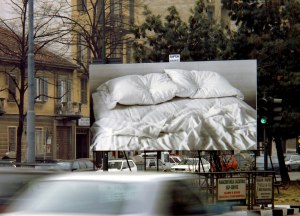
However, it would be highly disingenuous of me to say that I don’t see the stakes of John’s argument, that I don’t have stakes in it, that I’m a stranger here, I don’t speak the language, I am not subject to your borders, I’m just passing and passing through. Je ne parle pas Nancy. Because, as John points out in his discussion of Felix Gonzalez Torres’ Untitled, that image of the unmade bed on the billboard is not “the representational visual form added to a preexisting content (e.g. privacy, domesticity, coupledom), but is the very scene of the ethical-political contest over these various terms, and the performative spatial praxes to which they are conventionally assigned.” It seemed to me in reading John’s book that the image of an unmade bed—the proposition that there could be an unmade bed, that the bed could be unmade—kept appearing and reappearing: in Rauschenberg’s erasure of the de Kooning drawing, in the Mystic Writing Pad discussed by Freud, in the bed used by Duras, by Breillat, by Nancy; in Barthes’ embrace of haiku and photography and his impossible wish to be exempted from the image as a kind of social military service, in the Zen concept of satori. Barthes’ neutral, of course, is an unmade bed. Felix Gonzalez-Torres’ pile of candy is an unmade bed. The photographs in the book by Faucon and Baudinet are unmade beds.

This proposition is a scandal, and, as an American, it’s fitting to me that we are having this discussion in Canada, where the draft dodgers once went. John is clearly a gentleman and a scholar, but his proposition is obscene and getting more obscene by the minute. I accept, not without a certain amount of trepidation. I kept thinking about that queer slogan from the ‘80s, “An army of lovers cannot fail,” and how different it would sound to us today to say, “An army of exiles cannot fail,”—whoops—but then, of course, erase the army, erase the forward-moving syntax, erase the verb, erase the sense of failure of success, lift the sheet on the Mystic Writing Pad. All you’re left with are the exiles, and maybe even just the ex-. All lovers are ex-lovers. The term “queer neutrality,” socially, is an oxymoron if not an outrage. We are more wedded to identity now than we have ever been. Many of the people in their makeshift boats on the crossing die, because the space between is a perilous passage in which one cannot live. The prepositions to or from are mandated, and in very concrete terms. Indeed, the prepositions to and from have tremendous power at the moment. They are the prepositions du jour, if not de siècle. One can live and die of them.

Other prepositions—beyond, around, between, beside, before, after, behind—are powerless. They are the prepositions of the unmade bed. Scandalous prepositions, and propositions. To dwell in powerlessness, in between-ness, is a scandal as well, if not also high-risk behavior. To suggest that the phrase this place, as in John’s discussion of Gonzalez Torres’ two stacks of paper labeled “Somewhere Better Than This Place” and “Nowhere Better Than This Place,” refers not to one or the other places but to the place that is shared by both of them flies in the face not only of geopolitics but also of basic Western identity. Further, to posit that we already have the freedom to decide to partake in, to sustain, as John says, “the inappropriate space between us as no-thing and already unmade,” to take the candy and eat it, is increasingly unsayable. John seems to be suggesting that we take candy from strangers, indeed, that taking candy from strangers is a freedom we already possess. His book, itself, as much as the art works that are discussed there, offers us that invitation, that decision. It is an invitation to powerlessness, to traitorous collaboration, to unbecoming.

A novel that is an unmade bed, in these terms, is a novel that will not make up its mind, and, as a result, will not make up the reader’s mind. One can say that all writing, all novels, certainly, are already unmade beds, but that’s too facile. I can think of works that seem to me to be unmade beds—Gide’s The Immoralist, Duras’ The Lover, Theresa Hak Kyung Cha’s Dictee, Renata Adler’s Speedboat, all of Jane Bowles, all of Genet, of course. These are works of unbecoming—they unbecome the reader, and the pun seems apt as well. They are unbecoming books; they don’t make anyone look good, or bad, for that matter. They deliver us into a freedom from interpretation and identity that is uncomfortable. We become quite naked as readers. As John says, “what turns us on turns us out,” and I think the puns are apt there as well, being turned out as being exiled and being turned out as being prostituted, offered up to strangers, possibly strangers with candy. We are given or shown our freedom, our responsibility, our nakedness, and, frankly, this isn’t why most people read novels, or write them. The marriage plot is more popular now than ever.

The ability to discern this freedom, to dwell in it or at it, to see it as a decision that is always on offer, to apprehend works of art from this free position—by which I mean the neutral, the powerless, the partes extra partes—is severely constricted at the present moment. If you are without a place, you are an exile or a terrorist or a traitor. If you wish to be without a place, or attempt to be without a place, you have lost your mind. This is the moment in which we find ourselves. What fascinates me about The Decision Between Us is that John is not sounding a cry for liberation. His exploration rests on a freedom that is already there. The book, in this regard, strikes me as a kind of diagnosis or perhaps a punctum, to use Barthes’ term. I don’t know where to go from here. What has occurred to me in the wake of reading this book is a state I might call noticing. It seems to me, to return to Stein, a kindly way to feel separating, to have a space between, to show a likeness.

This is the public roundtable discussion of my recent book, The Decision Between Us: art and ethics in the time of scenes. It was held on April 1, 2016 at the University of Toronto, and featured remarks by David Clark, Stacey D’Erasmo, Jacques Khalip, Etienne Turpin and Tom McDonough.

I am deeply appreciative of the generous time and care that each of them has devoted to my work, and the many new insights that their precise observations, re-framings, and juxtapositions generated. It is certainly a rare occasion for an intellectual discussion in the academy to be structured less around questioning critique, and more in terms of a willingness to go along with another thinker and writer’s thinking and writing for awhile. Resonances and shared affinities and devotions emerge, and this is truly a genuine gift.

But I am equally grateful for David, Stacey, Jacques, Etienne and Tom’s commitment to making this roundtable discussion a real intellectual event and not simply a panegyrical celebration. They came not only as admirers but as readers, willing to probe the larger political, ethical and aesthetic dimensions of my work, and to situate those paths in relation to other contemporary discussions and events (e.g. the Anthropocene, queer pedagogy, the refugee crisis, the marriage plot, and the un-livable). And to open up my work to that of others: Roland Barthes, Guy Debord, Tracey Emin, Sophie Calle, Gertrue Stein, and Deborah Britzman—to name those that immediately come to mind.

Which also means that they did me the great honour of not imitating my style of theorizing, my particular way of speaking through a written text, and of rhetorically constructing an argument. Instead, they brought everything that makes their own work so distinct and uniquely theirs, and spoke in the very voices that have drawn me to their work over the years. This public conversation was neither a series of forgeries nor a canonization of a book or its author, but an exploration of what jointly emerged as the obscenity and scandal of thinking and perhaps trying to live in terms of “queer neutrality.”


On March 19th, I presented a talk titled, “Edging the Common” at the conference “Aisthesis and the Common: Reconfiguring the Public Sphere,” that was organized by the research group Media@McGill, and held at the Musée d’art contemporain de Montréal, March 18th and 19th. Other speakers included: Jean-Luc Nancy, Santiago Zabala, Pierre Dardot, amongst others. Videos of all of the presentations are available at: http://www.aisthesis.ca/videos/


I was invited to deliver one of the Keynote Lectures at the 26th Annual International Comparative Literature conference, by the graduate students in Comp Lit at the University of Toronto. The other Keynote speakers were Linda and Michael Hutcheon, and W.J.T. Mitchell. My talk, “Edging, Drawing, the Common,” took place on March 5th, 2016.

John Paul Ricco, “Edging, Drawing, the Common,” Keynote Address at the 26th Annual International Comparative Literature conference, University of Toronto, March 5, 2016.


This is the final scene from Todd Haynes’ film SAFE. In it, the character Carol, (Julianne Moore) enters the windowless igloo-like cabin that has been assigned to her, at a New Age recovery centre somewhere in the southern California desert. Suddenly drawn to the small mirror on the wall opposite her bed, she approaches it and while looking into the mirror, and says, in a nearly inaudible hushed tone, “I love you.” Shot from the point of view that we take to be occupied by the mirror, and which is the point of view that we as viewers are now made to assume, it is as though Carol is no longer professing her love to her mirror reflection and thus to herself, but (or perhaps also) to some unidentified and invisible other who inhabits the space outside of the frame, and towards which her gaze is directed. This could be any one of us as viewers, or more simply and expansively, it is an alterity that Carol (and each us) is in rapport with as the singularities that we are amongst other singularities.

Leo Bersani discusses this scene in his recent book, Thoughts and Things, specifically in terms of a certain “unnamed passion” that is presented here, and that Haynes and Moore ask us as viewers to reckon with. This scene, and Bersani’s reading of it, are also featured in my current paper/talk on “The Commerce of Anonymity.” There, I argue that an impersonal and anonymous commerce or compearance is staged here at the end of the film, in which through this “unnamed passion” that is also the passion and pleasure of not naming and of going unnamed, the self is opened up to as yet unknown encounters with yet-to-be-known others.

The “you” of Carol’s “I love you” is the “you” that each of us is in the anonymous commerce of our sociality. The decision that we are left with is the decision to sustain a love that is legitimate to the extent that it operates without the safety and security provided by the legitimizing authority of the name. Love—and therefore friendship and even more broadly the commerce of encounters with strangers, passersby, and other anonymous others—is thus redefined as that which finds its legitimacy in the de-legitimzing pleasures, risks and affects of that unnamed passion that is anonymity.


With this quotation from Georges Bataille’s text “Torture” (from his book Inner Experience, 1943), Jean-Luc Nancy opened his keynote address (via Skype) to the international colloquium on “Aisthesis and the Common: Reconfiguring the Public Sphere,” organized by Media@McGill and held at the Musée d’Art Contemporain de Montréal, on March 18-19, 2016.

More than one

As one of the defining principles of Nancy’s philosophy, meaning (or sense) means “more than one.” More than one person, thing, body (i.e singularity) that, each in their multiplicity, is always in rapport with other singularities: sending out and sending back differential gestures, voices, perceptions and (hence) senses. In turn, the notion that there exists something (or someone) that is absolutely unique, is—accordingly so—meaningless. This even applies to that purportedly unique and one-of-a-kind entity named “God.” There is no such thing as “only one being,” and if there were such a thing, it would be, as Nancy put it, “dissolved in its singleness.” So, for there to be some thing, there must be more than one thing, given that being means rapport and thus being is always and only ever being-with. The question is not why is there something rather than nothing, but more precisely, why are there somethings (in the plural), such that there is no one thing.

Implicitly drawing from Maurice Blanchot, Nancy pointed out that even the notions of being alone and of solitude precisely entail being without someone else; and that it is this being-with as being-with-out, that comes to define the singularity of each existing thing. When one feels oneself to be alone, one senses that solitude as distinct from others (and thus in rapport with others), and thus also in rapport with one’s own singularity defined as always in rapport with. God is not alone, and he created the world because of his insufficiency that exceeded himself.

Meaning or sense is always in rapport or relation to itself, because sense itself is always self-separated (i.e. divided and hence never a single whole entity or substance). It is from out of this separation that sense makes sense 0r meaning, when sense—now in terms of feeling or sensation— feels or senses itself. A feeling or sense that is possible, precisely because separation is the condition in which such a rapport between can happen. Yet this feeling of sense feeling itself, is not an infinite and closed relation to itself, but in its separation, remains open and exposed to the outside. It is in this way, that Nancy speaks of a certain auto-affection and auto-mimesis of sense. Yet that is, nonetheless, never the fact or production of a sameness of meaning, simply because sense is always divided and shared, amongst and between multiple singularities.

Here is where Nancy’s deconstruction of the autonomous self or subject, as that which is always self-affected in its exposure with the other—with the outside—lines up with my own argument regarding auto-eroticism as its own pleasurable and desirous rapport with the outside and with others. Relation with the outside, as the relation that defines existence as always being-with (and with-out) is the relation to self that comes to define that self as not even a self (in the sense of a coherent, stable entity) but as a singularity.

As Nancy then went on to say, “singularity is the unity of a separation.” It is a unity that derives its sense (meaning) of self from its self-separation and division. Here he turned to the example of unicellular reproduction or scissiparity, in which it is out of originary separation that a “self” is born.

Common Sense

When it comes to the notion and the expression common sense, Nancy argued that this has been, in part, a matter of philosophy’s pushback against what it has deemed and denigrated as ordinary and banal and hence not worthy of philosophical reflection. In this way, common sense has been a negative for philosophy. At the same time, that which does not simply reproduce common sense, in the forms that have caused philosophy so much anxiety and fear, is art and aesthetics. Meaning that art is the re-directing of the ordinary, the banal, or the given. It is the praxis of finding that which is distinct in the common and ordinary—at the outer edge, and along its opening to the outside.

Nancy then turned to Aristotle, for whom common sense was not a vague sensibility but consisted of common sensibles: movement, rest, figure, size, number, and unity. These are those sensible qualities that are common to each and every thing, in its singularity as that thing there (i.e. in the specificity of its presence). Along with the common sensibles, there are the five senses of perception, that are non-continuous and always fleeting, as they incessantly move to- and towards things. Opposite this, as Nancy emphasized, a constant continuous sensation is the very definition of torture.

If what is common are the common sensibles of things, then we access the commons and have a sense (aisthesis) of the common through our sensible access and relations to the common sensibilities of things. This sense of the common is shared with, at, and in proximity to things, the latter of which come to function as rendezvous or meeting points. In order to articulate the connections between these (often readymade) things, aisthesis and aesthetics, Nancy drew upon the example of Duchamp’s readymade, and the latter’s own designation of such things as more encounters and points of rendezvous, than as autonomous works of art.

Impressions on the Edges

Like the Duchampian readymade, art is the possibility of distinction that is drawn out from out of a continuum, and this is precisely what is meant by art’s ex-pression. Literally taken to mean: the outside (ex) pressing on and up against or alongside. Art’s expression is the impression of the outside that it temporarily impresses upon us and other things in the world, in the form of sense and meaning.

It is this that is common to us in our shared exposure to the outside; and it is art that offers us a sense of this rapport, sense and meaning as that which is without definitive end, completion, resolution, or satisfaction. Meaning that art offers us the pleasure of being-with and in rapport, that does not demand or seek or establish an end, but instead affirms that right on the immeasurable edge of things, is the opening to the outside, not beyond. It is along these edges, that, I argue, a sense of the common happens.

I am so pleased that my essay, “The Art of the Consummate Cruise and the Essential Risk of the Common” has now been published (in two parts) by Feedback, a truly excellent online, open-access critical theory weblog/journal. Part I: The Ethics of the Pleasure. Part II: Cruising as Aesthetic Intuition of the Common.

Gay Cruising Pair Bathroom Stall

The essay originated as a paper that I presented at last year’s American Studies Association conference (Toronto, October 2015) on a panel organized by Ricky Varghese titled, “Sex, Misère, and the Redemptive: Barebacking and Historicity.” I want to thank Ricky for the invitation to participate in what was a very thoughtful, insightful and provocative discussion.

In the essay, I argue that we need to shift from a language of self and other towards one of co-exposed singularities, in order to think further about an ethics of pleasure that is not predicated upon sacrifice—either of the other or of the self. In addition, I call for the need to think sexual and other forms of risk and pleasure in terms of the common. Based upon recent work by Bill Haver, the common here is understood as always a sense of the common—including the aesthetic intuition of, and erotic inclination towards, the impossibility of the common.

I also want to thank “Joe,” the photographer of the image that I have reproduced here and that accompanies both parts of the essay, for kindly granting me the permission to reproduce his strikingly beautiful, evocative and downright sexy photograph.


My research and writing this year has been primarily focused on completing a draft manuscript of my book, The Outside Not Beyond. This work has been aided tremendously by a 12-month research and study leave, of which I was at the midway point at the beginning of the year, and by a 12-month faculty research fellowship at the Jackman Humanities Institute (University of Toronto) that began this past July. The project also received very generous support beginning this year from the Social Science and Humanities Research Council (SSHRC, the national granting agency in Canada), which will provide funding over the next four years for research, assistants, travel, symposia, etc.

So over the past year I have had the time, solitude and resources to read and write and make significant progress on my projects. I have found my office at the JHI to be a particularly conducive place to work, and I really value the time I have had over the past 18 months, un-interrupted from teaching and university service duties, to focus on my own work and to remain with questions for extended periods of time.

Having submitted a book proposal to the University of Chicago Press in December of last year, by June of this year I finally received two Readers’ Reports, both of which very much endorsed the project and provided valuable feedback. I then turned my official response to these reports into an occasion to write what amounted to a second proposal: 11-pages that further expanded on the first, and represented the project in its current state of development. I found this to be an extremely productive task, one that really enabled me to flesh out both the major and minor scales and dimensions of the project. I walked away from the experience even more an advocate of “the second project outline.”

Topics and themes that have been pursuing in my research this past year include: the relation between poetry and prayer; anonymity and the neutral; edging and drawing; collective afterlives; ethics, politics and aesthetics of the common; drive, pleasure, and slippage; and measure and measurelessness.

The course of my research and reading this year, began with Georges Bataille’s major writings and publications, and then moved to Foucault’s lectures on governmentality and biopolitics; Dardot and Laval’s extension and elaboration of Foucault’s project, in their indispensable book, The New World Order: On Neoliberal Society; Derrida’s final seminar on the beast and the sovereign and his reading of Robinson Crusoe alongside Heidegger’s seminar The Fundamental Concepts of Metaphysics; and Michael Naas’s beautiful reading of Derrida’s seminar in his book,  The End of the World and Other Teachable Moments. I’ve also returned to the political writings of Maurice Blanchot, as well as some of his late-work, in particular The Step Not Beyond, along with Christopher Fynsk’s fantastic book, Last Steps: Maurice Blanchot’s Exilic Writing.

Other books that came out this year that I very much enjoyed, and that have remained with me, include: David Graeber’s book on bureaucracy, The Utopia of Rules; Kristin Ross’s Communal Luxury: The Political Imaginary of the Paris Commune; Elizabeth Kolbert’s, The Sixth Extinction; and McFadden and Al-Khalili’s Life on the Edge: The Coming Age of Quantum Biology. This last title is its own frontline education on one of the most exciting new fields of scientific research.

While writing, “The Art of the Consummate Cruise and the Essential Risk of the Common,” a paper for a panel on sexual risk and barebacking for the American Studies Association conference (Toronto, October 2015), I also returned to the work of William Haver—which remains the most inexhaustible source of inspiration and insight—as well that of Leo Bersani, Tim Dean. I have been in conversation with editors of an online journal, and hope that this paper will be published very soon.

I also continue to try to make fiction and poetry a regular part of my reading list. Books that particularly stood out this year are: Hanya Yanagihara’s A Little Life; Nell Zink’s Mislaid; Michel Houellebecq’s Submission; and Claudia Rankine’s Citizen.

Publications this year included: “The Separated Gesture: Partaking in the Inoperative Praxis of the Already-Unmade,” in the collection Nancy and the Political (Edinburgh University Press); my conversation with Jean-Luc Nancy, “The Existence of the World is Always Unexpected,” in Art and the Anthropocene (Open Humanities Press); my essay, “Drool: liquid fore-speech of the fore-scene,” in the online journal World Picture; and my essay, “Parasol, Setas, Parasite, Peasant,” in, Could, Should, Would, a monograph on architect J. Mayer H. (Hatje Cantz).

The first review of my book, The Decision Between Us, appeared in the January issue of Art in America (by Christa Noel Robbins); and that has since been followed by equally sympathetic, insightful and enthusiastic reviews in Critical Inquiry (by Tom McDonough), New Formations (by Jacques Khalip), and in Parallax (by Matthew Ellison and Tom Hastings).

As part of a conference seminar on Bataille that I co-organized with Etienne Turpin for the American Comparative Literature Association conference (Seattle), I presented a new paper titled, “A solvent for ‘poetry’s sticky temptation.'” It was a first attempt to consider the relation between poetry and prayer as it can be fashioned through a reading of Bataille’s A-Theological Summa. A keynote lecture at a conference on aesthetics and ethics at The Royal College of Art in London, gave me an opportunity to return to and to expand upon my paper, “The Commerce of Anonymity” which is on the art of mourning, and artist Shaan Syed’s “The Andrew Project.” An invitation to present some of the my current research at the Comparative Literature Emerging Research Lecture Series, here at the U of T this past fall, was yet another opportunity to further expand and develop the “Anonymity” paper into what I now feel is pretty much a completed chapter for the new book. Finally, last spring at Poetic Research Bureau in L.A. I read from and discussed my book, The Decision Between Us, along with readings by Etienne Turpin and Nadrin Hemada from collections that they have recently edited on the library and the prison, respectively.

Currently, I am preparing two keynote lectures in March 2016, one for the annual Comparative Literature conference, here at the University of Toronto, and the other for “Aisthesis & The Common: Reconfiguring the Public Sphere,” at McGill University. Also in March, I have been invited to speak at the Society for Philosophy and Culture at McMaster University.

Research travel this year included time in NYC in February in order to visit the National 9-11 Memorial and Museum at Ground Zero; and to Sicily in late-August to attend a week-long seminar on “sex and philosophy” taught by Jean-Luc Nancy.

This was also the year when I revived my performance art practice. It had been close to 7 years since I last presented my work and I have been wanting to return to performance for some time now. Since the late-summer I have been in conversation with Johannes Zits, and along with him and three other artists we have been developing a new work together. Many details will be posted here in the months to come, but for now I can say that at the end of January 2016 I will be part of a five-person, 6-hour durational performance at Katzman Contemporary, here in Toronto; and in February, I will be participating in a five-day workshop with artist Doris Uhlich, on dance, sound, and the naked body. All of this work is deeply connected to my thinking and writing on the peri-performative; naked image and naked sharing; exposure, risk, touch and trust. I am really excited to be able to translate this work into various forms of performance.

I will end this post by saying how grateful I am for those of you who have subscribed to this blog, and who take the time to be its readers. Happy New Year 2016!