bd0caa3c5e993ee6a5fce54e8290074d

Photo Credit: Thomas Roma, In the Vale of Cashmere, Powerhouse Books, 2015.

  1. Leo Bersani, “Sociability and Cruising” in Bersani, Is the Rectum a Grave? and other essays. Chicago: University of Chicago Press, 2010: 45-62.
  2. Tim Dean, “Cruising as a Way of Life,” in Dean, Unlimited Intimacy: Reflections on the Subculture of Barebacking. Chicago: University of Chicago Press, 2009: 176-212.
  3. Samuel R. Delany, Times Square Red, Times Square Blue. New York: New York University Press, 1999.
  4. Garth Greenwell, “How I Fell In Love with The Beautiful Art of Cruising,” BuzzFeed, April 4, 2016. https://www.buzzfeed.com/garthgreenwell/how-i-fell-in-love-with-the-beautiful-art-of-cruising?utm_term=.nc2W7wrg3#.vgd37mO0B
  5. William Haver, The Body of this Death: Historicity and Sociality in the Time of AIDS. Stanford: Stanford University Press, 1997.
  6. William Haver, “Really Bad Infinities: Queer’s Honour and the Pornographic Life,” Parallax, vol. 5, no. 4, 1999: 9-21.
  7. Timothy Morten, “Queer Ecology,” PLMA, vol. 125, no. 2, March 2010: 273-282.
  8. John Paul Ricco, The Logic of the Lure. Chicago: University of Chicago Press, 2003.
  9. John Paul Ricco, “The Art of the Consummate Cruise and the Essential Risk of the Common,” Feedback, February 2016. In two parts: http://openhumanitiespress.org/feedback/sexualities/the-consummate-cruise-1/ http://openhumanitiespress.org/feedback/sexualities/the-consummate-cruise-2/
  10. John Paul Ricco, “Jacking-off a Minor Architecture” (with new extended preface, 2016), Keep It Dirtyhttp://keepitdirty.org/a/jacking-off-a-minor-architecture/
  11. John Paul Ricco, “The Commerce of Anonymity,” Qui Parle, forthcoming, 2016.
  12. Thomas Roma, In the Vale of Cashmere, Powerhouse Books, 2015.

I am preparing for the 10th meeting of the undergraduate seminar I am teaching this fall term on “The Collective Afterlife of Things,” in which we will discuss “The Last Political Scene,” an interview with Sylvère Lotringer, conducted by Heather Davis and Etienne Turpin and published in their co-edited volume, Art in the Anthropocene.

At one point, Lotringer makes an argument that I find entirely relevant to our current situation, following the US Presidential election. A situation that includes the mass protests taking place in front of institutional architectures (Trump Towers, US embassies, etc.) and the reliance on Facebook (and all other social media platforms) to express discontent:

There is no civic mobilization possible because there are no civilians anymore; we have all been turned into warriors, part of a war because war and technology now mean the same thing. We are powerless because all the tools that we have—all the little trinkets given to us by the CIA and NASA, etc.—are there to turn us into the soldiers of the death of our civilization.

Earlier in the conversation, Lotringer makes the distinction between critique and collective action. Where critical counter-discourse is claimed to be that which “plays into the hands of the institution, of what it is supposed to criticize. Occupy Wall Street was an intimation of what could be done, but it didn’t go all the way. It stopped at the door of the institutions.” While in contrast, collective action experiments and creates unforeseen forms of being-with, together and in-common.

Yet as Lotringer goes on to argue, in the midst of anthropogenic species extinction, these forms of sociality must not lose sight of the fact that this very collectivity is living the last (political and critical) scene, and thus the collective task is to learn how to exit gracefully. Including in our relations with inorganic and inanimate things (as well as those organic lifeforms) that will survive us. In other words, today our ethical-ecological task concerns the afterlife of things, after “life.”

This calls for what Lotringer and I (and several others) see as an “art of disappearance:” of creatively engaging with and ethically exiting from this terminal scene. As Lotringer clarifies, this is something like non-art art. Meaning, art produced for reasons other than aesthetic (i.e. in terms of beauty, or perhaps even of the sublime). It is the art of the already-unmade and the anonymous. It is this kind of art, technique and praxis that we most need to partake in today; the kind that in its anonymity bears the signature of the common (of no one name), and as already-unmade affirms that existence is that which will forever remain un-finished. It is in this way that we might become something other than the soldiers of the death of our civilization.


…in a forthcoming issue of the journal L’Esprit Createur.

Irving Goh. The Reject: Community, Politics, and Religion after the Subject. Bronx, NY: Fordham University Press, 2015.

There is no better indication of the failure of the actual practice of critical theory in the academy today than the extent to which those who claim to be theorists remain wholly attached to “the subject” and “subjectivity.” Regardless of the ways and the extent to which poststructuralism and deconstruction have fundamentally put into question its ontological, political, and ethical status over the past fifty years, the subject remains incredibly resilient to critique; it is central to queer and affect theory; to disability, gender, and race studies, and it is undeniably present in the work of the most revered and cited of contemporary thinkers.

In The Reject: Community, Politics, and Religion after the Subject, Irving Goh not only traces the persistent presence of the subject in the work of Badiou (“the faithful subject of the event”), Rancière (“the uncounted subject”), Étienne Balibar (“the citizen-subject”), Rosi Braidotti (“the critical post-human subject”), and Katherine Hayles (“the flickering post-human subject”), he also provides clear and reasonable arguments as to why, in each case, this presence poses serious problems for their respective attempts to think community, democracy, religion, love, friendship, the post-secular, and the post-human in wholly new ways. More important, through his brilliant theoretical conceptualization of “the reject,” Goh offers one of the most rigorous and carefully articulated responses to the question “who comes after the subject.” Jean-Luc Nancy posed that question thirty years ago in a letter to fellow continental philosophers. Their responses were published two years later in the journal Topoi, and subsequently in Who Comes After the Subject (1991). Reading this book during my first year of graduate study, I distinctly remember the excitement I felt by the gauntlet thrown down by Nancy’s question. Over the past 25 years, I have consistently recommended the book, always a bit surprised to realize how little known it has become. Goh is thus owed a debt of gratitude for returning us to this groundbreaking volume and the seismic critical theoretical question it inaugurated.

Goh structures his discussion according to three distinct valences (or “turns” as he calls them) of the reject, which can be defined as follows: “passive rejects” are those who are rejected (e.g. refugees, sex workers, black bodies, the indigenous, et al.); “active rejects” are those who reject others; and “auto-rejects” are those who ‘self-reject,’ by rejecting the a priori subjective autonomous self and its hypostatization. While the first two rejects will be familiar to any reader, the originality of Goh’s argument – and hence the potential un-familiarity of its figure or image – lies in his conceptualization of the auto-reject. Not to be confused with any form of auto-critique, de-subjectivation or the nihilism of the abject, the auto-reject is predicated upon the a priori abandonment that is the originary force of existence. Singularities are born out of this abandonment of being to existence, thereby becoming the rejects that they are in relation to others. In its rejection of self, the auto-reject sustains this infinite abandonment, perhaps right up to the point at which neither the auto- nor the reject can be sustained, where they are abandoned and rejected, and some other unforeseeable form of being-in-common is generated.

Without being immune to being a passive or active reject, according to Goh, the auto-reject breaks their dialectical cycle of rejection by “keeping in mind that there is always the possibility that one is a reject in the eyes of others” (8), and thus in doing so, at times “sidestep[s] to an adjacent space” as a way to abandon any asserted self-positioning and effectively ‘getting over itself.’ However, lest this be confused with some liberal acquiescence toward the other, Goh further specifies that this “shift or sidestepping to an adjacent space further requires that the auto-reject respect the other’s desire to not fill the space left by the auto-reject.” In that respect, “the auto-reject rejects in itself the demand for the other to arrive. It recognizes that it is always possible that the other rejects coming to presence, that is to say, rejecting appearing in the presence of the auto-reject” (8). The auto-reject is the one that abandons itself to the possibility of the other’s non-response; of the other departing and walking away, and without explanation, rapprochement, reproach or even resentment. Indeed, the auto-reject is the rejection of these very responses and imperatives. Thus Goh has outlined what might be described as a non-imperative ethics, one that is without demand (or obligation, responsibility, mutuality), or even an ethics conceived as infinitely demanding.

For one of his scenes, Goh turns to contemporary digital-network technologies and social media platforms in order to underline the extent to which the reject is the exact opposite of the subjective self or “selfie” produced by Instagram, Facebook, and the like. As he notes, the selfie subject as inward-solipsistic-me is the subject that is in constant need of approval, exposure, notoriety, trackability, and the immediacy of connection, gratification and addictive ‘updating.’ In terms of queer theory, it is interesting to note how Goh’s conception of the ethics of the reject resembles the rejection at play in the impersonal erotics of cruising and anonymous sex spaces, where it is not assumed that others will always respond or be attracted, and where the art of the consummate cruise partly lies in the subtle and at times seductive techniques of the auto-reject.

Based upon his close reading of Jacques Derrida, Gilles Deleuze and Félix Guattari, along with Catherine Clément and Luce Irigaray, Goh identifies the friend who leaves town, the syncopic lover, the nomadic war machine, the animal-messiah, and the becoming-animal as various figures and trajectories that traverse the inoperative community of the reject. In our reading of Goh, we might not only begin to acknowledge ourselves to be the rejects that we are, but, in doing so, share in the impossibility of a single totalizing social unity or community ever being possible – or desirable. It is this shared impossibility (or “incompossible” as he terms it, drawing from Deleuze) of any common measure or commensurability of incommensurables, that distinguishes Goh’s uncommonly ethical and political sense of community, friendship, and the post-human. At which point we are left to ask: what comes after the reject?


The text below was written to accompany, “2016, 1996,” an online exhibition of 21 works by 17 artists included in the Artist Registry of Visual AIDS, and was also published in an issue of Drain magazine on “AIDS and Memory” (vol. 13:2, 2016). The essay responds to the journal’s theme, as I think back to an earlier historical moment in the history of AIDS, including the year 1996 when I curated “disappeared” (Randolph Street Gallery, Chicago). At the same time, the online exhibition was an opportunity to imagine how that earlier exhibition might be “doubled” today, twenty years later.

ramirez_godiva_4__5

Chuck Ramirez, Candy Tray Series: Godiva 4 & 5, 2002. Photograph pigment ink print, 24″ x 36″ Edition of 6 originally commissioned by Artpace San Antonio.

The Go-Go Boys were the first to go. After that, we were afraid that the rest of us would disappear too. We did. But then again, we didn’t. Not exactly. Or at least not then, or not yet.

The story of AIDS has been a lesson of the double.

Not of absence/presence, visibility/invisibility, or memory/forgetting, but the double of living on, of becoming-imperceptible, of forgetting that we forget. Not the unifying space of coupling, but the separated spacing of sharing in that which cannot be shared. Not the chronological time of history, but the a-temporal disjunct simultaneity [1] of time’s temporal dilation. Which is also to say: time’s irreparable disjuncture and thus its perfection. Time and the untimely timing of time. The encounter of proximity as the sense of the same time, just a little bit different. Too soon and too late, at once. Not the chronos of alterity but the kairos of the opportune moment—if not of opportunity or the opportunistic.

Traversing and yet other than—or irreducible to—bodies, the human, friendship, community, and life. Instead, it is the “absolute luminescence” [2] of the empty readymade; of “the sex appeal of the inorganic” [3], but also of a certain “disenchanted fetishism” [4] that is as much attracted as it is repulsed by the essentially “entropic solitude of things” [5]. A colour, a line, a knot, a last address, a hieroglyphic abstraction, glitter, rubber, a frayed edge, the impasse and its slender opening—all of these and other lures.

AIDS Doubles

1981 Bio-Political Oblivion – 1987 ACT UP Fight Back Fight AIDS – 1988 Pictures of People with AIDS – 1996 The End of AIDS – 1996 Disappeared – 2002 SARS – 2009 H1N1 – 2014 PREP – 2016 Undetectable –

“AIDS and Memory”—that double—is the provocation to return to “disappeared,” the art exhibition that I curated twenty years ago, in 1996, that was about the refusal to represent and the persistence of appearance in the midst of incalculable loss and death. 1996: when someone audaciously declared the  “end of AIDS,” and the time just before I read Haver’s The Body of This Death (1997) for the first time, and realized that I would forever remain beholden to—yet would never come close to doubling—the singular and uncompromising rigor of his thinking on the inconsolable perversity of existence. Meaning: what remains unimaginable and unknowable, unforgettable and un-rememberable. What queer theory remains largely unable to comprehend, and what dominant AIDS discourse will never allow.

This is about absolute memory. Absolute memory is the memory of the outside: beyond the archive, the clinic, the march, the oeuvre, the grave. We might say that absolute memory is at one with forgetting. For as Deleuze said, “Only forgetting recovers what is folded in memory” [6]. Which also means that the forgetting of forgetting is at once the source and sense of memory, and the impossible memory (i.e. the forgetting that cannot be remembered).

“2016-1996” is the double of “disappeared,” and thus its own preservation of the infinity of the aesthetic task. As Ann Smock once wrote: “To see something disappear: again, this is an experience which cannot actually start. Nor, therefore, can it ever come to an end” [7]. In their tracing of time and its erasure, the images and scenes assembled here belong neither to memory nor to forgetting per se, but to the disappearance of the present.

“It’s not over” is what the double tells us.

bcarpenter004

Brian Carpenter, [reenactment, infection 1], 2012. Archival inkjet print, 24″ x 36″

 References

[1] Haver, William. “The Art of Dirty Old Men: Rembrandt, Giacometti, Genet,” Parallax, volume 11:2, 2005, 25-35.

[2] Ibid.

[3] Perniola, Mario. The Sex Appeal of the Inorganic, translated by Massimo Verrdicchio, (New York: Continuum, 2004).

[4] Haver, William.

[5] Ibid.

[6] Deleuze, Gilles. Foucault, translated by Seán Hand (Minneapolis and London: University of Minnesota Press, 1988).

[7] Smock, Ann. ‘Translator’s Introduction’,” in Blanchot, Maurice, The Space of Literature (Lincoln and London: University of Nebraska Press, 1982).

I want to pick up on a question that I posed at the end of my last post, in which I asked, “How might the humanities, precisely in terms of some of its principal objects (art, poetry, literature, film), equip us with the means to contend, not only with the limits of humanism, but also with the end of the human?”

essays-on-extinction-claire-colebrook-553x372

This summer I have been reading and gaining a tremendous amount from Claire Colebrook’s two volumes of essays on extinction: Death of the PostHuman, and Sex After Life. At the same time, I have been crafting the course syllabi for the two seminars that I am teaching this fall term (2016).

Upon first glance, it may appear that the two seminars, “Queer Ethics & Aesthetics of Existence,” and “The Collective Afterlife of Things,” are at odds with each other. With their respective focus on questions of existence and extinction, it might seem as though the first course seeks to affirm the value of a certain form of human life, while the other seeks to consider the post-human and that which is not defined in terms of “life.” However they are in fact two major parts of a single ongoing theoretical endeavour to think what a thought and ethical-aesthetic praxis might be, in the absence or extinction of the human, life and, the living on or long-term survival of a collective “we.” Colebrook’s work has proven to be an indispensable companion as I think about these two courses in relation to each other.

Rooted as it is in the Foucault of finitude and the image of the erasure of the image of the human, “like a face drawn in sand at the edge of the sea,” the queer theory seminar takes Foucault’s aesthetics of existence to be not an ethics of being or becoming, but of unbecoming. An unbecoming ethics is the partaking-together in the inoperative/workless praxis of sustaining the spacing of separation—irreducible to no-thing or substance (i.e. nothing, res/rien)—that exists (exposed) just between us. An “us” that only exists from out of this shared-exposure to the outside, or what Foucault referred to as “madness, the absence of work.” Therefore, this queer aesthetics of existence is an art not of the finished work (oeuvre) but of the un-finished as that which is not given or even readymade, but already-unmade (désoeuvrement).

Further to the point, “whereas [as Claire Colebrook explains] Husserl and Bergson thought that the task that would save thought and philosophy would be the annihilation or acceleration of the natural world, and the destruction of man as a natural body within the world, today it is the possible extinction of the man of ethics and philosophy [and aesthetics] that may allow us to consider the survival of the cosmos” (Sex After Life, 148).

If we take “the man of ethics and philosophy [and aesthetics]” to be the “man of the humanities,” then in a certain very real sense, it is this equation of the end of the humanities with the afterlife of the cosmos that both seminars are dedicated to thinking. Ethics after community, collectivity and life is an ethics of the “collective afterlife of things,” in which, following Colebrook, it is not assumed that there is a “we” (“collective”) worthy of living on (“afterlife”). Which is to begin to think an ethics of inorganic and un-livable existence. In other words, a (queer) ethics and aesthetics of extinction.

Through these seminars and in our reading of Foucault, Colebrook, but also Haver, Genet, Benderson, and Bersani, we come to the realization—without any sense of mitigating irony—that perhaps only the end of the humanities can save the cosmos now.

Fire-411_0This course emerges out of a research project that I began a few years ago as a Faculty Research Fellow at the Jackman Humanities Institute (University of Toronto) in 2015-16. One of the terms of the fellowship, was that upon my return to undergraduate teaching, I would offer an advanced undergraduate seminar based upon my research project.
Like that project, also titled “The Collective Afterlife of Things,” this course is about aesthetic and philosophical responses to a collectively shared lack of confidence today in the long-term futures of three ecologies: intellectual, social, and environmental. Specifically, it is about the various possible roles that aesthetics and works of art, film, literature and poetry have in enabling us to envision and reckon with the forces of environmental devastation and extinction that we are confronted with today.

It addresses such topics, issues and questions as: the Anthropocene thesis; apocalypse; the post-human; futurity; and the very concept or reality of “ends.” It also asks about what we mean by “life,” “afterlife,” and “things” and how these relate to our sense of being-together and in-common. It is interested in those “things” that we collectively share in common: things that most of us partake of, yet none of us own or singularly possess. It seeks to consider how aesthetics and art might be principal forms of such collective things, and how a certain notion of aesthetics and artistic practices (e.g. “unfinished”, “workless”) might provide us with some of the best ways of thinking not only about the “afterlives” of people and things, but also about what might exist after life and after the human.

Simply put, this course asks about the relation between art, visual culture and extinction. In attempting to address this question, we will read, view and engage with a number of recent books, films, works of art, exhibitions and actual practitioners that—each in their own way—offer some of the most rigorous, challenging, inventive, critical and thought-provoking materializations and conceptualizations on art and (as) the possible and impossible ends of extinction. How might the humanities, precisely in terms of some of its principal objects (art, poetry, literature, film), equip us with the means to contend, not only with the limits of humanism, but also with the end of the human? In this course, we will engage with work in the theoretical humanities in which the human is defined as being always-already posthumous.

Core Readings, Films and Artists

P.D. James, Children of Men.
Alfonso Cuarón, Children of Men (film).
Roy Scranton, Learning to Die in the Anthropocene.
Art and the Anthropocene, edited by Heather Davis and Etienne Turpin.
Jean-Luc Nancy, The Catastrophe of Equivalence: After Fukushima.
Baum, Bayer, and Wagstaff, Unfinished: Thoughts Left Visible, exhibition catalogue, Met Breuer.
Lars von Trier, Melancholia (film).
Works by: Roni Horn, Joan Jonas, Armin Linke, Pierre Huyghe, and others.

Course Topics

Visual Culture and the Extinction of Ends
Learning to Die in the Anthropocene
Reproductive Futurity
The Collective Afterlife of Humanity
Romantic Images and Archeologies of the Future
Unfinished Art History
Art and the Ends of Extinction
Art and the Anthropocene
The Last Political (& Art) Scene
Melancholia
After Melancholia, After Fukushima

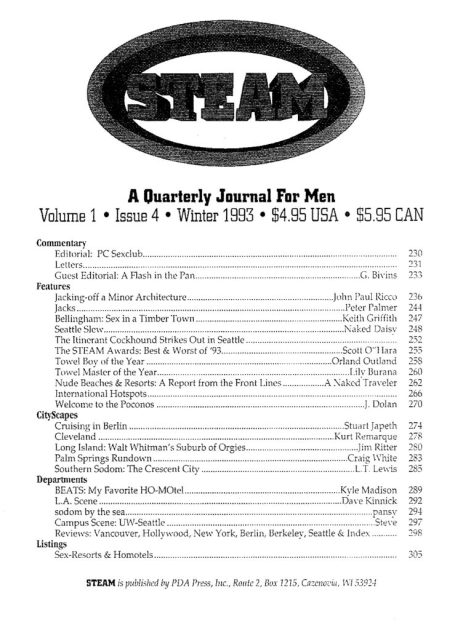
STEAM cover

“Jacking-off a Minor Architecture,” an essay that I published in 1993, has just been re-published in the online journal Keep It Dirtyin an issue on “Filth.” Editor Christian Hite approached me this past spring, believing that the essay deserved to be read—and perhaps more widely—23 years after its original publication. Having written a doctoral dissertation on masturbation and other technologies of arousal, this essay caught Hite’s attention, along with a second of mine on semen and the fluidity of body boundaries, that I had published around the same time in Gay and Lesbian Studies in Art History (edited by Whitney Davis).

To accompany the republication, I have written a preface in which I discuss the genesis of the text and its relation to emergent queer theory. While the political ethics of sex and architecture that I was experiencing, theorizing and writing about back then, have been pretty much eclipsed over the past 23 years by the very forms of bio-political governance and forces of domestication and assimilation to which queer anonymous sex stood opposite and refused, still there might be lessons to learn from a moment when, in the face of death and at the risk of life, masturbation was promiscuously communalized.


COL5127H QUEER ETHICS AND AESTHETICS
Fall 2016

Instructor: John Paul Ricco
Time: Thursdays, 2-4PM
Location: Centre for Comparative Literature, 3rd floor of Isabel Bader Theatre, Victoria University

Description
Working out from Michel Foucault’s focus on the question of ethics in his philosophical articulation of an aesthetics of existence, in this course we will read contemporary theorists whose work has been dedicated to thinking ethics and aesthetics together. Not only wholly tied to the experiences of sex and pleasure, here thinking itself is erotic. Such thought in turn provokes us to think in new ways about intimacy, friendship, betrayal, the pornographic, publics and commons, anonymity, the inorganic and the inhuman. And to trace the place of thought in each, beyond notions of the subject, identity, interiority, community, the human and life.

Authors include: Leo Bersani, William Haver, Samuel Delany, Tim Dean, Sarah Schulman, Claire Colebrook, Lauren Berlant, amongst others. In addition, we will discuss works of contemporary art, film, photography and fiction, by Hervé Guibert, Garth Greenwell, Dean Sameshima, Todd Haynes, Thomas Roma, and others.

Discussion Topics
1. Foucault’s Aesthetics of Existence
2. Infamous Men
3. Why Sex?
4. Unlimited Intimacy
5. Unbearable
6. Really Bad Infinities
7. Edge-pleasure and the Sense of the Common
8. Friendship
9. Traitorous Collaboration
10. Queer City
11. The Commerce of Anonymity
12. The Unlivable

I recently got around to reading the conversation between Tim Dean and Robyn Wiegman on the question of “critique.” It was published in a special issue of English Language Notes (51.2, Fall/Winter 2013) under the title, “What Does Critique Want? A Critical Exchange.”
Based upon their dialogue, and in light of a few other things that I have read this summer, I’ve put together the following notes on theory, queer theory, subjects/objects, reading, Foucault, aesthetics/ethics, and extinction.


In giving up on “critique,” one must also give up on all forms of the “subject” (beyond merely in terms of the critical mastery of the sovereign subject) and “objects” (including the notion that as thinkers/theorists, we have “objects” and hence that our thinking is always predicated upon, as the saying goes, “one’s relations to one’s objects”—which may or may not be distinct from “object-relations” [psychoanalysis] or “object lessons” [Wiegman]). Which would also mean re-thinking the political, outside the categories of subject and object, all the while retaining a commitment to thinking the relational (Foucault, Nancy) as the spacing of the political—irreducible to—and that which exceeds the domains of—subjects or objects, identities or things (and the “identity knowledges” that they produce). Hence the relational as always already non-relational. This entails radical re-definitions and conceptualizations of the “political” (spacing) as well as of the “ethical” (relational), in which neither would operate in the mode of being “critical.” In other words: can there be political and ethical thinking that is not, at the same time, critical—yet without being naive or without rigour?

In this regard, paranoid or reparative readings are not the only options or reading strategies available. There is also, for instance: deconstructive (inoperative, un-made) readings (which are not necessarily to be aligned with paranoid reading), and those aesthetic, literary or poetic modes of reading in which affect and sense (along with pleasure, desire, erotics) are central. Yet in ways that remain impersonal and transitive, rather than deriving from, or returning to, the individual subject who feels and becomes—the nexus of the critical and the personal (Sedgwick, et.al.) that is its own form of “performative narcissism.”

It is this strand that makes so much queer theory today not only reparative but therapeutic in its form and implicit intent. Queer Theory today has all too often become a project of coping (with life, affects, feelings, others, etc.), which is its own compensatory move vis-a-vis resentiment. In fact, what is the relation between the latter and critique—especially in terms of the ways in which critique is deployed in the humanities today (and in particular in queer theory) in the name of the political? Examples of this resentment (and its implicitly accompanying misogyny) cited in this dialogue include: why doesn’t she love us (asked by feminists about Sedgwick); critical theory and its lack of commitment to women (Gender Trouble); academic feminism using theory in order to feel smart and sexy; the aggressivity of Women’s Studies.

So also then, there is (once again) a fundamental rethinking of gender and sexual differences, and the difference these make to thinking, doing, making, and being-together outside the dialectic of subject-object—which might also be outside of gender and sexuality. The fact of the matter is that what Irving Goh has done for dominant critical theory in his recent and brilliant book, The Reject, needs to be done for hegemonic queer theory. Namely: to elucidate the extent to which it remains utterly beholden to the concept of the subject, and the ways in which Butler most especially, but also Sedgwick and a whole second generation are responsible for this unrelenting hold that the concept of the “subject” has had on the field.

This also points to the extent to which Queer Theory has betrayed the work of Foucault, which not only was a genealogy of the modern subject, but also an attempt to think “who comes after the subject” (in various forms of an ethical self in relation with others). Indeed, Nancy’s question from the late-1980s—asked after Foucault would have had a chance personally to respond—equally could have been written: “who comes after Foucault?” This is where Tim Dean’s quotation of Paul Veyne on Foucault is so incredibly important and useful. Veyne writes: “Foucault’s philosophy is not a philosophy of ‘discourse’ but a philosophy of relation…Instead of a world made up of subjects, or objects, or the dialectic between them, a world in which consciousness knows its objects in advance, targets them, or is itself what the objects make of it, we have a world in which relation is primary.” Of course this is also where the work of Leo Bersani comes in, and its commitment to thinking about ethical-aesthetic relationality in neither paranoid (aggressive) nor reparative (redemptive) ways. Further: we need to imagine the inorganic as beyond the human, and to think art and aesthetics in the absence of, and after life and the human. So not the traditional notion of art and its relation to immortality and the future, but art in relation to extinction and the posthumous. What I have been calling “the collective afterlife of things.”

It is in this respect that we are also dealing with questions of discourse and knowledge, which is to say, the  limits of knowing, and that is the primary task of theory—properly speaking—to trace. Including  in terms of that which exceeds gender and sexual categories and identities, and that as an experience of non-knowledge exceeds the epistemological (including epistemological mastery and the production of knowledge).

Theory is one of our principle relations to not-knowing, to epistemological erasure, and to extinction (ontological erasure). It is committed to thinking praxis as always inoperative (post-Marx and Arendt) and is a valence onto that which is unbecoming, un-livable and unimaginable. Such that the aesthetics of existence is the art of becoming-imperceptible and disappearing—but never enough. And where ethics wholly entails attesting to the fact that we—together-apart—are already living the time of extinction.