Archive

Social Ethics

With this quotation from Georges Bataille’s text “Torture” (from his book Inner Experience, 1943), Jean-Luc Nancy opened his keynote address (via Skype) to the international colloquium on “Aisthesis and the Common: Reconfiguring the Public Sphere,” organized by Media@McGill and held at the Musée d’Art Contemporain de Montréal, on March 18-19, 2016.

More than one

As one of the defining principles of Nancy’s philosophy, meaning (or sense) means “more than one.” More than one person, thing, body (i.e singularity) that, each in their multiplicity, is always in rapport with other singularities: sending out and sending back differential gestures, voices, perceptions and (hence) senses. In turn, the notion that there exists something (or someone) that is absolutely unique, is—accordingly so—meaningless. This even applies to that purportedly unique and one-of-a-kind entity named “God.” There is no such thing as “only one being,” and if there were such a thing, it would be, as Nancy put it, “dissolved in its singleness.” So, for there to be some thing, there must be more than one thing, given that being means rapport and thus being is always and only ever being-with. The question is not why is there something rather than nothing, but more precisely, why are there somethings (in the plural), such that there is no one thing.

Implicitly drawing from Maurice Blanchot, Nancy pointed out that even the notions of being alone and of solitude precisely entail being without someone else; and that it is this being-with as being-with-out, that comes to define the singularity of each existing thing. When one feels oneself to be alone, one senses that solitude as distinct from others (and thus in rapport with others), and thus also in rapport with one’s own singularity defined as always in rapport with. God is not alone, and he created the world because of his insufficiency that exceeded himself.

Meaning or sense is always in rapport or relation to itself, because sense itself is always self-separated (i.e. divided and hence never a single whole entity or substance). It is from out of this separation that sense makes sense 0r meaning, when sense—now in terms of feeling or sensation— feels or senses itself. A feeling or sense that is possible, precisely because separation is the condition in which such a rapport between can happen. Yet this feeling of sense feeling itself, is not an infinite and closed relation to itself, but in its separation, remains open and exposed to the outside. It is in this way, that Nancy speaks of a certain auto-affection and auto-mimesis of sense. Yet that is, nonetheless, never the fact or production of a sameness of meaning, simply because sense is always divided and shared, amongst and between multiple singularities.

Here is where Nancy’s deconstruction of the autonomous self or subject, as that which is always self-affected in its exposure with the other—with the outside—lines up with my own argument regarding auto-eroticism as its own pleasurable and desirous rapport with the outside and with others. Relation with the outside, as the relation that defines existence as always being-with (and with-out) is the relation to self that comes to define that self as not even a self (in the sense of a coherent, stable entity) but as a singularity.

As Nancy then went on to say, “singularity is the unity of a separation.” It is a unity that derives its sense (meaning) of self from its self-separation and division. Here he turned to the example of unicellular reproduction or scissiparity, in which it is out of originary separation that a “self” is born.

Common Sense

When it comes to the notion and the expression common sense, Nancy argued that this has been, in part, a matter of philosophy’s pushback against what it has deemed and denigrated as ordinary and banal and hence not worthy of philosophical reflection. In this way, common sense has been a negative for philosophy. At the same time, that which does not simply reproduce common sense, in the forms that have caused philosophy so much anxiety and fear, is art and aesthetics. Meaning that art is the re-directing of the ordinary, the banal, or the given. It is the praxis of finding that which is distinct in the common and ordinary—at the outer edge, and along its opening to the outside.

Nancy then turned to Aristotle, for whom common sense was not a vague sensibility but consisted of common sensibles: movement, rest, figure, size, number, and unity. These are those sensible qualities that are common to each and every thing, in its singularity as that thing there (i.e. in the specificity of its presence). Along with the common sensibles, there are the five senses of perception, that are non-continuous and always fleeting, as they incessantly move to- and towards things. Opposite this, as Nancy emphasized, a constant continuous sensation is the very definition of torture.

If what is common are the common sensibles of things, then we access the commons and have a sense (aisthesis) of the common through our sensible access and relations to the common sensibilities of things. This sense of the common is shared with, at, and in proximity to things, the latter of which come to function as rendezvous or meeting points. In order to articulate the connections between these (often readymade) things, aisthesis and aesthetics, Nancy drew upon the example of Duchamp’s readymade, and the latter’s own designation of such things as more encounters and points of rendezvous, than as autonomous works of art.

Impressions on the Edges

Like the Duchampian readymade, art is the possibility of distinction that is drawn out from out of a continuum, and this is precisely what is meant by art’s ex-pression. Literally taken to mean: the outside (ex) pressing on and up against or alongside. Art’s expression is the impression of the outside that it temporarily impresses upon us and other things in the world, in the form of sense and meaning.

It is this that is common to us in our shared exposure to the outside; and it is art that offers us a sense of this rapport, sense and meaning as that which is without definitive end, completion, resolution, or satisfaction. Meaning that art offers us the pleasure of being-with and in rapport, that does not demand or seek or establish an end, but instead affirms that right on the immeasurable edge of things, is the opening to the outside, not beyond. It is along these edges, that, I argue, a sense of the common happens.

I am so pleased that my essay, “The Art of the Consummate Cruise and the Essential Risk of the Common” has now been published (in two parts) by Feedback, a truly excellent online, open-access critical theory weblog/journal. Part I: The Ethics of the Pleasure. Part II: Cruising as Aesthetic Intuition of the Common.

Gay Cruising Pair Bathroom Stall

The essay originated as a paper that I presented at last year’s American Studies Association conference (Toronto, October 2015) on a panel organized by Ricky Varghese titled, “Sex, Misère, and the Redemptive: Barebacking and Historicity.” I want to thank Ricky for the invitation to participate in what was a very thoughtful, insightful and provocative discussion.

In the essay, I argue that we need to shift from a language of self and other towards one of co-exposed singularities, in order to think further about an ethics of pleasure that is not predicated upon sacrifice—either of the other or of the self. In addition, I call for the need to think sexual and other forms of risk and pleasure in terms of the common. Based upon recent work by Bill Haver, the common here is understood as always a sense of the common—including the aesthetic intuition of, and erotic inclination towards, the impossibility of the common.

I also want to thank “Joe,” the photographer of the image that I have reproduced here and that accompanies both parts of the essay, for kindly granting me the permission to reproduce his strikingly beautiful, evocative and downright sexy photograph.


My research and writing this year has been primarily focused on completing a draft manuscript of my book, The Outside Not Beyond. This work has been aided tremendously by a 12-month research and study leave, of which I was at the midway point at the beginning of the year, and by a 12-month faculty research fellowship at the Jackman Humanities Institute (University of Toronto) that began this past July. The project also received very generous support beginning this year from the Social Science and Humanities Research Council (SSHRC, the national granting agency in Canada), which will provide funding over the next four years for research, assistants, travel, symposia, etc.

So over the past year I have had the time, solitude and resources to read and write and make significant progress on my projects. I have found my office at the JHI to be a particularly conducive place to work, and I really value the time I have had over the past 18 months, un-interrupted from teaching and university service duties, to focus on my own work and to remain with questions for extended periods of time.

Having submitted a book proposal to the University of Chicago Press in December of last year, by June of this year I finally received two Readers’ Reports, both of which very much endorsed the project and provided valuable feedback. I then turned my official response to these reports into an occasion to write what amounted to a second proposal: 11-pages that further expanded on the first, and represented the project in its current state of development. I found this to be an extremely productive task, one that really enabled me to flesh out both the major and minor scales and dimensions of the project. I walked away from the experience even more an advocate of “the second project outline.”

Topics and themes that have been pursuing in my research this past year include: the relation between poetry and prayer; anonymity and the neutral; edging and drawing; collective afterlives; ethics, politics and aesthetics of the common; drive, pleasure, and slippage; and measure and measurelessness.

The course of my research and reading this year, began with Georges Bataille’s major writings and publications, and then moved to Foucault’s lectures on governmentality and biopolitics; Dardot and Laval’s extension and elaboration of Foucault’s project, in their indispensable book, The New World Order: On Neoliberal Society; Derrida’s final seminar on the beast and the sovereign and his reading of Robinson Crusoe alongside Heidegger’s seminar The Fundamental Concepts of Metaphysics; and Michael Naas’s beautiful reading of Derrida’s seminar in his book,  The End of the World and Other Teachable Moments. I’ve also returned to the political writings of Maurice Blanchot, as well as some of his late-work, in particular The Step Not Beyond, along with Christopher Fynsk’s fantastic book, Last Steps: Maurice Blanchot’s Exilic Writing.

Other books that came out this year that I very much enjoyed, and that have remained with me, include: David Graeber’s book on bureaucracy, The Utopia of Rules; Kristin Ross’s Communal Luxury: The Political Imaginary of the Paris Commune; Elizabeth Kolbert’s, The Sixth Extinction; and McFadden and Al-Khalili’s Life on the Edge: The Coming Age of Quantum Biology. This last title is its own frontline education on one of the most exciting new fields of scientific research.

While writing, “The Art of the Consummate Cruise and the Essential Risk of the Common,” a paper for a panel on sexual risk and barebacking for the American Studies Association conference (Toronto, October 2015), I also returned to the work of William Haver—which remains the most inexhaustible source of inspiration and insight—as well that of Leo Bersani, Tim Dean. I have been in conversation with editors of an online journal, and hope that this paper will be published very soon.

I also continue to try to make fiction and poetry a regular part of my reading list. Books that particularly stood out this year are: Hanya Yanagihara’s A Little Life; Nell Zink’s Mislaid; Michel Houellebecq’s Submission; and Claudia Rankine’s Citizen.

Publications this year included: “The Separated Gesture: Partaking in the Inoperative Praxis of the Already-Unmade,” in the collection Nancy and the Political (Edinburgh University Press); my conversation with Jean-Luc Nancy, “The Existence of the World is Always Unexpected,” in Art and the Anthropocene (Open Humanities Press); my essay, “Drool: liquid fore-speech of the fore-scene,” in the online journal World Picture; and my essay, “Parasol, Setas, Parasite, Peasant,” in, Could, Should, Would, a monograph on architect J. Mayer H. (Hatje Cantz).

The first review of my book, The Decision Between Us, appeared in the January issue of Art in America (by Christa Noel Robbins); and that has since been followed by equally sympathetic, insightful and enthusiastic reviews in Critical Inquiry (by Tom McDonough), New Formations (by Jacques Khalip), and in Parallax (by Matthew Ellison and Tom Hastings).

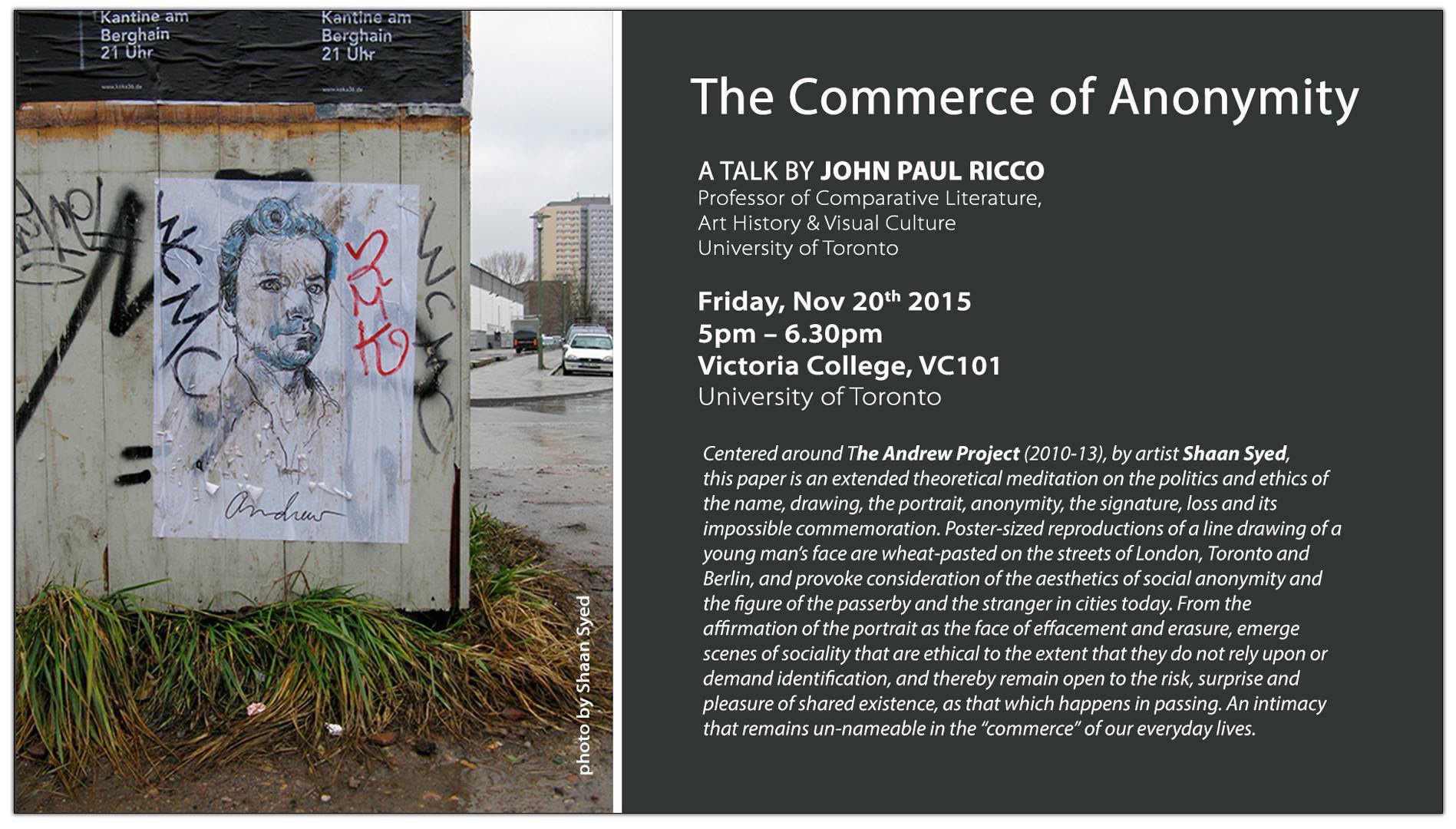
As part of a conference seminar on Bataille that I co-organized with Etienne Turpin for the American Comparative Literature Association conference (Seattle), I presented a new paper titled, “A solvent for ‘poetry’s sticky temptation.'” It was a first attempt to consider the relation between poetry and prayer as it can be fashioned through a reading of Bataille’s A-Theological Summa. A keynote lecture at a conference on aesthetics and ethics at The Royal College of Art in London, gave me an opportunity to return to and to expand upon my paper, “The Commerce of Anonymity” which is on the art of mourning, and artist Shaan Syed’s “The Andrew Project.” An invitation to present some of the my current research at the Comparative Literature Emerging Research Lecture Series, here at the U of T this past fall, was yet another opportunity to further expand and develop the “Anonymity” paper into what I now feel is pretty much a completed chapter for the new book. Finally, last spring at Poetic Research Bureau in L.A. I read from and discussed my book, The Decision Between Us, along with readings by Etienne Turpin and Nadrin Hemada from collections that they have recently edited on the library and the prison, respectively.

Currently, I am preparing two keynote lectures in March 2016, one for the annual Comparative Literature conference, here at the University of Toronto, and the other for “Aisthesis & The Common: Reconfiguring the Public Sphere,” at McGill University. Also in March, I have been invited to speak at the Society for Philosophy and Culture at McMaster University.

Research travel this year included time in NYC in February in order to visit the National 9-11 Memorial and Museum at Ground Zero; and to Sicily in late-August to attend a week-long seminar on “sex and philosophy” taught by Jean-Luc Nancy.

This was also the year when I revived my performance art practice. It had been close to 7 years since I last presented my work and I have been wanting to return to performance for some time now. Since the late-summer I have been in conversation with Johannes Zits, and along with him and three other artists we have been developing a new work together. Many details will be posted here in the months to come, but for now I can say that at the end of January 2016 I will be part of a five-person, 6-hour durational performance at Katzman Contemporary, here in Toronto; and in February, I will be participating in a five-day workshop with artist Doris Uhlich, on dance, sound, and the naked body. All of this work is deeply connected to my thinking and writing on the peri-performative; naked image and naked sharing; exposure, risk, touch and trust. I am really excited to be able to translate this work into various forms of performance.

I will end this post by saying how grateful I am for those of you who have subscribed to this blog, and who take the time to be its readers. Happy New Year 2016!


4648095c4b5a46c5e402568ba86e731a

Throughout my childhood growing up in Utica, NY, I was very close with my paternal grandmother and we spent a tremendous amount of time together. One of our regular afternoon rituals was to go to any one of her three preferred grocery stores: Grand Union, A&P and Chanatry’s. While the first two were part of a national chain, the last was a smaller, locally-owned store. Chanatry’s may have had more than one location, but back then my grandmother preferred the one on Culver Avenue in East Utica, next to the castle-like turreted Armoury, and across the street from the WPA-era Buckingham (public) Pool. In many respects I think it was my grandmother’s favourite of the three, and without question, it was mine.

UticaParkwayEast_Postcard

Armoury, Utica, NY


Municipal Swimming Pool, Culver Avenue Utica

Municipal Swimming Pool, Culver Avenue Utica, NY

Back then, in the late-1960s and early-’70s, years before UPC scanners were introduced, grocery store cashiers manually entered into the cash register each price that was written on or, in the form of a small sticker, affixed to each item. Of course, due to simple human error, every once in awhile a cashier, in the process of punching those only somewhat forgiving raised buttons on the register, would “ring up” the wrong price.

Out of this developed a sense that certain cashiers were more careful and accurate than others. Or at least this was my grandmother’s view of things. So at some point early on in her patronage of Chanatry’s, she evidently identified one of the cashiers as the most reliable, and would actually schedule her shopping trips to coincide with this woman’s shift (in those days, pretty much every cashier was a woman, and in Utica, usually middle-aged and white).

Terry. That was her name; the cashier whom my grandmother nearly swore by, and into whose “line” she would always go, regardless of how long that line was. But Terry was not only my grandmother’s preferred or favourite cashier, she was for me the only cashier in the world. There’s no doubt that my grandmother was largely responsible, at least initially, for the affection that I felt for Terry, but I also think that something else was at play, and that is what I want to write about here.

Besides the oil-cured black olives stored in big plastic bins at the deli counter in the back of the store—which I would beg my grandmother to buy for me—the other big attraction, the one thing that I eagerly anticipated more than anything, was to see Terry. After winding our way through the few narrow aisles of the store, finally we would be ready to approach her cashier’s station. “Her’s” in the sense that, if I remember correctly, she was always working at the same number/line.

Once we got up to the front of the line, both Terry and my grandmother would make a big deal out of the fact that I was there. My grandmother saying something like: “Look who I brought with me today!” and Terry responding with: “It’s my little boyfriend John.” One year, for I think Valentine’s Day or perhaps it was for Terry’s birthday, I wanted to give her a gift. It was either my mother or my grandmother who found a small box of embroidered handkerchiefs for me to present to Terry the next time we went to the store. That pretty much solidified our relationship, and many many years later, after I had moved away from home to attend university in New York City, my mom or grandmother would tell me that Terry would continue to ask about me and remind them of the handkerchiefs that I gave her.

The point that I want to make by telling this story, is that separate and apart from fulfilling the job description or being (my grandmother’s) personal ideal type of “grocery store cashier,” Terry, that actual person, was for me in those early years of my childhood, one of my first experiences of what in my current work I am theorizing as “the commerce of anonymity.”

“Commerce” obviously based upon the commercial context of the situation, but also in terms of a certain reciprocal exchange between us that stood to the side of the mercantile, and yet did not either rely upon life-biographical details nor was directed toward the goal of developing into some sort of personal friendship beyond the context of the store. It is in the absence of the latter two aspects that this everyday rapport between Terry and I can be understood as anonymous.

Anonymous in the sense of “pre-predicative,” to the precise extent that I did not relate to Terry based upon her job description (how strange that would have been for a 5-year old to do), nor based upon her being a personal ideal type of cashier, as she was for my grandmother. Instead, the picture that I have of her, and that I would argue was the picture that I had of her back then as a little boy, is/was not a portrait of identity, but of anonymity. Which is to say: neither the genre of the type, nor the generic genre of the general, but an anonymity that was named Terry, and that for me—precisely in its anonymity—was an early source and sense of the social.


Since the 12th-century, there has been in Christian moral theology a notion of taking pleasure in “expectantly waiting (Lat. moratur) in the desire for an object that remains absent because it is inaccessible or prohibited” (Dictionary of Untranslatables, 792). It is not a delay of pleasure, but rather of pleasure in the delay of satisfied desire, that is enjoyed by and in the imagination. In other words, it is the pleasure that one derives from desiring, and it is this pleasure-in-desiring that affirms that there is pleasure inherent in desire itself—and thus not only in desire’s fulfillment (a point that was clear to Lacan in his reading of the “paradox of fore-pleasures” in Freud).

It is important to underline that this “morose delectation” is not the postponement or infinite deferral of pleasure, nor is it entirely divorced from desire. Rather, it is the pleasure that is enjoyed in the very relation to desire. Neither the negation nor the positive presence of the object of desire, delectatio morosa is what we might describe as a neutral yet wholly pleasurable relation to desire.

I am interested in this Scholastic notion because it strikes me that it provides us with a way to think about the “neutral mourning” that I have theorized in my recent reading of Roland Barthes as its own form of pleasure. What I suggested in that chapter of The Decision Between Us dedicated to Barthes, is that in the midst and in the wake of mourning the recent death of his mother, Barthes sought what he had described as “a desire for the neutral,” and that this desire was, at the same time, a desire for a vita nova (“new life”—the eponymous name for the “novel” that he had begun to outline just before he died).

Drawing from his knowledge of Zen Buddhism, his fascination with Rousseau’s far niente (doing nothing), and his memory of a young Moroccan boy sitting on a low wall, I argued that Barthes imagined the neutral (and mourning) as a scene of just sitting, doing nothing. “To be idle, without master, and yes, perhaps even to be without guide (mother), and finally to be able to just sit without equivocation, without profit or debt, sin, prostration, or will-to-possess…something like the neutral sitting of a neutral mourning.”  Drawing further upon the etymology of the Latin word morosus, we can now understand this scene of neutral mourning as a scene of pleasure—of delectatio morosa. “In Italian…morosita means ‘delay’ (particularly in acquitting oneself of a debt or an obligation)…and where the English “moroseness” is rendered by malinconia [“melancholy”]…and in Spanish, where…moroso means ‘lazy'” (Untranslatables, 792).

When mourning is the act of the imagination enjoying its waiting in desire, it is neutral. It is in this way that neutral mourning is neither morbidly morose mourning nor melancholia, but instead is a desire for the neutral and its own form of neutral pleasure.


Here is the link to the audio file on YouTube of my Lecture, On the Commerce of Anonymity, that I presented on November 20, 2015, as part of the Emerging Research in Comparative Literature Series, at the University Toronto.

I want to thank Fan Wu and Jesscia Copley for the invitation to present some of my current work, and to all those in attendance that evening for their engaging questions and responses. I also want to thank Bao Nguyen for his editing of this audio recording. Finally, my thanks to Shaan Syed, whose work—the focus of this talk—continues to be such an important provocation and inspiration for my own.

For the final section of the paper that I did not have the time to present, see my earlier post on “anonymous and neutral mourning.”

Last week, as I was preparing a public lecture on “The Commerce of Anonymity,” I began to think more about the conceptual relations between anonymity and the neutral, and in particular the ways in which together they might bear upon acts of mourning.

At once drawing me back to ideas that I recently presented in chapter 5 of my book, The Decision Between Us, on Roland Barthes’ neutral mourning, and also closer to more recent events in which many of us find ourselves mourning the deaths of largely unknown or anonymous others, I returned not only to Barthes’ work, but also to Maurice Blanchot’s, in order to try to think about how a politics and ethics of the anonymous and neutral might disrupt or refuse some of the more dominant and prevailing responses to such violent atrocities and mass deaths.

In his book, The Step Not Beyond, Blanchot writes that,

The anonymous after the name is not the nameless anonymous. The anonymous does not consist in refusing the name in withdrawing from it. [Thus we might say that the anonymous is the withdrawal of the name through (as) the name of the nameless]. The anonymous puts the name in place, leaves it empty, as if the name were there only to let itself be passed through because the name does not name, but is the non-unity and non-presence of the nameless (34-35).

The name is the passage through which the anonymous passes. And in its passing/withdrawing through the name, the anonymous leaves the place of the name empty, as if the anonymous were the place-name (if not place-holder) for the name.

What I want to suggest is that as the neutral name (neuter) of the name, the anonymous, when mourned, calls for an equally neutral mourning. For Barthes, there is indeed a form of mourning that is without codification and assimilation, and without any one proper place. Hence, it is not only without memorial or monument, it is, Barthes argues, therefore also socially untenable. Moving away from the will-to-possess toward the will-to-love, this neutral mourning represents the second type of “neutral” that Barthes is (more) interested in. It is differentiated from the first-degree neutral (i.e. the suspension of conflicts), while at the same time being distinct from the “desperate vitality” (a phrase that he derives from Pasolini), that he takes to be equivalent to a hatred of death. Thus while Barthes does not use the phrase, I think we find here what amounts to a conception of neutral mourning. Within the context of my current thinking and writing, I want to suggest that such neutral mourning is at the same time, anonymous mourning, specifically the mourning of those who go by anonymous names (in the departure of the departed, in passing).

For just as for Blanchot, “the anonymous puts the name in place” yet only to be the place of passage for the name and its emptying out of nomination, so with Barthes, the temporality of the neutral is nothing more than a moment or instant, specifically an opportune opening—what we might think of as the kairos to Blanchot’s anonymous topos.

This itinerancy of the anonymous and the neutral is what makes them both operate as lures, yet not in terms of a name, but as predicates or adjectives. Which is to say, as a certain kind of aesthetic provocation and attraction, and an opening of the ethical. For what Barthes more fully says about the kairos of the neutral is that “perhaps the Neutral is that: to accept the predicate as nothing more than a moment: a time” (Neutral, 61). The kairos (or opportune moment) of the neutral, is the non-nominalizable singularity (of space and of time) that is anonymity (as in the German neuter form Das Moment: cause, force, momentum).

Neutral mourning is the will-to-love that moment of departure that passes between the anonymous and the predicate—between any one name and passing quality. The neutral and the anonymous are thus not the names (or not only the names) but the adjectives or predicates of an originary movement, force and temporality of the momentums and moments of being together (i.e. the commerce of anonymity).

In light of recent events, this is what we must respond to, counter-sign (“not in our names”), and thus begin to take responsibility for—prior to and in excess of political and theological sovereignty. It is in this way that we might affirm, as Michael Naas has argued, “that there can be no sovereign last word [or name] to put an end to the violence or the endless discussion” (The End of the World and Other Teachable Moments, 167).


In his remarkable review essay [PDF] of my book, The Decision Between Us, Jacques Khalip (Professor of English, Brown University) beautifully illuminates the ways in which something as ordinary as a blank sheet of paper is—for me, in my thinking and in this work—an aesthetic event and an ethical scene. Not a place or product in the service of judgment, but the spacing of decision. The measure of which lies in the separation or apartness that sustains the between-ness of our being-together.

With great care Khalip attends to the aesthetic and ethical dimensions of my argument, and makes evident how “art and art’s ethical deliberation are…of a piece in this study,” and how “art measures (even if it is measureless) the infinite demands of an ethos that appears and disappears under our feet.”

Of the many, many things that I appreciate about Khalip’s reading, I especially value his foregrounding of my chapter on Roland Barthes, “Neutral Mourning,” and its reading of Camera Lucida alongside Barthes’ lectures at the Collège de France and the mourning diary that Barthes kept immediately following his mother’s death. For here is where a Roland Barthes emerges whom I believe is so deeply informed by Maurice Blanchot and Blanchot’s own philosophy of the neutral. It is also here where we truly begin to gain a sense of what it means for Khalip to cast my work as its own form of “queer neutrality” and what import this might have, not only for queer theory, politics and ethics, but also for the study of the work of Barthes and Blanchot.

As the concluding paragraph, Khalip writes,

If The Decision Between Us impresses upon us an ethics that is not coterminous with the self-possessed subject, the galvanizing effect of this reasoning is to bring into view an awareness that art is the intensification of an ethics-beyond-ethics, a kind of thinking that occurs beyond mere identity, narration or historical contextualization. Among the various illuminating moves in Ricco’s book is its immersion in the various environments it evokes and theorizes, at once setting up scenes while at the same time distancing the reader from them, page after page. As readers, we cannot help but waver between decision and indecision with each of Ricco’s arguments—every movement forward compels a further critique and judgment. Indeed, the book is buoyed by the anonymous, aesthetic power between decision and indecision, not as a choice between positions but as a contamination in the very space of the two that propels unending, queer deliberations.

I am deeply and sincerely grateful for this review, and as my work continues to move on, I will remain indebted to Jacques Khalip’s reading.