Archive

Queer Theory

Markus D. Dubber, Professor of Law and Director of the Centre for Ethics at the University of Toronto, has invited me to participate in a workshop on “apologies” that he is organizing to be held in fall 2017. He tells me that it is “partly inspired by a recent report in which EGALE [Canadian Human Rights Trust] called on the Canadian government to apologize for ‘Canada’s History of LGBTQ2SI Persecution.'”

Here is the abstract of the paper that I have proposed to present at the workshop.

“On Queer Forgiveness”

John Paul Ricco

Following “On Forgiveness,” the translated and edited version of Jacques Derrida’s response to a series of questions put to him by the French intellectual journal Le Monde des débats in 1999, my paper argues that the concept and act of forgiveness is essentially queer. Derrida persuasively argued that true forgiveness consists in forgiving the unforgivable. Which means that the logic of forgiveness is structured as a relation to the impossible, to that which is without code, norm or end. It is in excess of any measure or finality. An ethics of apology, in which the State seeks forgiveness for its violence and persecution of its lesbian, bisexual, gay, queer, transgendered, two-spirited and questioning citizens, therefore requires forms of queer forgiveness that exceed the judicial logic of reconciliation. For if queers forgive the State of its violence and negligence, do they not also and at the same time abdicate the future possibility of acting in ways that the State would deem unforgivable? Say in the face of future injustice and in the name of justice yet to be had? Or perhaps in terms of erotic and indeed unconditional pornographic excess that re-conceptualizes sovereignty as unmistakably queer. In both cases: as that which transcends norm and law through a notion of sovereignty that we inherit from Georges Bataille. In other words: is the queer acceptance of the State’s confessed guilt also a normalizing of the queer within a stated-based juridical-theological discourse of rights? Must we not remain vigilant in our attention to the ways in which reconciliation is its own form of normalization? In doing so, we need to affirm the limits of the common, and of the ways in which while language itself is shared it is so, only as the very enunciation of separation. Alterity, non-identification, the unintelligible—in a word: queer—restlessly resides at the heart of apology and forgiveness. By returning to my theory of a disappeared aesthetics of erasure and the ways in which such aesthetics attests to the indelible absence of those who—unforgivably—have been disappeared and are no longer here to receive an apology and to forgive, I argue that this is one way to conceive the ethical scene of forgiveness.

ROM Panel - Curating Sex & Sexuality Poster-01Here’s a video recording of my talk at the panel on “Curating Sex and Sexuality,” that was held at University College (University of Toronto) on October 13th, 2016. Hosted in conjunction with the Royal Ontario Museum’s (ROM) A Third Gender: Beautiful Youth in Japanese Prints exhibition, the panel explored the questions of curatorial choice in the context of potentially controversial sexual representations. The exhibition is currently on view at the Japan Society in New York, until June 11, 2017.

In my short presentation, I discuss the pair of exhibitions on queer contemporary video art that I curated at V-Tape (Toronto) in 2008: “Love in a time of empty promises,” and “Sex is so abstract.” A revised and slightly expanded version of my paper, “Queer Curating: Abstract and Abject,” will be included in a collection of essays and portfolios on LGBTQIA issues in art and politics, to be published in the September 2017 issue of the bilingual journal of “arts + opinion” Esse.

The other three panelists’ presentations can also be viewed on YouTube.


Yesterday I was one of four invited speakers for a roundtable discussion on policing sexuality, cruising and anonymous public sex, and police entrapment.

This flash event,”Project Marie: Policing Sexuality in Law, Ethics, and Policy,” was organized and sponsored by the Centre for Ethics at the University of Toronto, moderated by Mariana Valverde (Criminology, U of T), and featuring comments by Patrick Keilty (iSchool U of T), Simon Starn (School of Law, U of T) and Kyle Kirkup (School of Law, U of Ottawa).

It was a public forum organized in response to a recent two-month operation by the Toronto Police Service, called “Project Marie,” in which undercover police officers charged 72 individuals with 89 separate infractions for indecent exposure and sexual solicitation, in Marie Curtis Park, in Etobicoke, Ontario. Approximately 40-50 people attended, and many voices and perspectives were heard. It was an extremely successful event; one of those rare occasions when the university community and the non-academic community meet in order to talk about the relations between sex, ethics and publics.

mc-path2

Here are the remarks that I presented at the opening of the panel:

In today’s urban political climate, in which the stranger, the foreigner, the one who lingers, the solitary walker, the workless or out-of-work someone—and not least of all, the one who is simply curious—when each of these someones in the singularity of their anonymity, itinerancy, promiscuity, and clandestinity—and thus in their essential illegitimacy—are increasingly targets of suspicion and surveillance, bodies to be taunted, beaten, entrapped, and at times permanently marked as illegal, the cruising ground remains more necessary than ever, given that it is an ethical training ground. 

A cruising ground is an ethical ground in the precise sense that it is a place where being together with others does not rely upon the law of identity and the logic of the name. Instead, it is a place consecrated to the joys and pleasures of the passing encounter, and the liberating fact that, as Tim Dean has intimated: strangers can be lovers and yet remain strangers. Meaning: sharing an erotic and perhaps sexual bond that is less structured in terms of attachment than separation, and that thus affirms that a mutual intimate experience can be had that does not require or ask for the assimilation of oneself into an other, but instead remains open to the outside.

But of course the cruising ground is also where such pleasures find a place in the world that in so many ways and in so many instances have pushed them out of the sanctioned spaces of domesticity and the family; the school and the church. That have relegated them to zones of the unthinkable by normative relations of sexuality (including those which go by such names as sexual relationship, monogamy, and marriage), and that have been expropriated by the gentrification of minds and bodies, no less than the gentrification of city neighbourhoods (as Sarah Schulman has recently argued). It is precisely those spaces, those norms, and those processes of gentrification that create conditions that are unsafe for some of us: the adolescent queer, the closeted, the exhibitionist, the spouse, the homeless. As Samuel Delany has argued, “if every sexual encounter involves bringing someone back to your house, the general sexual activity in a city becomes anxiety-filled, class-bound, and choosy. This is precisely why public restrooms, peep shows, sex movies, bars with grope rooms, and parks with enough greenery are necessary for a relaxed and friendly sexual atmosphere in a democratic metropolis” (Times Square Red, Times Square Blue, 127).

Lest you think that I am only arguing for the more practical political importance of the cruising ground, allow me to close by noting that the logic of the lure is not only driven by the need to escape the normalizing and criminalizing logic of the law, but that it is also an attraction to that which is imperceptible, un-nameable, transitory, and even unconsummated. But all of this also means that cruising offers us a sense of the ways in which erotic pleasure is not only sexual, but spatial, and that for some of us, where we do it, is just as important as who or what we do. Cruising eroticizes the essential anonymity of the common and urban intimacy, and so, to the extent that there are cities, there will be cruising, because in the cruising ground persist some of the  essential truths of a city. Today we are faced with nothing less than the question of how to ethically create a city. In doing so, we must insist on the fact that “sex lives matter.”*

*Thanks to Etienne Turpin for this phrasing.

bd0caa3c5e993ee6a5fce54e8290074d

Photo Credit: Thomas Roma, In the Vale of Cashmere, Powerhouse Books, 2015.

  1. Leo Bersani, “Sociability and Cruising” in Bersani, Is the Rectum a Grave? and other essays. Chicago: University of Chicago Press, 2010: 45-62.
  2. Tim Dean, “Cruising as a Way of Life,” in Dean, Unlimited Intimacy: Reflections on the Subculture of Barebacking. Chicago: University of Chicago Press, 2009: 176-212.
  3. Samuel R. Delany, Times Square Red, Times Square Blue. New York: New York University Press, 1999.
  4. Garth Greenwell, “How I Fell In Love with The Beautiful Art of Cruising,” BuzzFeed, April 4, 2016. https://www.buzzfeed.com/garthgreenwell/how-i-fell-in-love-with-the-beautiful-art-of-cruising?utm_term=.nc2W7wrg3#.vgd37mO0B
  5. William Haver, The Body of this Death: Historicity and Sociality in the Time of AIDS. Stanford: Stanford University Press, 1997.
  6. William Haver, “Really Bad Infinities: Queer’s Honour and the Pornographic Life,” Parallax, vol. 5, no. 4, 1999: 9-21.
  7. Timothy Morten, “Queer Ecology,” PLMA, vol. 125, no. 2, March 2010: 273-282.
  8. John Paul Ricco, The Logic of the Lure. Chicago: University of Chicago Press, 2003.
  9. John Paul Ricco, “The Art of the Consummate Cruise and the Essential Risk of the Common,” Feedback, February 2016. In two parts: http://openhumanitiespress.org/feedback/sexualities/the-consummate-cruise-1/ http://openhumanitiespress.org/feedback/sexualities/the-consummate-cruise-2/
  10. John Paul Ricco, “Jacking-off a Minor Architecture” (with new extended preface, 2016), Keep It Dirtyhttp://keepitdirty.org/a/jacking-off-a-minor-architecture/
  11. John Paul Ricco, “The Commerce of Anonymity,” Qui Parle, forthcoming, 2016.
  12. Thomas Roma, In the Vale of Cashmere, Powerhouse Books, 2015.

The text below was written to accompany, “2016, 1996,” an online exhibition of 21 works by 17 artists included in the Artist Registry of Visual AIDS, and was also published in an issue of Drain magazine on “AIDS and Memory” (vol. 13:2, 2016). The essay responds to the journal’s theme, as I think back to an earlier historical moment in the history of AIDS, including the year 1996 when I curated “disappeared” (Randolph Street Gallery, Chicago). At the same time, the online exhibition was an opportunity to imagine how that earlier exhibition might be “doubled” today, twenty years later.

ramirez_godiva_4__5

Chuck Ramirez, Candy Tray Series: Godiva 4 & 5, 2002. Photograph pigment ink print, 24″ x 36″ Edition of 6 originally commissioned by Artpace San Antonio.

The Go-Go Boys were the first to go. After that, we were afraid that the rest of us would disappear too. We did. But then again, we didn’t. Not exactly. Or at least not then, or not yet.

The story of AIDS has been a lesson of the double.

Not of absence/presence, visibility/invisibility, or memory/forgetting, but the double of living on, of becoming-imperceptible, of forgetting that we forget. Not the unifying space of coupling, but the separated spacing of sharing in that which cannot be shared. Not the chronological time of history, but the a-temporal disjunct simultaneity [1] of time’s temporal dilation. Which is also to say: time’s irreparable disjuncture and thus its perfection. Time and the untimely timing of time. The encounter of proximity as the sense of the same time, just a little bit different. Too soon and too late, at once. Not the chronos of alterity but the kairos of the opportune moment—if not of opportunity or the opportunistic.

Traversing and yet other than—or irreducible to—bodies, the human, friendship, community, and life. Instead, it is the “absolute luminescence” [2] of the empty readymade; of “the sex appeal of the inorganic” [3], but also of a certain “disenchanted fetishism” [4] that is as much attracted as it is repulsed by the essentially “entropic solitude of things” [5]. A colour, a line, a knot, a last address, a hieroglyphic abstraction, glitter, rubber, a frayed edge, the impasse and its slender opening—all of these and other lures.

AIDS Doubles

1981 Bio-Political Oblivion – 1987 ACT UP Fight Back Fight AIDS – 1988 Pictures of People with AIDS – 1996 The End of AIDS – 1996 Disappeared – 2002 SARS – 2009 H1N1 – 2014 PREP – 2016 Undetectable –

“AIDS and Memory”—that double—is the provocation to return to “disappeared,” the art exhibition that I curated twenty years ago, in 1996, that was about the refusal to represent and the persistence of appearance in the midst of incalculable loss and death. 1996: when someone audaciously declared the  “end of AIDS,” and the time just before I read Haver’s The Body of This Death (1997) for the first time, and realized that I would forever remain beholden to—yet would never come close to doubling—the singular and uncompromising rigor of his thinking on the inconsolable perversity of existence. Meaning: what remains unimaginable and unknowable, unforgettable and un-rememberable. What queer theory remains largely unable to comprehend, and what dominant AIDS discourse will never allow.

This is about absolute memory. Absolute memory is the memory of the outside: beyond the archive, the clinic, the march, the oeuvre, the grave. We might say that absolute memory is at one with forgetting. For as Deleuze said, “Only forgetting recovers what is folded in memory” [6]. Which also means that the forgetting of forgetting is at once the source and sense of memory, and the impossible memory (i.e. the forgetting that cannot be remembered).

“2016-1996” is the double of “disappeared,” and thus its own preservation of the infinity of the aesthetic task. As Ann Smock once wrote: “To see something disappear: again, this is an experience which cannot actually start. Nor, therefore, can it ever come to an end” [7]. In their tracing of time and its erasure, the images and scenes assembled here belong neither to memory nor to forgetting per se, but to the disappearance of the present.

“It’s not over” is what the double tells us.

bcarpenter004

Brian Carpenter, [reenactment, infection 1], 2012. Archival inkjet print, 24″ x 36″

 References

[1] Haver, William. “The Art of Dirty Old Men: Rembrandt, Giacometti, Genet,” Parallax, volume 11:2, 2005, 25-35.

[2] Ibid.

[3] Perniola, Mario. The Sex Appeal of the Inorganic, translated by Massimo Verrdicchio, (New York: Continuum, 2004).

[4] Haver, William.

[5] Ibid.

[6] Deleuze, Gilles. Foucault, translated by Seán Hand (Minneapolis and London: University of Minnesota Press, 1988).

[7] Smock, Ann. ‘Translator’s Introduction’,” in Blanchot, Maurice, The Space of Literature (Lincoln and London: University of Nebraska Press, 1982).

I want to pick up on a question that I posed at the end of my last post, in which I asked, “How might the humanities, precisely in terms of some of its principal objects (art, poetry, literature, film), equip us with the means to contend, not only with the limits of humanism, but also with the end of the human?”

essays-on-extinction-claire-colebrook-553x372

This summer I have been reading and gaining a tremendous amount from Claire Colebrook’s two volumes of essays on extinction: Death of the PostHuman, and Sex After Life. At the same time, I have been crafting the course syllabi for the two seminars that I am teaching this fall term (2016).

Upon first glance, it may appear that the two seminars, “Queer Ethics & Aesthetics of Existence,” and “The Collective Afterlife of Things,” are at odds with each other. With their respective focus on questions of existence and extinction, it might seem as though the first course seeks to affirm the value of a certain form of human life, while the other seeks to consider the post-human and that which is not defined in terms of “life.” However they are in fact two major parts of a single ongoing theoretical endeavour to think what a thought and ethical-aesthetic praxis might be, in the absence or extinction of the human, life and, the living on or long-term survival of a collective “we.” Colebrook’s work has proven to be an indispensable companion as I think about these two courses in relation to each other.

Rooted as it is in the Foucault of finitude and the image of the erasure of the image of the human, “like a face drawn in sand at the edge of the sea,” the queer theory seminar takes Foucault’s aesthetics of existence to be not an ethics of being or becoming, but of unbecoming. An unbecoming ethics is the partaking-together in the inoperative/workless praxis of sustaining the spacing of separation—irreducible to no-thing or substance (i.e. nothing, res/rien)—that exists (exposed) just between us. An “us” that only exists from out of this shared-exposure to the outside, or what Foucault referred to as “madness, the absence of work.” Therefore, this queer aesthetics of existence is an art not of the finished work (oeuvre) but of the un-finished as that which is not given or even readymade, but already-unmade (désoeuvrement).

Further to the point, “whereas [as Claire Colebrook explains] Husserl and Bergson thought that the task that would save thought and philosophy would be the annihilation or acceleration of the natural world, and the destruction of man as a natural body within the world, today it is the possible extinction of the man of ethics and philosophy [and aesthetics] that may allow us to consider the survival of the cosmos” (Sex After Life, 148).

If we take “the man of ethics and philosophy [and aesthetics]” to be the “man of the humanities,” then in a certain very real sense, it is this equation of the end of the humanities with the afterlife of the cosmos that both seminars are dedicated to thinking. Ethics after community, collectivity and life is an ethics of the “collective afterlife of things,” in which, following Colebrook, it is not assumed that there is a “we” (“collective”) worthy of living on (“afterlife”). Which is to begin to think an ethics of inorganic and un-livable existence. In other words, a (queer) ethics and aesthetics of extinction.

Through these seminars and in our reading of Foucault, Colebrook, but also Haver, Genet, Benderson, and Bersani, we come to the realization—without any sense of mitigating irony—that perhaps only the end of the humanities can save the cosmos now.

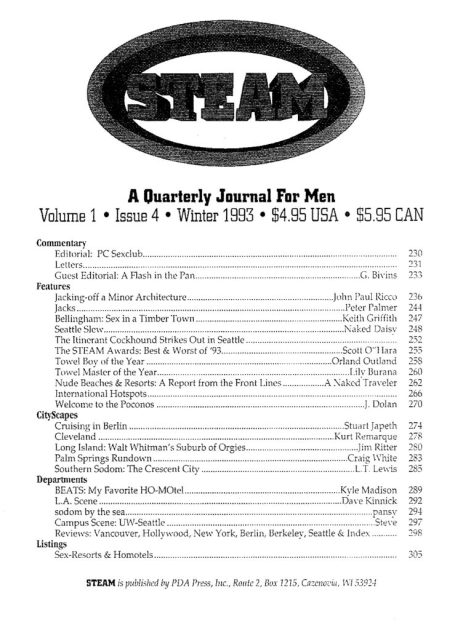
STEAM cover

“Jacking-off a Minor Architecture,” an essay that I published in 1993, has just been re-published in the online journal Keep It Dirtyin an issue on “Filth.” Editor Christian Hite approached me this past spring, believing that the essay deserved to be read—and perhaps more widely—23 years after its original publication. Having written a doctoral dissertation on masturbation and other technologies of arousal, this essay caught Hite’s attention, along with a second of mine on semen and the fluidity of body boundaries, that I had published around the same time in Gay and Lesbian Studies in Art History (edited by Whitney Davis).

To accompany the republication, I have written a preface in which I discuss the genesis of the text and its relation to emergent queer theory. While the political ethics of sex and architecture that I was experiencing, theorizing and writing about back then, have been pretty much eclipsed over the past 23 years by the very forms of bio-political governance and forces of domestication and assimilation to which queer anonymous sex stood opposite and refused, still there might be lessons to learn from a moment when, in the face of death and at the risk of life, masturbation was promiscuously communalized.


COL5127H QUEER ETHICS AND AESTHETICS
Fall 2016

Instructor: John Paul Ricco
Time: Thursdays, 2-4PM
Location: Centre for Comparative Literature, 3rd floor of Isabel Bader Theatre, Victoria University

Description
Working out from Michel Foucault’s focus on the question of ethics in his philosophical articulation of an aesthetics of existence, in this course we will read contemporary theorists whose work has been dedicated to thinking ethics and aesthetics together. Not only wholly tied to the experiences of sex and pleasure, here thinking itself is erotic. Such thought in turn provokes us to think in new ways about intimacy, friendship, betrayal, the pornographic, publics and commons, anonymity, the inorganic and the inhuman. And to trace the place of thought in each, beyond notions of the subject, identity, interiority, community, the human and life.

Authors include: Leo Bersani, William Haver, Samuel Delany, Tim Dean, Sarah Schulman, Claire Colebrook, Lauren Berlant, amongst others. In addition, we will discuss works of contemporary art, film, photography and fiction, by Hervé Guibert, Garth Greenwell, Dean Sameshima, Todd Haynes, Thomas Roma, and others.

Discussion Topics
1. Foucault’s Aesthetics of Existence
2. Infamous Men
3. Why Sex?
4. Unlimited Intimacy
5. Unbearable
6. Really Bad Infinities
7. Edge-pleasure and the Sense of the Common
8. Friendship
9. Traitorous Collaboration
10. Queer City
11. The Commerce of Anonymity
12. The Unlivable

I recently got around to reading the conversation between Tim Dean and Robyn Wiegman on the question of “critique.” It was published in a special issue of English Language Notes (51.2, Fall/Winter 2013) under the title, “What Does Critique Want? A Critical Exchange.”
Based upon their dialogue, and in light of a few other things that I have read this summer, I’ve put together the following notes on theory, queer theory, subjects/objects, reading, Foucault, aesthetics/ethics, and extinction.


In giving up on “critique,” one must also give up on all forms of the “subject” (beyond merely in terms of the critical mastery of the sovereign subject) and “objects” (including the notion that as thinkers/theorists, we have “objects” and hence that our thinking is always predicated upon, as the saying goes, “one’s relations to one’s objects”—which may or may not be distinct from “object-relations” [psychoanalysis] or “object lessons” [Wiegman]). Which would also mean re-thinking the political, outside the categories of subject and object, all the while retaining a commitment to thinking the relational (Foucault, Nancy) as the spacing of the political—irreducible to—and that which exceeds the domains of—subjects or objects, identities or things (and the “identity knowledges” that they produce). Hence the relational as always already non-relational. This entails radical re-definitions and conceptualizations of the “political” (spacing) as well as of the “ethical” (relational), in which neither would operate in the mode of being “critical.” In other words: can there be political and ethical thinking that is not, at the same time, critical—yet without being naive or without rigour?

In this regard, paranoid or reparative readings are not the only options or reading strategies available. There is also, for instance: deconstructive (inoperative, un-made) readings (which are not necessarily to be aligned with paranoid reading), and those aesthetic, literary or poetic modes of reading in which affect and sense (along with pleasure, desire, erotics) are central. Yet in ways that remain impersonal and transitive, rather than deriving from, or returning to, the individual subject who feels and becomes—the nexus of the critical and the personal (Sedgwick, et.al.) that is its own form of “performative narcissism.”

It is this strand that makes so much queer theory today not only reparative but therapeutic in its form and implicit intent. Queer Theory today has all too often become a project of coping (with life, affects, feelings, others, etc.), which is its own compensatory move vis-a-vis resentiment. In fact, what is the relation between the latter and critique—especially in terms of the ways in which critique is deployed in the humanities today (and in particular in queer theory) in the name of the political? Examples of this resentment (and its implicitly accompanying misogyny) cited in this dialogue include: why doesn’t she love us (asked by feminists about Sedgwick); critical theory and its lack of commitment to women (Gender Trouble); academic feminism using theory in order to feel smart and sexy; the aggressivity of Women’s Studies.

So also then, there is (once again) a fundamental rethinking of gender and sexual differences, and the difference these make to thinking, doing, making, and being-together outside the dialectic of subject-object—which might also be outside of gender and sexuality. The fact of the matter is that what Irving Goh has done for dominant critical theory in his recent and brilliant book, The Reject, needs to be done for hegemonic queer theory. Namely: to elucidate the extent to which it remains utterly beholden to the concept of the subject, and the ways in which Butler most especially, but also Sedgwick and a whole second generation are responsible for this unrelenting hold that the concept of the “subject” has had on the field.

This also points to the extent to which Queer Theory has betrayed the work of Foucault, which not only was a genealogy of the modern subject, but also an attempt to think “who comes after the subject” (in various forms of an ethical self in relation with others). Indeed, Nancy’s question from the late-1980s—asked after Foucault would have had a chance personally to respond—equally could have been written: “who comes after Foucault?” This is where Tim Dean’s quotation of Paul Veyne on Foucault is so incredibly important and useful. Veyne writes: “Foucault’s philosophy is not a philosophy of ‘discourse’ but a philosophy of relation…Instead of a world made up of subjects, or objects, or the dialectic between them, a world in which consciousness knows its objects in advance, targets them, or is itself what the objects make of it, we have a world in which relation is primary.” Of course this is also where the work of Leo Bersani comes in, and its commitment to thinking about ethical-aesthetic relationality in neither paranoid (aggressive) nor reparative (redemptive) ways. Further: we need to imagine the inorganic as beyond the human, and to think art and aesthetics in the absence of, and after life and the human. So not the traditional notion of art and its relation to immortality and the future, but art in relation to extinction and the posthumous. What I have been calling “the collective afterlife of things.”

It is in this respect that we are also dealing with questions of discourse and knowledge, which is to say, the  limits of knowing, and that is the primary task of theory—properly speaking—to trace. Including  in terms of that which exceeds gender and sexual categories and identities, and that as an experience of non-knowledge exceeds the epistemological (including epistemological mastery and the production of knowledge).

Theory is one of our principle relations to not-knowing, to epistemological erasure, and to extinction (ontological erasure). It is committed to thinking praxis as always inoperative (post-Marx and Arendt) and is a valence onto that which is unbecoming, un-livable and unimaginable. Such that the aesthetics of existence is the art of becoming-imperceptible and disappearing—but never enough. And where ethics wholly entails attesting to the fact that we—together-apart—are already living the time of extinction.