Archive

Publications

My research and writing this year has been primarily focused on completing a draft manuscript of my book, The Outside Not Beyond. This work has been aided tremendously by a 12-month research and study leave, of which I was at the midway point at the beginning of the year, and by a 12-month faculty research fellowship at the Jackman Humanities Institute (University of Toronto) that began this past July. The project also received very generous support beginning this year from the Social Science and Humanities Research Council (SSHRC, the national granting agency in Canada), which will provide funding over the next four years for research, assistants, travel, symposia, etc.

So over the past year I have had the time, solitude and resources to read and write and make significant progress on my projects. I have found my office at the JHI to be a particularly conducive place to work, and I really value the time I have had over the past 18 months, un-interrupted from teaching and university service duties, to focus on my own work and to remain with questions for extended periods of time.

Having submitted a book proposal to the University of Chicago Press in December of last year, by June of this year I finally received two Readers’ Reports, both of which very much endorsed the project and provided valuable feedback. I then turned my official response to these reports into an occasion to write what amounted to a second proposal: 11-pages that further expanded on the first, and represented the project in its current state of development. I found this to be an extremely productive task, one that really enabled me to flesh out both the major and minor scales and dimensions of the project. I walked away from the experience even more an advocate of “the second project outline.”

Topics and themes that have been pursuing in my research this past year include: the relation between poetry and prayer; anonymity and the neutral; edging and drawing; collective afterlives; ethics, politics and aesthetics of the common; drive, pleasure, and slippage; and measure and measurelessness.

The course of my research and reading this year, began with Georges Bataille’s major writings and publications, and then moved to Foucault’s lectures on governmentality and biopolitics; Dardot and Laval’s extension and elaboration of Foucault’s project, in their indispensable book, The New World Order: On Neoliberal Society; Derrida’s final seminar on the beast and the sovereign and his reading of Robinson Crusoe alongside Heidegger’s seminar The Fundamental Concepts of Metaphysics; and Michael Naas’s beautiful reading of Derrida’s seminar in his book,  The End of the World and Other Teachable Moments. I’ve also returned to the political writings of Maurice Blanchot, as well as some of his late-work, in particular The Step Not Beyond, along with Christopher Fynsk’s fantastic book, Last Steps: Maurice Blanchot’s Exilic Writing.

Other books that came out this year that I very much enjoyed, and that have remained with me, include: David Graeber’s book on bureaucracy, The Utopia of Rules; Kristin Ross’s Communal Luxury: The Political Imaginary of the Paris Commune; Elizabeth Kolbert’s, The Sixth Extinction; and McFadden and Al-Khalili’s Life on the Edge: The Coming Age of Quantum Biology. This last title is its own frontline education on one of the most exciting new fields of scientific research.

While writing, “The Art of the Consummate Cruise and the Essential Risk of the Common,” a paper for a panel on sexual risk and barebacking for the American Studies Association conference (Toronto, October 2015), I also returned to the work of William Haver—which remains the most inexhaustible source of inspiration and insight—as well that of Leo Bersani, Tim Dean. I have been in conversation with editors of an online journal, and hope that this paper will be published very soon.

I also continue to try to make fiction and poetry a regular part of my reading list. Books that particularly stood out this year are: Hanya Yanagihara’s A Little Life; Nell Zink’s Mislaid; Michel Houellebecq’s Submission; and Claudia Rankine’s Citizen.

Publications this year included: “The Separated Gesture: Partaking in the Inoperative Praxis of the Already-Unmade,” in the collection Nancy and the Political (Edinburgh University Press); my conversation with Jean-Luc Nancy, “The Existence of the World is Always Unexpected,” in Art and the Anthropocene (Open Humanities Press); my essay, “Drool: liquid fore-speech of the fore-scene,” in the online journal World Picture; and my essay, “Parasol, Setas, Parasite, Peasant,” in, Could, Should, Would, a monograph on architect J. Mayer H. (Hatje Cantz).

The first review of my book, The Decision Between Us, appeared in the January issue of Art in America (by Christa Noel Robbins); and that has since been followed by equally sympathetic, insightful and enthusiastic reviews in Critical Inquiry (by Tom McDonough), New Formations (by Jacques Khalip), and in Parallax (by Matthew Ellison and Tom Hastings).

As part of a conference seminar on Bataille that I co-organized with Etienne Turpin for the American Comparative Literature Association conference (Seattle), I presented a new paper titled, “A solvent for ‘poetry’s sticky temptation.'” It was a first attempt to consider the relation between poetry and prayer as it can be fashioned through a reading of Bataille’s A-Theological Summa. A keynote lecture at a conference on aesthetics and ethics at The Royal College of Art in London, gave me an opportunity to return to and to expand upon my paper, “The Commerce of Anonymity” which is on the art of mourning, and artist Shaan Syed’s “The Andrew Project.” An invitation to present some of the my current research at the Comparative Literature Emerging Research Lecture Series, here at the U of T this past fall, was yet another opportunity to further expand and develop the “Anonymity” paper into what I now feel is pretty much a completed chapter for the new book. Finally, last spring at Poetic Research Bureau in L.A. I read from and discussed my book, The Decision Between Us, along with readings by Etienne Turpin and Nadrin Hemada from collections that they have recently edited on the library and the prison, respectively.

Currently, I am preparing two keynote lectures in March 2016, one for the annual Comparative Literature conference, here at the University of Toronto, and the other for “Aisthesis & The Common: Reconfiguring the Public Sphere,” at McGill University. Also in March, I have been invited to speak at the Society for Philosophy and Culture at McMaster University.

Research travel this year included time in NYC in February in order to visit the National 9-11 Memorial and Museum at Ground Zero; and to Sicily in late-August to attend a week-long seminar on “sex and philosophy” taught by Jean-Luc Nancy.

This was also the year when I revived my performance art practice. It had been close to 7 years since I last presented my work and I have been wanting to return to performance for some time now. Since the late-summer I have been in conversation with Johannes Zits, and along with him and three other artists we have been developing a new work together. Many details will be posted here in the months to come, but for now I can say that at the end of January 2016 I will be part of a five-person, 6-hour durational performance at Katzman Contemporary, here in Toronto; and in February, I will be participating in a five-day workshop with artist Doris Uhlich, on dance, sound, and the naked body. All of this work is deeply connected to my thinking and writing on the peri-performative; naked image and naked sharing; exposure, risk, touch and trust. I am really excited to be able to translate this work into various forms of performance.

I will end this post by saying how grateful I am for those of you who have subscribed to this blog, and who take the time to be its readers. Happy New Year 2016!


  1. “The Inoperative Praxis of the Already-Unmade,” in Labour, Work, Action, edited by Michael Corris, Jaspar Joseph-Lester, and Sharon Kivland, Artwords Press, 2013. 
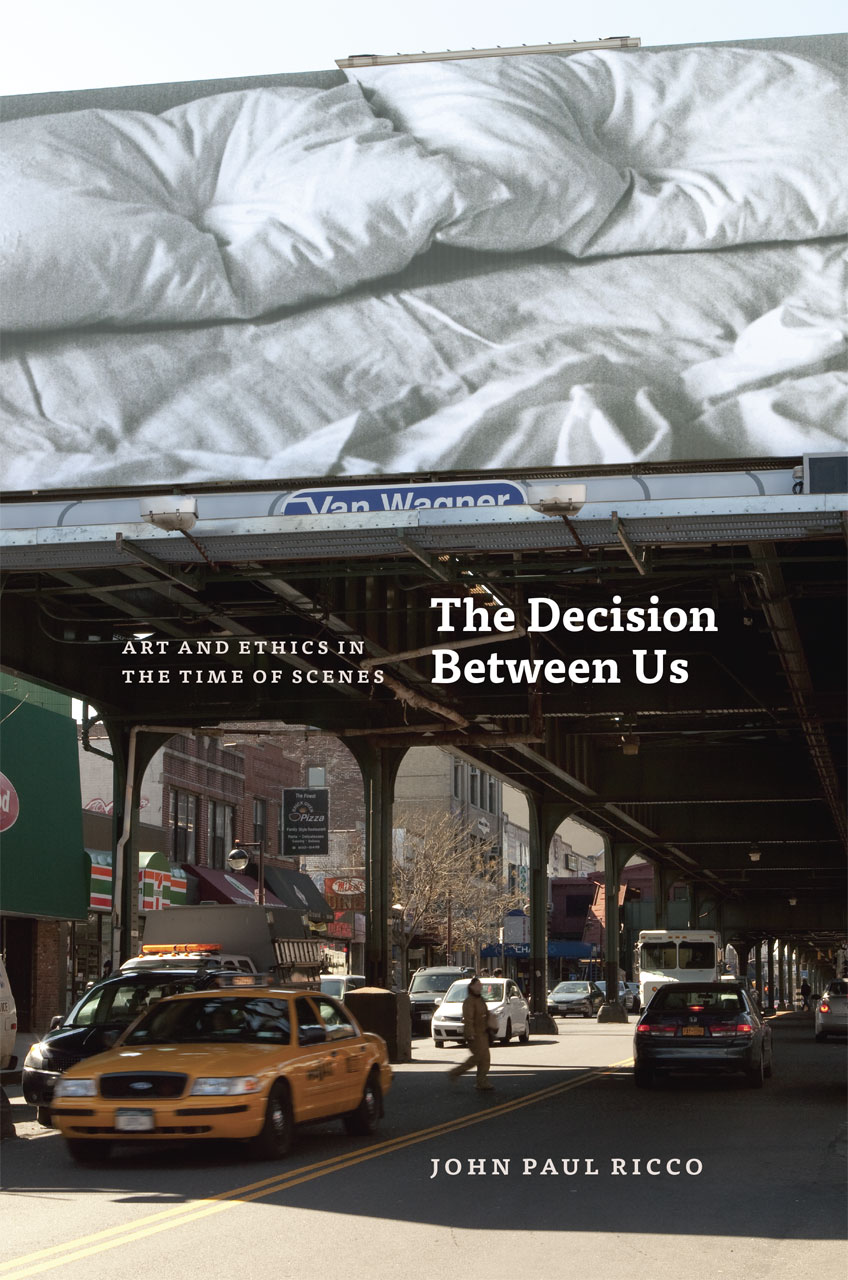
  2. John Paul Ricco, The Decision Between Us: art and ethics in the time of scenes, University of Chicago Press, 2014. 
  3. “Pornographic Faith: Two Sources of Naked Sense at the Limits of Belief and Humiliation,” in Porn Archives, edited by Tim Dean, Steven Ruszczycky, and David Squires, Duke University Press, 2014. 
  4. “The Existence of the World is Always Unexpected: Jean-Luc Nancy in conversation with John Paul Ricco,” in Art and the Anthropocene: Encounters Among Aesthetics, Politics, Environments and Epistemologies, edited by Heather Davis and Etienne Turpin, Open Humanities Press, 2015.
  5. “The Separated Gesture: Partaking in the Inoperative Praxis of the Already-Unmade,” in Nancy and the Political, edited by Sanja Dejanovic, Edinburgh University Press, 2015.
  6. “Parasol, Setas, Parasite, Peasant,” in J. Mayer H.: Could Should Would, Hatje Cantz, 2015. 
  7. PLUS: “Drool: liquid fore-speech of the fore-scene,” in World Picture, issue on “Abandon,” summer 2015 ( available online). 

Book Cover

I am so pleased to be included in this big, new beautiful book on the work of the Berlin-based architecture firm J. Mayer H. und partners.

My essay focuses on Metropol Parasol, the redevelopment of the Plaza de la Encarnación in Seville, Spain, as a public space of political contestation, occupation, and social gathering, including its articulations between city and countryside, urban and rural. Here is the concluding paragraph:

While claiming the status of being one of the largest wooden structures in the world, Metropol Parasol is not a built structure—an architecture—with the aspiration to unify, totalize, and wholly encompass some image of the world, as in Noah’s Ark. Which is also to say that it might be understood less in terms of mega-structures [which since the inception of this aspiring word in the early-1960s has been primarily about size], and more as something gigantic [which is about scale]. And as Susan Stewart illustrated years ago in her beautiful meditation, the gigantic is our scaled measure to landscape. By making gigantic mushrooms [parasols, setas, parásitos] grow in the middle of the city, and thereby creating a place irreducible to any notion of context, and uncontainable by any single structure [mega or otherwise] Metropol Parasol offers a sense of what it means to occupy the world. The political-ethical task is nothing less than that gigantic.

This is the video of the symposium organized around the book launch of Nancy and the Political, edited by Sanja Dejanovic (Edinburgh University Press), held at Beit Zatoun, Toronto, on July 11, 2015. It features presentations by Dejanovic, Marie-Eve Morin, and me on our respective contributions to the volume, as well as a presentation by, and discussion with Jean-Luc Nancy, who was present via video link.

Edinburgh University Press, 2015.

Edinburgh University Press, 2015.

Here are some prefatory remarks along with a schematic outline of the three-part configuration of the political, ethical and aesthetic that I think we derive from our reading of Nancy.

The work of Jean-Luc Nancy has always been driven by the question of community; that is, of the commune, the common and common things. Common things in the sense of res communes: precisely those things that are not “things” (res) in the reified sense, and thus things that cannot be appropriated, sacrificed, but that can only be either destroyed or shared. For example: atmosphere, the spacing of the “with,” friendship, and son. Each of these, along with language (logos) is a figure of the outside, and like the others, language is only ever the sharing of voices (of words, letters, speech). Nancy’s thinking, like that of other ethical philosophers, is driven by the question: what kind of life do we want to create and partake in together? In which partaking is understood as the praxis (doing, acting) of shared-separation (Fr. partager), such that the self-with-others exposed to the Outside, are transformed together in the mutual heterogeneity that is co-existence. Again, this praxis of partaking is the sharing not in things per se, but in separation “itself,” meaning, that spacing outside and between any two more more bodies, places, and things. In our invocation of the commune, the common and common things, we might hear the sense of res communes as being at once political, ethical and aesthetic. If so, the question then arises how, in our reading of Nancy, we can begin to outline a formulation for this tripartite configuration of the sense of co-existence.
Relatively recently in his book, The Truth of Democracy, Nancy theorizes the rapport between these three spheres or axises in terms of “the condition of nonequivalent affirmation.” Meaning, I think, that in their mutual affirmation of each, none of these is equivalent to any other, but instead remains incommensurable. So for instance in the opening lines of the chapter “A Space Formed for the Infinite,” he writes:
The condition of nonequivalent affirmation is political inasmuch as politics prepares the space for it. But the affirmation itself is not political. It can be almost anything you like—existential, artistic, literary, dreamy, amorous, scientific, thoughtful, leisurely, playful, friendly gastronomic, urban and so on: politics subsumes none of these registers; it only give them their space and possibility.

In my article for the recently published collection, Nancy and the Political (Edinburgh University Press, 2015), titled, “The Separated Gesture: Partaking in the Inoperative Praxis of the Already-Unmade,” I tried to outline the formulation of this configuration. In the most schematic of ways, but deliberately for the purposes of enabling an initial observation and understanding of their alignment, here is what I take to be Nancy’s thinking about the connections between the political, the ethical and the aesthetic.

Political: logos + polis (outside of politics in the conventional sense of the term) > space or better, form-of-place (locus) of the in-common, of being-together, and toward.
  • The political is access and opening, it is about making room.
  • The political is the retreating of signification, figuration, identification, substantiality, ground, and totality.
  • City/Polis/ res publica (public thing; republic).
Ethical: logos + ethos (outside of ethics) > form-of-life. Stance or disposition in relation to and in rapport with the decision to share in the praxis of sustaining this spacing of separation amongst and between bodies, things and places (that is, sense, of co-existence).
  • The ethical is a qualitative relational bond, non-codified and informal ties and decisions between us (actual proximities, friendship, rapport with the anonymous other,  the passerby, the stranger, the commerce of anonymity).
  • Peri-performative (i.e. dis-enclosed) scenes (not ethos as securitized oikos, dwelling or abode—as in the Heideggerean sense).
Aesthetic: logos + aisthesis (outside of aesthetics) > form-of-sense. Gestures and techniques, forces and forms, configurations of sense, and sensuous conjurations of partes extra partes (the part that is not part of the whole). In an upcoming post, I will provide further elaboration of this definition of aesthetic praxis.

  • I take these ways of thinking the political, ethical and aesthetic to be figures and affirmations of the Outside. There is no essential or necessary principle that joins and unites all three. Except perhaps the thought from the Outside.
  • No one sphere is more privileged or prioritized, supplementary to, determined by, or reducible to either of the other two. There is no unsurpassable political, ethical or aesthetic horizon, including one that would be the ultimate measure and limit for the others.
  • Politics does not provide signifiers for art, art does not provide a figure for the political, and operating without a given signification or figuration, the ethical is deprived of the pre-given foundation by which to prescribe a particular stance in relation to this political place and aesthetic gesture of shared-separation. Indeed, the ethical is the very space of separation, which we infinitely share as the decision just between us (some bodies with some other bodies and some things).

art-in-the-anthropocene_cover_150x225

Published in the recently released book, Art in the Anthropocene: Encounters Among Aesthetics, Politics, Environments and Epistemologies. Edited by Heather Davis and Etienne Turpin (Open Humanities Press, Critical Climate Change Series, 2015).

You can read and download the entire 400+ page volume here:

Art in the Anthropocene

Published in the latest issue of the online, open-access journal World Picture, on the theme of abandon. You can read and download my essay and the others in the volume, here: World Picture 10: Abandon

University of Chicago Press, March 2014.

University of Chicago Press, March 2014.

The Decision Between Us combines an inventive reading of Jean-Luc Nancy with queer theoretical concerns to argue that while scenes of intimacy are spaces of sharing, they are also spaces of separation. John Paul Ricco shows that this tension informs our efforts to coexist ethically and politically, an experience of sharing and separation that informs any decision. Using this incongruous relation of intimate separation, Ricco goes on to propose that “decision” is as much an aesthetic as it is an ethical construct, and one that is always defined in terms of our relations to loss, absence, departure, and death.

Laying out this theory of “unbecoming community” in modern and contemporary art, literature, and philosophy, and calling our attention to such things as blank sheets of paper, images of unmade beds, and the spaces around bodies, The Decision Between Us opens in 1953, when Robert Rauschenberg famously erased a drawing by Willem de Kooning, and Roland Barthes published Writing Degree Zero, then moves to 1980 and the “neutral mourning” of Barthes’ Camera Lucida, and ends in the early 1990s with installations by Felix Gonzalez-Torres. Offering surprising new considerations of these and other seminal works of art and theory by Jean Genet, Marguerite Duras, and Catherine Breillat, The Decision Between Us is a highly original and unusually imaginative exploration of the spaces between us, arousing and evoking an infinite and profound sense of sharing in scenes of passionate, erotic pleasure, as well as deep loss and mourning.

“Through a compelling, lucid, and wonderfully suggestive reading of Nancy’s writings, we are exposed throughout The Decision Between Us to numerous scenes of seduction and abandoned existence, scenes at once erotic and funerary, intimate and desolate. An incisive contribution to the ways in which Nancy’s writings might be read today, the sense of sharing at the heart of the argument is both transformative and intensely ethical.”

Philip Armstrong, Ohio State University

“Ricco’s The Decision Between Us is a beautifully executed book on the execution and extension of being-in-relation. Its articulation of sexuality theory, deconstructive philosophy, and queer art opens up different idioms to each other the way lovers open to each other—excitedly, productively, and yet always enigmatically, pointing beyond what seems present. Ricco is also a brilliant close reader. An enrapturing read.”

Lauren Berlant, University of Chicago

“Reopening ground broken by Jean-Luc Nancy, The Decision Between Us traces the paradoxes of relational being across a range of artistic, literary, and philosophical ‘scenes.’ Through a series of startling juxtapositions, Ricco weaves together scenes of exposure, erasure, and unmaking to reveal the inseparability of aesthetics from ethics.  This is an original and challenging work by one of our most brilliant philosophers of visuality.”

Tim Dean, State University of New York at Buffalo


Transmission Annual (2013)

LABOUR, WORK, ACTION
Edited by Michael Corris, Jaspar Joseph-Lester, Sharon Kivland
With guest editors Maureen Connor and Elizabeth Legge

Taking up Hannah Arendt’s reflections on three important human activities – labour, work, action – this book addresses the role that might be played by artist or work of art, and how this makes for agents and agency.

Contributors: Ivana Bago, Jordan Bear, Pascal Beausse, Bernard Brunon, Pavel Büchler, Armin Chodzinski, Annie Coll, Michael Corris, Janeil Engelstad, Francesco Finizio, Charlie Gere, Jerome Harrington, David Hopkins, Shannon Jackson, Vincent Victor Jouffe, the Pedagogy Group, Elizabeth Legge, Dale MacFarlane, Roberto Martinez, Mary-Lou Lobsinger, Hester Reeve, Oliver Ressler, John Paul Ricco, Abigail Satinsky, Juliet Steyn.

Transmission is a project that has encompassed an annual journal, a series of related publications, a lecture series, symposia and other events. Transmission Annual is a yearly publication, now in four volumes, edited by Jaspar Joseph-Lester (Royal College of Art, London), Sharon Kivland (Sheffield Hallam University), Michael Corris (The Meadows School of the Arts, SMU, Dallas, Texas), who were joined for 2012 by Noah Simblist (The Meadows School of the Arts, SMU, Dallas, Texas).

The Decision Between Us: Art and Ethics in the Time of Scenes

(University of Chicago Press, 2014)

John Paul Ricco


The Decision Between Us combines an inventive reading of Jean-Luc Nancy with queer theoretical concerns to argue that while scenes of intimacy are spaces of sharing, they are also spaces of separation. John Paul Ricco shows that this tension informs our efforts to coexist ethically and politically, an experience of sharing and separation that informs any decision. Using this incongruous relation of intimate separation, Ricco goes on to propose that “decision” is as much an aesthetic as it is an ethical proposition, and one that is always defined in terms of our relations to loss, absence, departure, and death.

            Laying out this theory of “unbecoming community” in modern and contemporary art, literature, and philosophy, and calling our attention to such things as blank sheets of paper, images of unmade beds, and the spaces around bodies, The Decision Between Us opens in 1953, when Robert Rauschenberg famously erased a drawing by Willem de Kooning, and Roland Barthes published Writing Degree Zero, then moves to 1980 and the “neutral mourning” of Barthes’ Camera Lucida, and ends in the early-1990s and installations by Felix Gonzalez-Torres. Offering surprising new considerations of these and other seminal works of art and theory by Jean Genet, Marguerite Duras, and Catherine Breillat, The Decision Between Us is a highly original and unusually imaginative exploration of the spaces between us, arousing and evoking scenes of both passionate, erotic pleasure as well as deep loss and mourning.