
Upcoming Keynote Talk at “TRANS” – Comparative Literature Conference (U of T)
Leave a comment

My research and writing this year has been primarily focused on completing a draft manuscript of my book, The Outside Not Beyond. This work has been aided tremendously by a 12-month research and study leave, of which I was at the midway point at the beginning of the year, and by a 12-month faculty research fellowship at the Jackman Humanities Institute (University of Toronto) that began this past July. The project also received very generous support beginning this year from the Social Science and Humanities Research Council (SSHRC, the national granting agency in Canada), which will provide funding over the next four years for research, assistants, travel, symposia, etc.
So over the past year I have had the time, solitude and resources to read and write and make significant progress on my projects. I have found my office at the JHI to be a particularly conducive place to work, and I really value the time I have had over the past 18 months, un-interrupted from teaching and university service duties, to focus on my own work and to remain with questions for extended periods of time.
Having submitted a book proposal to the University of Chicago Press in December of last year, by June of this year I finally received two Readers’ Reports, both of which very much endorsed the project and provided valuable feedback. I then turned my official response to these reports into an occasion to write what amounted to a second proposal: 11-pages that further expanded on the first, and represented the project in its current state of development. I found this to be an extremely productive task, one that really enabled me to flesh out both the major and minor scales and dimensions of the project. I walked away from the experience even more an advocate of “the second project outline.”
Topics and themes that have been pursuing in my research this past year include: the relation between poetry and prayer; anonymity and the neutral; edging and drawing; collective afterlives; ethics, politics and aesthetics of the common; drive, pleasure, and slippage; and measure and measurelessness.
The course of my research and reading this year, began with Georges Bataille’s major writings and publications, and then moved to Foucault’s lectures on governmentality and biopolitics; Dardot and Laval’s extension and elaboration of Foucault’s project, in their indispensable book, The New World Order: On Neoliberal Society; Derrida’s final seminar on the beast and the sovereign and his reading of Robinson Crusoe alongside Heidegger’s seminar The Fundamental Concepts of Metaphysics; and Michael Naas’s beautiful reading of Derrida’s seminar in his book, The End of the World and Other Teachable Moments. I’ve also returned to the political writings of Maurice Blanchot, as well as some of his late-work, in particular The Step Not Beyond, along with Christopher Fynsk’s fantastic book, Last Steps: Maurice Blanchot’s Exilic Writing.
Other books that came out this year that I very much enjoyed, and that have remained with me, include: David Graeber’s book on bureaucracy, The Utopia of Rules; Kristin Ross’s Communal Luxury: The Political Imaginary of the Paris Commune; Elizabeth Kolbert’s, The Sixth Extinction; and McFadden and Al-Khalili’s Life on the Edge: The Coming Age of Quantum Biology. This last title is its own frontline education on one of the most exciting new fields of scientific research.
While writing, “The Art of the Consummate Cruise and the Essential Risk of the Common,” a paper for a panel on sexual risk and barebacking for the American Studies Association conference (Toronto, October 2015), I also returned to the work of William Haver—which remains the most inexhaustible source of inspiration and insight—as well that of Leo Bersani, Tim Dean. I have been in conversation with editors of an online journal, and hope that this paper will be published very soon.
I also continue to try to make fiction and poetry a regular part of my reading list. Books that particularly stood out this year are: Hanya Yanagihara’s A Little Life; Nell Zink’s Mislaid; Michel Houellebecq’s Submission; and Claudia Rankine’s Citizen.
Publications this year included: “The Separated Gesture: Partaking in the Inoperative Praxis of the Already-Unmade,” in the collection Nancy and the Political (Edinburgh University Press); my conversation with Jean-Luc Nancy, “The Existence of the World is Always Unexpected,” in Art and the Anthropocene (Open Humanities Press); my essay, “Drool: liquid fore-speech of the fore-scene,” in the online journal World Picture; and my essay, “Parasol, Setas, Parasite, Peasant,” in, Could, Should, Would, a monograph on architect J. Mayer H. (Hatje Cantz).
The first review of my book, The Decision Between Us, appeared in the January issue of Art in America (by Christa Noel Robbins); and that has since been followed by equally sympathetic, insightful and enthusiastic reviews in Critical Inquiry (by Tom McDonough), New Formations (by Jacques Khalip), and in Parallax (by Matthew Ellison and Tom Hastings).
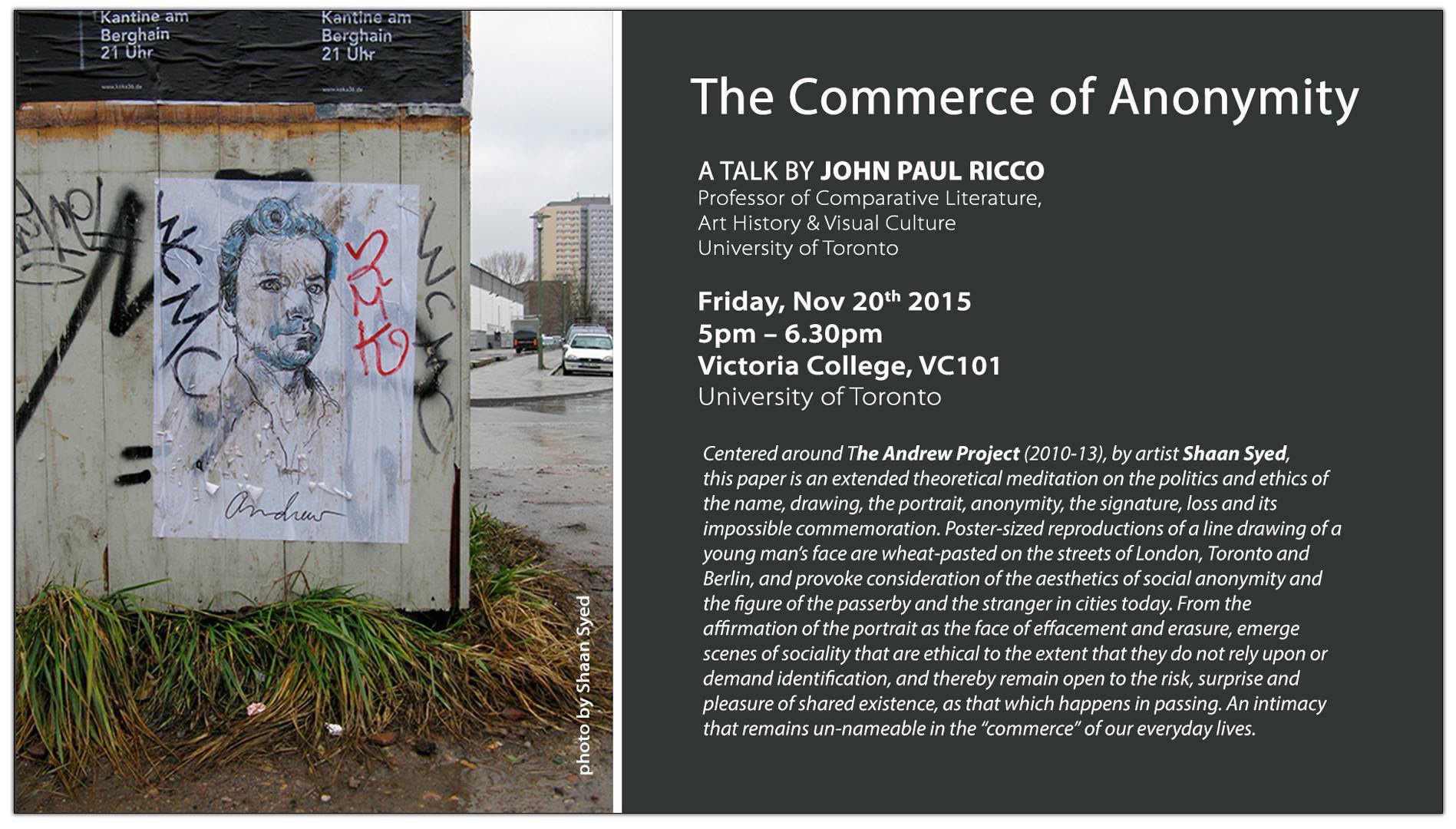
As part of a conference seminar on Bataille that I co-organized with Etienne Turpin for the American Comparative Literature Association conference (Seattle), I presented a new paper titled, “A solvent for ‘poetry’s sticky temptation.'” It was a first attempt to consider the relation between poetry and prayer as it can be fashioned through a reading of Bataille’s A-Theological Summa. A keynote lecture at a conference on aesthetics and ethics at The Royal College of Art in London, gave me an opportunity to return to and to expand upon my paper, “The Commerce of Anonymity” which is on the art of mourning, and artist Shaan Syed’s “The Andrew Project.” An invitation to present some of the my current research at the Comparative Literature Emerging Research Lecture Series, here at the U of T this past fall, was yet another opportunity to further expand and develop the “Anonymity” paper into what I now feel is pretty much a completed chapter for the new book. Finally, last spring at Poetic Research Bureau in L.A. I read from and discussed my book, The Decision Between Us, along with readings by Etienne Turpin and Nadrin Hemada from collections that they have recently edited on the library and the prison, respectively.
Currently, I am preparing two keynote lectures in March 2016, one for the annual Comparative Literature conference, here at the University of Toronto, and the other for “Aisthesis & The Common: Reconfiguring the Public Sphere,” at McGill University. Also in March, I have been invited to speak at the Society for Philosophy and Culture at McMaster University.
Research travel this year included time in NYC in February in order to visit the National 9-11 Memorial and Museum at Ground Zero; and to Sicily in late-August to attend a week-long seminar on “sex and philosophy” taught by Jean-Luc Nancy.
This was also the year when I revived my performance art practice. It had been close to 7 years since I last presented my work and I have been wanting to return to performance for some time now. Since the late-summer I have been in conversation with Johannes Zits, and along with him and three other artists we have been developing a new work together. Many details will be posted here in the months to come, but for now I can say that at the end of January 2016 I will be part of a five-person, 6-hour durational performance at Katzman Contemporary, here in Toronto; and in February, I will be participating in a five-day workshop with artist Doris Uhlich, on dance, sound, and the naked body. All of this work is deeply connected to my thinking and writing on the peri-performative; naked image and naked sharing; exposure, risk, touch and trust. I am really excited to be able to translate this work into various forms of performance.
I will end this post by saying how grateful I am for those of you who have subscribed to this blog, and who take the time to be its readers. Happy New Year 2016!

Here is the link to the audio file on YouTube of my Lecture, On the Commerce of Anonymity, that I presented on November 20, 2015, as part of the Emerging Research in Comparative Literature Series, at the University Toronto.
I want to thank Fan Wu and Jesscia Copley for the invitation to present some of my current work, and to all those in attendance that evening for their engaging questions and responses. I also want to thank Bao Nguyen for his editing of this audio recording. Finally, my thanks to Shaan Syed, whose work—the focus of this talk—continues to be such an important provocation and inspiration for my own.
For the final section of the paper that I did not have the time to present, see my earlier post on “anonymous and neutral mourning.”
This is the video of the symposium organized around the book launch of Nancy and the Political, edited by Sanja Dejanovic (Edinburgh University Press), held at Beit Zatoun, Toronto, on July 11, 2015. It features presentations by Dejanovic, Marie-Eve Morin, and me on our respective contributions to the volume, as well as a presentation by, and discussion with Jean-Luc Nancy, who was present via video link.

Edinburgh University Press, 2015.
Here are some prefatory remarks along with a schematic outline of the three-part configuration of the political, ethical and aesthetic that I think we derive from our reading of Nancy.
The condition of nonequivalent affirmation is political inasmuch as politics prepares the space for it. But the affirmation itself is not political. It can be almost anything you like—existential, artistic, literary, dreamy, amorous, scientific, thoughtful, leisurely, playful, friendly gastronomic, urban and so on: politics subsumes none of these registers; it only give them their space and possibility.
Francisco-Fernando Granados, spatial profiling – after Margaret Dragu’s Eine Kleine Nacht Radio (2011). Performance, site-specific drawing; performed at VIVO Media Arts Centre for the LIVE Biennial of Performance Art, Vancouver. Photographs by Jesse Birch and Francisco-Fernando Granados
Here is a short description of a paper that I will be working on for the next few months, as a keynote that I have been invited to present at a conference on “Aisthesis and the Common: Reconfiguring the Public Sphere” to be held at McGill University, Montreal, in March 2016.
Bodies are exorbitant extremities, and not enclosed and discrete or “embodied” entities. This is just one of the reasons why we do not speak of a body having a center or margins. Ontologically speaking, any material-physical thing that is open and always in excess of its limits is a body. Thus not only are there non-human and inorganic bodies, just as there are human bodies, but the matter of bodies and how they come to matter and mean, happens in those indeterminate and undecidable zones where it is often impossible to know where one body begins and another ends. Edge is the name that we might give for this shared spacing, there where bodies partake in a sense of the intimacy of the outside. In my paper I consider works by three contemporary artists: Francisco-Fernando Granados, Shaan Syed, and Sarah Kabot, in which a performative praxis of drawing traces the non-mediating line of the edge as the space-time of the common—its tense, tension and extension. In the public performance of repetitively tracing a facial profile (Granados), or a portrait of lost lover posted on city streets (Syed), or in which all of the lines in a public bathroom are shifted by half-an-inch (Kabot), these works peri-performatively open up spaces around bodies, and places and things. Spaces that are virtual rather than possible, inoperative rather than productive, anonymous rather than identitarian. Indeterminate zones but never empty voids, these edgings are where appearing and disappearing, becoming and unbecoming persist as the immeasurable infinities that they are. The sense and experience (aisthesis) of the common lies in the pleasures and risks of our affinities to these edges.
THESE SCENES OF UNBECOMING
A conversation with John Paul Ricco, Nasrin Himada and Etienne Turpin
Tuesday, the 31st of March 2015
6-8PM
Poetic Research Bureau
951 Chung King Road
Los Angeles, CA 90012
To celebrate the release of our recent respective publications, I will join Nasrin Himada and Etienne Turpin in a discussion of the ethics and politics of unbecoming. Within this theoretical framework, and in relation to various scenes, topics for engagement will include: violence, sex, death, brutality, sharing, extinction, pleasure, animality, mourning, confinement, and bodies. Copies of the publications will be available for purchase.
Nasrin Himada currently holds a post-doctoral research fellowship in Communications at the Université de Montréal, and is a visiting scholar in the Aesthetics and Politics program at Cal Arts. She is co-editor (with Chris Lee) of issue number 7 (Fall/Winter 2014 of the journal Scapegoat: Architecture/Landscape/Political Economy, on the theme of “Incarceration.”
Etienne Turpin is a philosopher living and working in Jakarta, Indonesia, where is the director of anexact office. He is the co-editor (with Anna-Sophie Springer) of the two-volume Intercalations: Volume 1 Fantasies of the Library; and Volume 2 Land & Animal & Nonanimal; both published by K. Verlag and Haus der Kulturen Welt, 2015.
On March 7 & 8, 2013 I will give a lecture and lead a seminar based upon my current book project: Non-consensual futures: pornographic faith and the economy of the eve. I am honored by the invitation extended by Professor Deborah Harter and her graduate students in the Mellon Seminar:
Frames of the Beautiful, the Criminal, and the Mad: The Art and the Science of Excess
Faculty leader: Deborah Harter, associate professor of French studies
Student participants: Sarah Seewoester Cain (linguistics), Linda Ceriello (religious studies), Kristen Ray (English), Nathaniel Vlachos (anthropology), and Rachel Schneider Vlachos (religious studies).
Seminar Description
Reflecting on representations of the “excessive” in science and in art of the modern period – madness, genius, criminal, eccentric, beautiful, and pathological – this seminar welcomes students from all fields in the humanities and social sciences. We will consider the aesthetic with scientific, the ethical with the historical, and play havoc with all usual boundaries of disciplines, period, and genre.
PURE BLOCK, TRANSPARENT
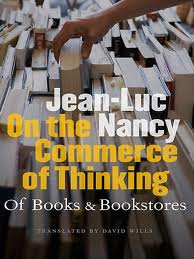
(Fordham University Press, 2008)
Multi-session workshop on Jean-Luc Nancy’s
On the Commerce of Thinking: Of Books and Bookstores,
as facilitated by John Paul Ricco. Realized in coordination
with the exhibition Sediment at G Gallery, Art Metropole
and Of Swallows, Bookshop.
The three sessions of this workshop will cumulatively
involve a close and direct reading of this short book by
Jean-Luc Nancy. Each session will begin with 3-4 sections
of On the Commerce … being read aloud by workshop
participants with subsequent group discussion of the text,
led by John Paul Ricco.
Details for the three sessions are as follows:
Session 1: January 26 2012 at G Gallery, 7-9pm (sections 1-3)
On the Commerce of Thinking, Of Books and Bookstores
The Idea and Character of the Book
The Book’s End in Itself
Session 2: February 2 2012 at Art Metropole, 7-9pm (sections 4-6)
The People of the Book
Interminable Reading
The Publication of the Unpublished
Session 3: February 16 2012 at Of Swallows, Bookshop, 7-9pm (sections 7-10)
Book Open and Closed
The Scents of the Bookstore
The Commerce of Thinking
The Matter of Books
Those interested in attending the workshop are asked to
RSVP as soon as possible as there will be a limited number
of spots. Individuals that wish to RSVP are asked to
do so with the intention of attending all three sessions in
order to provide continuity and depth to the discussions.
To RSVP and for other information, please contact
Shane Krepakevich at skrepakevich(at)gmail(dot)com
G Gallery *NEW LOCATION*
134 Ossington Street (Entrance on Foxley Pl, rear of building)
Toronto, Ontario M6J 2Z5
info@sidecentre.com
Gallery Hours: Friday to Sunday 12 – 5pm
G Gallery location
G Gallery and sidecentre.com are generously supported by the College of Arts
and the School of Fine Arts and Music at the University of Guelph.
 unbecoming community