Archive

Anonymity

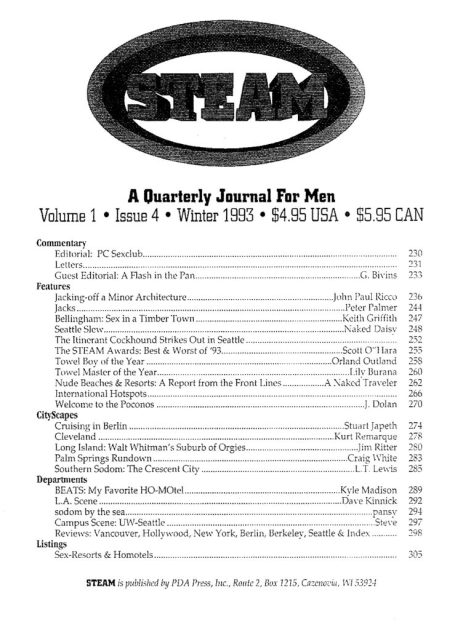
STEAM cover

“Jacking-off a Minor Architecture,” an essay that I published in 1993, has just been re-published in the online journal Keep It Dirtyin an issue on “Filth.” Editor Christian Hite approached me this past spring, believing that the essay deserved to be read—and perhaps more widely—23 years after its original publication. Having written a doctoral dissertation on masturbation and other technologies of arousal, this essay caught Hite’s attention, along with a second of mine on semen and the fluidity of body boundaries, that I had published around the same time in Gay and Lesbian Studies in Art History (edited by Whitney Davis).

To accompany the republication, I have written a preface in which I discuss the genesis of the text and its relation to emergent queer theory. While the political ethics of sex and architecture that I was experiencing, theorizing and writing about back then, have been pretty much eclipsed over the past 23 years by the very forms of bio-political governance and forces of domestication and assimilation to which queer anonymous sex stood opposite and refused, still there might be lessons to learn from a moment when, in the face of death and at the risk of life, masturbation was promiscuously communalized.


This is the remarkable text that Stacey D’Erasmo presented at “Of Queer Neutrality: Apartness, Erasure, Intimacy,” the symposium and public roundtable on my book, The Decision Between Us, that was held on April 1, 2016 at the University of Toronto. 

I am deeply moved by Stacey’s words and thrilled by the deep resonance between her thinking and writing and my own. Her book on intimacy and its written form in various works of literature and poetry is a revelation, and is its own guide towards an ethics of the nearly impossible-to-occupy space between. Many who attended the symposium have expressed their own appreciation and excitement of this text, and thanks to Stacey’s generosity, I am happy and honoured to be able to publish it here. The title is not hers, but one that I have given the essay, drawing from its own language and argument. 


Thank you to John and to the Jackman Humanitites Institute for inviting me to this discussion. It’s a pleasure to be here. I have to admit that I was a bit surprised to be asked—I’m primarily a novelist, and I speak theory about as well as I speak French, which is to say enough to get around, order breakfast, ask for directions (take a left at Ranciere…), but I’m not fluent. The reason John asked me is that I wrote a book-length essay called The Art of Intimacy: The Space Between in which I looked at how it is that writers create a sense of intimacy on the page—intimacy among characters, between reader and writer, erotic and thanatopic intimacies, intimacies for which we do not have a name. I wrote this book for a literary series on craft and criticism, but I am sure that my book was very frustrating for any apprentice writer, because when I looked at various texts what I found was that these intimacies were not, strictly speaking, there. Instead, they were produced by what John, in his book calls the peri-space or the peri-performative: the space around, the space between. Our sense as readers that an intimacy had occurred was made by various meetings, often quite brief or glancing, in verb tenses, in the image, in murderous transaction, in white space, and so on. I opened the book with an epigraph from Gertrude Stein from the “Roast Beef” section of Tender Buttons: “The kindly way to feel separating is to have a space between. This shows a likeness.”

My job as a novelist is easier than any of yours because all I have to do is give the reader the feeling that something has happened, say an intimacy of some kind. If that intimacy was detonated in the margins of the page, in the syntax of the scene, in the shadows of the subjunctive, the reader, like Nancy’s image of Psyche, doesn’t know and doesn’t care. The reader—unlike the Psyche who is, of course, more awake in the myth than prone and unconscious or maybe dead—doesn’t lift the lamp. And if you say to the reader, as I did, ‘well, you know, the room is empty, the hat is empty, there is no rabbit, also no room and no hat,’ the reader basically shrugs. She already knew that.

FGT 1600x1154

However, it would be highly disingenuous of me to say that I don’t see the stakes of John’s argument, that I don’t have stakes in it, that I’m a stranger here, I don’t speak the language, I am not subject to your borders, I’m just passing and passing through. Je ne parle pas Nancy. Because, as John points out in his discussion of Felix Gonzalez Torres’ Untitled, that image of the unmade bed on the billboard is not “the representational visual form added to a preexisting content (e.g. privacy, domesticity, coupledom), but is the very scene of the ethical-political contest over these various terms, and the performative spatial praxes to which they are conventionally assigned.” It seemed to me in reading John’s book that the image of an unmade bed—the proposition that there could be an unmade bed, that the bed could be unmade—kept appearing and reappearing: in Rauschenberg’s erasure of the de Kooning drawing, in the Mystic Writing Pad discussed by Freud, in the bed used by Duras, by Breillat, by Nancy; in Barthes’ embrace of haiku and photography and his impossible wish to be exempted from the image as a kind of social military service, in the Zen concept of satori. Barthes’ neutral, of course, is an unmade bed. Felix Gonzalez-Torres’ pile of candy is an unmade bed. The photographs in the book by Faucon and Baudinet are unmade beds.

This proposition is a scandal, and, as an American, it’s fitting to me that we are having this discussion in Canada, where the draft dodgers once went. John is clearly a gentleman and a scholar, but his proposition is obscene and getting more obscene by the minute. I accept, not without a certain amount of trepidation. I kept thinking about that queer slogan from the ‘80s, “An army of lovers cannot fail,” and how different it would sound to us today to say, “An army of exiles cannot fail,”—whoops—but then, of course, erase the army, erase the forward-moving syntax, erase the verb, erase the sense of failure of success, lift the sheet on the Mystic Writing Pad. All you’re left with are the exiles, and maybe even just the ex-. All lovers are ex-lovers. The term “queer neutrality,” socially, is an oxymoron if not an outrage. We are more wedded to identity now than we have ever been. Many of the people in their makeshift boats on the crossing die, because the space between is a perilous passage in which one cannot live. The prepositions to or from are mandated, and in very concrete terms. Indeed, the prepositions to and from have tremendous power at the moment. They are the prepositions du jour, if not de siècle. One can live and die of them.

Other prepositions—beyond, around, between, beside, before, after, behind—are powerless. They are the prepositions of the unmade bed. Scandalous prepositions, and propositions. To dwell in powerlessness, in between-ness, is a scandal as well, if not also high-risk behavior. To suggest that the phrase this place, as in John’s discussion of Gonzalez Torres’ two stacks of paper labeled “Somewhere Better Than This Place” and “Nowhere Better Than This Place,” refers not to one or the other places but to the place that is shared by both of them flies in the face not only of geopolitics but also of basic Western identity. Further, to posit that we already have the freedom to decide to partake in, to sustain, as John says, “the inappropriate space between us as no-thing and already unmade,” to take the candy and eat it, is increasingly unsayable. John seems to be suggesting that we take candy from strangers, indeed, that taking candy from strangers is a freedom we already possess. His book, itself, as much as the art works that are discussed there, offers us that invitation, that decision. It is an invitation to powerlessness, to traitorous collaboration, to unbecoming.

A novel that is an unmade bed, in these terms, is a novel that will not make up its mind, and, as a result, will not make up the reader’s mind. One can say that all writing, all novels, certainly, are already unmade beds, but that’s too facile. I can think of works that seem to me to be unmade beds—Gide’s The Immoralist, Duras’ The Lover, Theresa Hak Kyung Cha’s Dictee, Renata Adler’s Speedboat, all of Jane Bowles, all of Genet, of course. These are works of unbecoming—they unbecome the reader, and the pun seems apt as well. They are unbecoming books; they don’t make anyone look good, or bad, for that matter. They deliver us into a freedom from interpretation and identity that is uncomfortable. We become quite naked as readers. As John says, “what turns us on turns us out,” and I think the puns are apt there as well, being turned out as being exiled and being turned out as being prostituted, offered up to strangers, possibly strangers with candy. We are given or shown our freedom, our responsibility, our nakedness, and, frankly, this isn’t why most people read novels, or write them. The marriage plot is more popular now than ever.

The ability to discern this freedom, to dwell in it or at it, to see it as a decision that is always on offer, to apprehend works of art from this free position—by which I mean the neutral, the powerless, the partes extra partes—is severely constricted at the present moment. If you are without a place, you are an exile or a terrorist or a traitor. If you wish to be without a place, or attempt to be without a place, you have lost your mind. This is the moment in which we find ourselves. What fascinates me about The Decision Between Us is that John is not sounding a cry for liberation. His exploration rests on a freedom that is already there. The book, in this regard, strikes me as a kind of diagnosis or perhaps a punctum, to use Barthes’ term. I don’t know where to go from here. What has occurred to me in the wake of reading this book is a state I might call noticing. It seems to me, to return to Stein, a kindly way to feel separating, to have a space between, to show a likeness.

This is the public roundtable discussion of my recent book, The Decision Between Us: art and ethics in the time of scenes. It was held on April 1, 2016 at the University of Toronto, and featured remarks by David Clark, Stacey D’Erasmo, Jacques Khalip, Etienne Turpin and Tom McDonough.

I am deeply appreciative of the generous time and care that each of them has devoted to my work, and the many new insights that their precise observations, re-framings, and juxtapositions generated. It is certainly a rare occasion for an intellectual discussion in the academy to be structured less around questioning critique, and more in terms of a willingness to go along with another thinker and writer’s thinking and writing for awhile. Resonances and shared affinities and devotions emerge, and this is truly a genuine gift.

But I am equally grateful for David, Stacey, Jacques, Etienne and Tom’s commitment to making this roundtable discussion a real intellectual event and not simply a panegyrical celebration. They came not only as admirers but as readers, willing to probe the larger political, ethical and aesthetic dimensions of my work, and to situate those paths in relation to other contemporary discussions and events (e.g. the Anthropocene, queer pedagogy, the refugee crisis, the marriage plot, and the un-livable). And to open up my work to that of others: Roland Barthes, Guy Debord, Tracey Emin, Sophie Calle, Gertrue Stein, and Deborah Britzman—to name those that immediately come to mind.

Which also means that they did me the great honour of not imitating my style of theorizing, my particular way of speaking through a written text, and of rhetorically constructing an argument. Instead, they brought everything that makes their own work so distinct and uniquely theirs, and spoke in the very voices that have drawn me to their work over the years. This public conversation was neither a series of forgeries nor a canonization of a book or its author, but an exploration of what jointly emerged as the obscenity and scandal of thinking and perhaps trying to live in terms of “queer neutrality.”


On March 19th, I presented a talk titled, “Edging the Common” at the conference “Aisthesis and the Common: Reconfiguring the Public Sphere,” that was organized by the research group Media@McGill, and held at the Musée d’art contemporain de Montréal, March 18th and 19th. Other speakers included: Jean-Luc Nancy, Santiago Zabala, Pierre Dardot, amongst others. Videos of all of the presentations are available at: http://www.aisthesis.ca/videos/


I was invited to deliver one of the Keynote Lectures at the 26th Annual International Comparative Literature conference, by the graduate students in Comp Lit at the University of Toronto. The other Keynote speakers were Linda and Michael Hutcheon, and W.J.T. Mitchell. My talk, “Edging, Drawing, the Common,” took place on March 5th, 2016.

John Paul Ricco, “Edging, Drawing, the Common,” Keynote Address at the 26th Annual International Comparative Literature conference, University of Toronto, March 5, 2016.


This is the final scene from Todd Haynes’ film SAFE. In it, the character Carol, (Julianne Moore) enters the windowless igloo-like cabin that has been assigned to her, at a New Age recovery centre somewhere in the southern California desert. Suddenly drawn to the small mirror on the wall opposite her bed, she approaches it and while looking into the mirror, and says, in a nearly inaudible hushed tone, “I love you.” Shot from the point of view that we take to be occupied by the mirror, and which is the point of view that we as viewers are now made to assume, it is as though Carol is no longer professing her love to her mirror reflection and thus to herself, but (or perhaps also) to some unidentified and invisible other who inhabits the space outside of the frame, and towards which her gaze is directed. This could be any one of us as viewers, or more simply and expansively, it is an alterity that Carol (and each us) is in rapport with as the singularities that we are amongst other singularities.

Leo Bersani discusses this scene in his recent book, Thoughts and Things, specifically in terms of a certain “unnamed passion” that is presented here, and that Haynes and Moore ask us as viewers to reckon with. This scene, and Bersani’s reading of it, are also featured in my current paper/talk on “The Commerce of Anonymity.” There, I argue that an impersonal and anonymous commerce or compearance is staged here at the end of the film, in which through this “unnamed passion” that is also the passion and pleasure of not naming and of going unnamed, the self is opened up to as yet unknown encounters with yet-to-be-known others.

The “you” of Carol’s “I love you” is the “you” that each of us is in the anonymous commerce of our sociality. The decision that we are left with is the decision to sustain a love that is legitimate to the extent that it operates without the safety and security provided by the legitimizing authority of the name. Love—and therefore friendship and even more broadly the commerce of encounters with strangers, passersby, and other anonymous others—is thus redefined as that which finds its legitimacy in the de-legitimzing pleasures, risks and affects of that unnamed passion that is anonymity.


I am so pleased that my essay, “The Art of the Consummate Cruise and the Essential Risk of the Common” has now been published (in two parts) by Feedback, a truly excellent online, open-access critical theory weblog/journal. Part I: The Ethics of the Pleasure. Part II: Cruising as Aesthetic Intuition of the Common.

Gay Cruising Pair Bathroom Stall

The essay originated as a paper that I presented at last year’s American Studies Association conference (Toronto, October 2015) on a panel organized by Ricky Varghese titled, “Sex, Misère, and the Redemptive: Barebacking and Historicity.” I want to thank Ricky for the invitation to participate in what was a very thoughtful, insightful and provocative discussion.

In the essay, I argue that we need to shift from a language of self and other towards one of co-exposed singularities, in order to think further about an ethics of pleasure that is not predicated upon sacrifice—either of the other or of the self. In addition, I call for the need to think sexual and other forms of risk and pleasure in terms of the common. Based upon recent work by Bill Haver, the common here is understood as always a sense of the common—including the aesthetic intuition of, and erotic inclination towards, the impossibility of the common.

I also want to thank “Joe,” the photographer of the image that I have reproduced here and that accompanies both parts of the essay, for kindly granting me the permission to reproduce his strikingly beautiful, evocative and downright sexy photograph.


4648095c4b5a46c5e402568ba86e731a

Throughout my childhood growing up in Utica, NY, I was very close with my paternal grandmother and we spent a tremendous amount of time together. One of our regular afternoon rituals was to go to any one of her three preferred grocery stores: Grand Union, A&P and Chanatry’s. While the first two were part of a national chain, the last was a smaller, locally-owned store. Chanatry’s may have had more than one location, but back then my grandmother preferred the one on Culver Avenue in East Utica, next to the castle-like turreted Armoury, and across the street from the WPA-era Buckingham (public) Pool. In many respects I think it was my grandmother’s favourite of the three, and without question, it was mine.

UticaParkwayEast_Postcard

Armoury, Utica, NY


Municipal Swimming Pool, Culver Avenue Utica

Municipal Swimming Pool, Culver Avenue Utica, NY

Back then, in the late-1960s and early-’70s, years before UPC scanners were introduced, grocery store cashiers manually entered into the cash register each price that was written on or, in the form of a small sticker, affixed to each item. Of course, due to simple human error, every once in awhile a cashier, in the process of punching those only somewhat forgiving raised buttons on the register, would “ring up” the wrong price.

Out of this developed a sense that certain cashiers were more careful and accurate than others. Or at least this was my grandmother’s view of things. So at some point early on in her patronage of Chanatry’s, she evidently identified one of the cashiers as the most reliable, and would actually schedule her shopping trips to coincide with this woman’s shift (in those days, pretty much every cashier was a woman, and in Utica, usually middle-aged and white).

Terry. That was her name; the cashier whom my grandmother nearly swore by, and into whose “line” she would always go, regardless of how long that line was. But Terry was not only my grandmother’s preferred or favourite cashier, she was for me the only cashier in the world. There’s no doubt that my grandmother was largely responsible, at least initially, for the affection that I felt for Terry, but I also think that something else was at play, and that is what I want to write about here.

Besides the oil-cured black olives stored in big plastic bins at the deli counter in the back of the store—which I would beg my grandmother to buy for me—the other big attraction, the one thing that I eagerly anticipated more than anything, was to see Terry. After winding our way through the few narrow aisles of the store, finally we would be ready to approach her cashier’s station. “Her’s” in the sense that, if I remember correctly, she was always working at the same number/line.

Once we got up to the front of the line, both Terry and my grandmother would make a big deal out of the fact that I was there. My grandmother saying something like: “Look who I brought with me today!” and Terry responding with: “It’s my little boyfriend John.” One year, for I think Valentine’s Day or perhaps it was for Terry’s birthday, I wanted to give her a gift. It was either my mother or my grandmother who found a small box of embroidered handkerchiefs for me to present to Terry the next time we went to the store. That pretty much solidified our relationship, and many many years later, after I had moved away from home to attend university in New York City, my mom or grandmother would tell me that Terry would continue to ask about me and remind them of the handkerchiefs that I gave her.

The point that I want to make by telling this story, is that separate and apart from fulfilling the job description or being (my grandmother’s) personal ideal type of “grocery store cashier,” Terry, that actual person, was for me in those early years of my childhood, one of my first experiences of what in my current work I am theorizing as “the commerce of anonymity.”

“Commerce” obviously based upon the commercial context of the situation, but also in terms of a certain reciprocal exchange between us that stood to the side of the mercantile, and yet did not either rely upon life-biographical details nor was directed toward the goal of developing into some sort of personal friendship beyond the context of the store. It is in the absence of the latter two aspects that this everyday rapport between Terry and I can be understood as anonymous.

Anonymous in the sense of “pre-predicative,” to the precise extent that I did not relate to Terry based upon her job description (how strange that would have been for a 5-year old to do), nor based upon her being a personal ideal type of cashier, as she was for my grandmother. Instead, the picture that I have of her, and that I would argue was the picture that I had of her back then as a little boy, is/was not a portrait of identity, but of anonymity. Which is to say: neither the genre of the type, nor the generic genre of the general, but an anonymity that was named Terry, and that for me—precisely in its anonymity—was an early source and sense of the social.


Here is the link to the audio file on YouTube of my Lecture, On the Commerce of Anonymity, that I presented on November 20, 2015, as part of the Emerging Research in Comparative Literature Series, at the University Toronto.

I want to thank Fan Wu and Jesscia Copley for the invitation to present some of my current work, and to all those in attendance that evening for their engaging questions and responses. I also want to thank Bao Nguyen for his editing of this audio recording. Finally, my thanks to Shaan Syed, whose work—the focus of this talk—continues to be such an important provocation and inspiration for my own.

For the final section of the paper that I did not have the time to present, see my earlier post on “anonymous and neutral mourning.”

Last week, as I was preparing a public lecture on “The Commerce of Anonymity,” I began to think more about the conceptual relations between anonymity and the neutral, and in particular the ways in which together they might bear upon acts of mourning.

At once drawing me back to ideas that I recently presented in chapter 5 of my book, The Decision Between Us, on Roland Barthes’ neutral mourning, and also closer to more recent events in which many of us find ourselves mourning the deaths of largely unknown or anonymous others, I returned not only to Barthes’ work, but also to Maurice Blanchot’s, in order to try to think about how a politics and ethics of the anonymous and neutral might disrupt or refuse some of the more dominant and prevailing responses to such violent atrocities and mass deaths.

In his book, The Step Not Beyond, Blanchot writes that,

The anonymous after the name is not the nameless anonymous. The anonymous does not consist in refusing the name in withdrawing from it. [Thus we might say that the anonymous is the withdrawal of the name through (as) the name of the nameless]. The anonymous puts the name in place, leaves it empty, as if the name were there only to let itself be passed through because the name does not name, but is the non-unity and non-presence of the nameless (34-35).

The name is the passage through which the anonymous passes. And in its passing/withdrawing through the name, the anonymous leaves the place of the name empty, as if the anonymous were the place-name (if not place-holder) for the name.

What I want to suggest is that as the neutral name (neuter) of the name, the anonymous, when mourned, calls for an equally neutral mourning. For Barthes, there is indeed a form of mourning that is without codification and assimilation, and without any one proper place. Hence, it is not only without memorial or monument, it is, Barthes argues, therefore also socially untenable. Moving away from the will-to-possess toward the will-to-love, this neutral mourning represents the second type of “neutral” that Barthes is (more) interested in. It is differentiated from the first-degree neutral (i.e. the suspension of conflicts), while at the same time being distinct from the “desperate vitality” (a phrase that he derives from Pasolini), that he takes to be equivalent to a hatred of death. Thus while Barthes does not use the phrase, I think we find here what amounts to a conception of neutral mourning. Within the context of my current thinking and writing, I want to suggest that such neutral mourning is at the same time, anonymous mourning, specifically the mourning of those who go by anonymous names (in the departure of the departed, in passing).

For just as for Blanchot, “the anonymous puts the name in place” yet only to be the place of passage for the name and its emptying out of nomination, so with Barthes, the temporality of the neutral is nothing more than a moment or instant, specifically an opportune opening—what we might think of as the kairos to Blanchot’s anonymous topos.

This itinerancy of the anonymous and the neutral is what makes them both operate as lures, yet not in terms of a name, but as predicates or adjectives. Which is to say, as a certain kind of aesthetic provocation and attraction, and an opening of the ethical. For what Barthes more fully says about the kairos of the neutral is that “perhaps the Neutral is that: to accept the predicate as nothing more than a moment: a time” (Neutral, 61). The kairos (or opportune moment) of the neutral, is the non-nominalizable singularity (of space and of time) that is anonymity (as in the German neuter form Das Moment: cause, force, momentum).

Neutral mourning is the will-to-love that moment of departure that passes between the anonymous and the predicate—between any one name and passing quality. The neutral and the anonymous are thus not the names (or not only the names) but the adjectives or predicates of an originary movement, force and temporality of the momentums and moments of being together (i.e. the commerce of anonymity).

In light of recent events, this is what we must respond to, counter-sign (“not in our names”), and thus begin to take responsibility for—prior to and in excess of political and theological sovereignty. It is in this way that we might affirm, as Michael Naas has argued, “that there can be no sovereign last word [or name] to put an end to the violence or the endless discussion” (The End of the World and Other Teachable Moments, 167).