On 31 May 2019, I participated in a roundtable discussion, structured around the question, “Why Does Art History Matter?” The panel was part of a day-long event organized by several doctoral students in the PhD program in Art History at the University of Toronto (where I hold a graduate faculty appointment). I want to thank Samantha Chang and Brittany Myburgh for the invitation, and for all of their efforts in their organization of a truly impressive, lively, and informative series of discussions.

Below are the comments that I prepared and delivered.

In my brief response to the question that has been posed to us, I will say a few things about why art history matters politically. Today, for obvious and ample reasons, there are calls for a renewal of political imagination. Such a reviving entails not only re-imagining the political, but also understanding the ways in which the imagination itself can be political. This is where art history can play a role and matter, given its commitment to images, the source of which obviously lie—at least to a large extent—in the imagination (i.e. the pure potential to see, to envision, to visually speculate, to invent and to create). But the question then arises: what is the source of the imagination? Answer: the unimaginable (the imagination’s potential to be and not to-be) or: “the imagination with no more images” (as Giorgio Agamben has phrased it in his book Nymphs).

It might sound strange to argue, given its study of images, that art history can matter, and matter politically, to the extent that it attends to the imagination absent (or we might say, “free”) of images. Yet this is exactly the argument I would want to make. I say “would want to” because the time that we’ve been allotted, while justifiably brief, does not allow me to fully elaborate. Nonetheless, allow me to make the following points in summary:
  1. It is difficult to see the world today, not because we are not seeing things, but because we are seeing (or merely “looking at”) too much.
  2. This inundation of images has curtailed the possibility, the capacity, and the reach of the imagination—political, artistic and other wise.
  3. Just as much as the imagination itself cannot be seen, but is instead the source of imaginative vision, it needs to retain its potential to not-see/not-image, as much as its potential to see and to render images.
  4. In other words, the imagination must retain its source in the unimaginable, which is its power to operate free from prescribed or pre-given images. Therein lies what is not yet imagined, and the possibility of imagining things differently.
  5. But that not-yet and that possibility only remain viable to the extent that the seeable—the capacity or potential to see—does not only move in the direction of the seen (including in the form of visible images—art history’s ostensible domain), but also when the seeable can shift to the unseeable.
  6. The power of the imagination lies in that slide from the seeable to the unseeable, as much as in the move from the seeable to the seen.
  7. For art history to matter, it cannot devote itself only to the visible and the image, but must also preserve (returning now to Agamben) the non-reified and in-appropriable space of the imagination. A space that is only imaginable as being without images, thanks to the seemingly endless proliferation of works of art, each of which in its singularity exemplifies the lack of art historical closure, and thereby testifies to the sense that not everything has been seen, imaged or imagined.
  8. Just as much as there is no universal principle according to which art history does its work, and just as much as no one particular work is essentially of greater art historical value than any other, there is also no final art historical example. Art history matters—including politically—in its understanding of this lack of universality, sovereign exceptionality, and determined finality.

For the annual conference of the Society for Literature, Science and the Arts (SLSA), held in Toronto in November 2018, art historian Hannah Higgins organized a two-panel session, titled “Fluxed Body Parts in 6’40”.

Each of us 21 panelists were asked to prepare a presentation on a particular body part of our choosing. However, we were all limited to twenty slides, and our accompanying comments were limited to twenty seconds. 20 slides @ 20 seconds each = a six-minute and 40-second presentation.

Inspired by the practices of Fluxus, but extending to a wide variety of other performative and conceptual models and modes, the presentations were some of the most animated that I have ever encountered at an academic conference. Participants and audience members agreed that the session was one of the most exciting, generative and memorable they had ever experienced.

Below is my presentation on “Anus.” It consists of 20 images, with each image accompanied by a short text that I read in 20 seconds, before the next slide image was automatically advanced. I had never used this format before, but I am now convinced that it deserves to be transported into any number of other settings, including the classroom, perhaps as a way for students to structure their in-class art history or visual culture presentations.

Bataille, L'Anus Solaire (book cover)

1. The anus is the most sovereign part of the body. The conviction of this insight belongs—first and foremost—to Georges Bataille who, in various publications from the late-1920s and early-1930s, including “The Solar Anus”of 1927, defined the butthole’s sovereignty in terms of it being a site of erotic, excessive, and useless expenditure. In other words, for Bataille, it was part of a general, as opposed to a restricted, economy.

Etymology of SOVEREIGN 
Adjective
*superānus (feminine *superāna, neuter *superānum); first/second declension (Vulgar Latin) sovereign, chief
2. Etymologically, anus as the Latin word for “ring” is present in the word sovereign, as the latter word also traces the resonance of ring and reign, such that, that which is sovereign is that which bears the ring or crown—the one who therefore reigns supreme. By the way, it is from super-anus that we also derive the word “soprano.”

Volaire, Vesuvius
3. Bataille is widely known as the philosopher of hyperbolic transgression, and in the context of my presentation, of an especially flaming excremental explosiveness, in which the volcano-ass/ass-volcano, that is: the volcanus, is one vision of excess that at this time, he names the Jesuve (a portmanteau that has been understood to be a combination of Je + Jesus + Vesuvius).

Hamilton, Slip It To Me
4. But I am interested in a quieter, slower and more subtle Bataille, while still remaining right at and around the ring or rim of the anus. This is the Bataille who regularly resorts to the language of slippage (glissement), and thus suggests the movement of an inadvertent sliding or slipping in, as opposed to a violent penetrating or thrusting.

Macaquinhos (color)
5. This is what the ring of bodies perform in Veloso, Caio and Dallas’ Macaquinhos (little monkeys). Their asses? Yes, but this word is also the slang for a woman who prefers anal over vaginal sex. For the Brazilian artists, the anus is the southern hemisphere of the body, and has the potential to function as its own democratic and collectivizing site, and as the opening of de-colonizing explorations of bodies, desires, anxieties, privacy and exposure.

glisser
glissant
glissement 
glissade 
glissando 
glisten 
6. Glisser (French: to slip) is one of a number of gl- words: glissant (French: slippery), glissement (slippage), glissade (a joining step in ballet), glissando (slide upwards or downward between musical notes), glisten (wet shine).

Derrida, GLAS (book cover)
7. Such glottal resonances were mined by Jacques Derrida in his book, Glas: the title of which refers to the knell or ring of the bell. As Naomi Waltham-Smith has recently theorized, this might be heard as the rhythmic sounds of the bio-political, and its own sovereign exceptions over bodies and pleasures; over the decision as to who lives and who dies.

Higgins, Glass Lass
8. Gl- is also the sound that we repeatedly hear and utter in Dick Higgins’ poem, Glass Lass, in which, in the iterative enunciation of those two words, we continuously hear and speak, as though from the depths of the text, the echo of ass—its own anal glossolalia.

Photo of Freud (gold eyeglasses)
9. Of course, it was Freud, in “Character and Anal Eroticism,” who drew a distinction between “anal” as character trait and what we can understand as the regimented ordering of obsessive-compulsive anality, as opposed to the de-sublimating libidinal energy of anal eroticism.

Fluxus Year Box 2 1967
10. What I want to suggest is that in the particular ordering produced by its partitioned (Year= Annus) boxes, and in the de-limited uses of the objects contained therein, Fluxus uniquely combined these two seemingly opposed traits, so as to achieve an aesthetic that is structure and play, at once.

Miller, Orifice Flux Plugs (box)
11. For the topic of anus, Larry MIller’s Orifice Flux Plugs (from 1974) is a quintessential example of this remarkable tension, in which a variety of a body’s orifices are all understood to be anatomical structures of flux, and no one plug is necessarily prescribed to fit into only one corporeal opening. As Leo Bersani notes: Freud implicitly argues that anal eroticism is indifferent to objects and the activities by which it is satisfied. Fluxus provides us with an artistic corollary of this object-based indifference, yet one that does not necessarily result in aesthetic—or erotic—dissatisfaction with non-completion.

Miller, Orifice Flux Plugs (label)
12. The label for Miller’s box features an illustration of a forefinger slipping into an anus, and thereby might be understood as the provided instructions for how to use the box, in which one slips a finger or two into any one of its compartments, as though each were its own anal cavity, and there find a plug and a means to play.

Maciunas (name)
13. As a portrait of George Maciunas, Miller’s box seems more than an appropriate object, not only because it is meant to correspond to Maciunas’ obsessions with the body’s erotogenic zones, but also because, on second glance (another gl- word), one notices that the last four letters of Maciunas’ last name, anagrammatically read as “anus.”

Maciunas Drawing for Miller's Orifice Flux Plugs
14. Maciunas drew this chart or table for Miller’s Orifice Flux Plugs, and in the three-columned row at the bottom labelled “ass,” listed: tampons, syringe, candle (repeated twice), rubber tube, suppository (mis-spelled) and condom. I have yet to decipher the logic that underlies this three-part division of the table.

Vautier, Flux Holes, 1964
15. With Ben Vautier’s Flux Holes, we are led to understand that flux equates with holes and holes with flux. Hence if any anus hole can be the site of flux, then there is an inextricable between flux and anus, and hence between anus and Fluxus. For Fluxus, the anus is sovereign, because the sovereignty of the anal drive lies in its mobility, its instability, its promiscuity—including its deviation from this drive as source and anus as site.

Leiderstam, Shepherds (first name vases)
16. This is even the case for gay men, yet importantly in ways that, as Leo Bersani argued in his classic essay “Is the Rectum a Grave?,” the anus is the site of a divestment of self and the burial of ego-investments. Those investments include identity, yet perhaps not necessarily naming, as evidenced in Matts Leiderstam’s series of ceramic vases with anal puckers where there otherwise would be openings. A range of colours indexing different skin tones, the vases, in their respective titles, bear the first-name anonymity of cruising.

ButtBlanc (anal bleaching cream)
17. This, opposite the recent trend in porno-cosmetic-aesthetics of anal bleaching, in which the skin around the ring of the anus is lightened in colour. How racist are you, when even your butthole must be white?

Larry Johnson, Donkey (2007)
18. With Larry Johnson’s Donkey, we have an image of how the anus can be the site of pleasurable erasure or, returning to Bataille, of useless erotic expenditure and the sovereign dissolution and passionate abandonment of self, subject, and the more familiar sovereignty of his majesty the ego. Of course with that, I arrive at the issue of our current political Annus Mirabilis—actually the past two years—and that relentlessly inescapable image of autocratic sovereignty. Not the sweet little pucker that I have been toying with, but the lips of this big asshole motherfucker.

Trump's Mouth
19. The ironic twist: Trump is the incarnation of anality that, in its combination of unrestrained sexuality and its brutal repression, operates as the mythical promotion (i.e. sublimation in the form of populist nationalism) of a fantasy of massive destruction in the form of radical reparation (“make America great again”). As Bersani concludes: “The anal character trait is anal sexuality negativized, a negativizing that—as in the case of individual and social compulsions of order—can present itself as a reparation, indeed almost as an atonement for a defiling explosiveness” (“Erotic Assumptions,” in Culture of Redemption, 46).

Delvoye, Anal Kiss
20. With his series of Anal Kiss prints from 2011, it is as though artist Wim Delvoye, had a premonition of the rise of these lipstick traces smacked in hotel rooms across the country as this asshole goes from rally and rally, and around the world as he kisses the asses of tyrants and dictators. It is our own Rorschach, testing our ability to perceive the subtle as well as the more bombastic forms and forces of sovereignty. For as Bataille noted immediately after WWII: “From the outset, the sovereign operation presents a difficulty so great, that one has to look for it in a slipping” (“Method of Meditation,” 1947).

Below are my opening remarks (slightly revised) to a day-long series of conversations with four of our most interesting novelists writing on sex today: Justin Torres, Jamie Quatro, Eimear McBride, and Garth Greenwell. The event took place at the University of Toronto, on September 22, 2018.


In Jamie Quatro’s novel, Fire Sermon, the main character and narrator Maggie, writes and sends an email to the poet James K. Abbott. Provoked by her admiration of his new collection of poems, she takes it upon herself to write to Abbott, even though they don’t know each other personally. She has however, come to know him, we might say, impersonally, that is, as a reader. This relation between the personal and the impersonal, the autobiographical and the fictional will be one of the topics of discussion today. But the other reason why I make mention of Maggie’s email, is because I wrote and sent out similar emails several months ago (in one case, a couple of years ago), to four authors, and like Maggie, I was provoked by the simple fact that I admire their work so much and wanted them to know that.

In writing to them, as a fan, I also was inviting each of them to come to Toronto, with the idea that not only would they read and discuss their work individually and separately, but that they would also have a conversation together, one that would focus on sex and sexuality, desire and intimacy, kinship, violence, writing and storytelling. While they are fully aware of each other’s work, in some cases having endorsed each other’s books—and at least on one or two occasions that I am aware of, were paired together at a public literary event—Toronto is the first time that all four appear together on the same stage at the same time.

I cannot convey how grateful I am that Justin Torres, Eimear McBride, Jamie Quatro and Garth Greenwell, were interested in such an event, and indeed that all of them unhesitatingly responded positively and enthusiastically to my invitation. It is, at the same time, nothing short of a miracle, I think, that all four of them were available on the same weekend. It is an absolute pleasure, distinct honour and personal thrill to have them here today, for what promises to be a unique and memorable series of conversations on sex and the contemporary novel.

In retrospect, thinking back to the genesis of this event, one of the things that I find most telling, is a complete inability to recall exactly which of the four authors I discovered first. Which book did I encounter first, and in what order did I then go about reading the others. The sheer force of their impression on me has been so great, that I can only describe it as something of a concentrated burst or unabated flood that occurred sometime in the past two or three years. This sense of an acute chronology of reading has not left me, even though I am well aware, based upon publication dates and the good fortune of being able to read these novels almost immediately after they came out, that Justin Torres’  We the Animals, is the earliest to have appeared (in 2011) and Jamie Quatro’s Fire Sermon, is the most recent (it came out at the beginning of this year).

At the same time, in describing them as a group of authors that I cannot think apart from each other, I am not suggesting that their work has in any way lost its singular distinctiveness for me, or that I am in any way interested in christening a new school or literary sub-genre, under which the four authors would be branded, as though circumscribed by some sheer legibility of a certain marketability.

In addition to inviting four of my most favourite contemporary literary authors, I have also used this event as an occasion to pair each of these authors with a reader (each of whom is also a writer), all of whom I also greatly admire.  Precisely for the ways in which they move through texts, and the insights that I have gained from their singular reading practices. So, this afternoon, I also welcome Luis Jacob, Fan Wu, Mahité Breton and Chaya Litvack, each of whom shares a set of affinities with the author with whom they are paired.

In the overall spirit of wanting to keep this afternoon’s conversations as open, un-scripted and expansive as possible, I have invited each of the interlocutors to pursue their own path, and to allow the conversation to reflect their own particular engagement with the books, based not only upon the thematic of today’s event, but their own inclinations, proclivities, and commitments. All of the conversations that will unfold today will be the result of nearly first-time in-person encounters. Some based upon a extended familiarity with the author and their work, while in other cases, occasioned by the invitation to participate here today.

Here is how the day’s program will run. There will be four consecutive conversations between invited writer and reader, during which the authors might read from their works, and at the end of which there will be an opportunity for you, members of the audience, to ask questions. Ushers will have microphones, which we ask you to use so that everyone in the theatre can hear your question, and so that we can capture your voice on the video recording. We ask that you keep your questions as brief as possible, and that they take the form of an actual question. We have reserved close to an hour for each session, and between each conversation there will be a very short break, in order to facilitate set-up of microphones, switch out water glasses, and take a quick bathroom break. Washrooms are located downstairs, and we remind you that drinking and eating in the theatre proper are not allowed.

At 5:00PM, following the fourth and last one-on-one conversation, all four authors will gather together on stage for a final 1-hour conversation that I will moderate.  This will be an opportunity to discuss issues and to ask questions that in various ways extend across their respective works. After that, at 6PM, there will be a modest reception in the lobby, right outside the theatre, where the authors will be signing books—copies of which are available for purchase in the lobby.


I have organized this event as part of my SSHRC-funded 4-year research project on “The Risks and Pleasures of Bodily Abandonment and Freedom,” of which one component is a working group on “Sex, Ethics and Publics.” With this project, now in its fourth year, I have sought to bring together academics and non-academics in order to think about the relations between sex, ethics and publics, including in public forums such as today’s event. The conviction upon which the research project and the working group are based, is that the political begins in intimacy, and that the aesthetic (i.e. art, literature, etc.) plays a vital role in the conceptualization and imagination of this inauguration. Indeed, I argue that the aesthetic is a principal staging of the scene of intimacy, of which sex is one principal manifestation.

This afternoon is an opportunity to delve deep into the work of four of the most exciting authors writing in remarkably original, provocative, moving, and challenging ways about sex. As such, it is also an opportunity to think and talk about ways in which the contemporary novel is a critical component in the ongoing grappling with such questions as: “how do we talk about sex?” How do we tell stories about the sex that we have, want to have, wish we didn’t have, and, at times, wish we didn’t have to talk about?

Given recent events, it is undeniable that at this particular moment, the need and desire to put sex into words has proven to be as difficult as it has ever been. While sex talk need not always take a narrative form, literary narration—as in the form of the novel and the short story (but not limited to those genres)—can function not only as a zone of translation between sex and language, but more importantly, it can tell stories about the limits of sex, the limits of language, and the limits of their mutual rapport. The latter of which is its own form of intimacy, often structured as an impasse. Yet at times that impasse can prove to be its own form of passage, and even something of a way out.

One of the things that drew me into the work of each of our authors, and has kept me tethered to them, is the way in which each affirms the degree to which intimacy is inseparable from separation. That is, the way in which erotic and sexual—but also social, literary—forms of intimacy are not the overcoming of prior relational separation, but instead is the sustaining of that very space of separation. Each of these authors reminds us that intimacy is an intimate rapport with separation, and thus with that which exceeds the couple or even the group-form, the inter-subjective, the private, the domestic and the personal. Which also means that in intimacy, one is in rapport with what of the other remains impersonal and anonymous. It is here that we can begin to outline an ethical sense of intimacy, one that was aptly phrased by Tim Dean as the final sentence of book, Unlimited Intimacy, when he asked, “Why should strangers not be lovers and yet [still] remain strangers?”

At this particular historical moment, and in light of the social-media saturated environments that we are bound to inhabit, it is increasingly important to resist the data-colonization of the deepest recesses, but also the most exposed surfaces, that constitute the intimate dimensions of our lives.

When the anonymous stranger that I am invoking here has been reduced to an utterly formulaic identity and the algorithmic profile, and when the clandestine is on the verge of extinction through various processes of gentrification, and social-sexual imperceptibilities are rendered as marketable data, we desperately need fiction, poetry and art, precisely because they are places where we can continue to imagine the pleasurable mis-alignment of social subjects and encounters in passing, as scenes of intimacy.

As recently pointed out by Amia Srinivasan (“Does Anyone Have the Right to Sex?” London Review of Books, 22 March 2018)—and similar to the point I made earlier about the untranslatability of sex and the erotic pleasure—the care and use of bodies is not a transactional affair, as though following in the norms of capitalist free exchange (the less queer meaning of “trade”). For that way goes a contractual and liberal consensual model of intimacy (and sociality more broadly), that does not pay attention to the conditions that give rise to desires, attractions, impulses, aversions and yearnings. What Justin Torres, Eimear McBride, Jamie Quatro and Garth Greenwell all attend to in their own entirely distinct and unforgettable novels, is the very formation of sexual desire—the social and ethical, economic, spatial and aesthetic forces that shape their protagonists as the sexual subjects that they are.

In other words, for all of the many ways in which one’s sexual taste is utterly unique, it is also political. In reading them, I find sex de-personalized all the while the specificity of taste is not lost. Where the political conditions of sex and how it tastes are implicit, yet without ever falling into either a naive notion of liberal equality or authoritarian moralism. In these stories, the dynamics of sex (power, decision, attraction, repulsion) are rarely anything other than asymmetrical and opaque, and yet this is also precisely where not knowing the limits of the object of pleasure is accompanied by an unparalleled enjoying in the very non-knowledge of this pleasure.

Below are my opening remarks (slightly revised) for a panel on “Queer Artists of Colour in NYC during the AIDS Epidemic,” at the College Art Association (CAA) conference, held in NYC on February 13th, 2019.

Two years ago, when the CAA conference was last held here in New York, I dedicated my paper presentation to Jann Marson and Amy Bingaman. Two friends: one a doctoral student in Art History at the University of Toronto where I teach, the other a grad school classmate while we were at the University of Chicago. Both had died in the past year: so young and smart and full of warmth, humor, and generosity. On that occasion I was part of a panel on Queer Art History, chaired by my friend, the young art historian and curator, Robert Summers. This past summer, Robert suddenly passed away. I received word just days after we had exchanged emails, in which we celebrated the acceptance of our respective CAA panel proposals for this year’s conference. In his email and in his customary way, Robert said: “we fucking better have drinks in NYC!” Well here’s to you Robert! I raise a glass in honour of your memory, and on the panel that you had envisioned.

When I heard of Robert’s death, I immediately knew that this panel must be convened. I wrote to Hunter O’Hanlan [Executive Director of CAA], who unhesitatingly supported the idea and made the necessary arrangements so that we could go forward. Robert was a dear friend and I will always admire his curating and writing, most especially in foregrounding the sex and sexiness, and the unapologetic in-your-face protest of contemporary queer and feminist art. This work included Robert’s founding of the not-for-profit Queer Art Network, in 2016, along with a particularly longstanding and special devotion to the work of Vaginal Davis. To all of his work in queer art history, Robert brought a degree of irreverence, wit, passion and fearlessness that will be missed by so many of us, including each time we gather at the CAA conference. I wish he were still here. I wish I didn’t have to serve as Chair Designate. I just wanted to see him up here, once again. Let’s give him the session that he wanted.

I will keep my remaining comments brief but allow me to say just a few things—axiomatic, no doubt—by way of introduction. AIDS cannot be thought outside of racism, and racism cannot be thought separate and apart from AIDS and all other manifestations of the biopolitical and necropolitical. The ways in which AIDS was racialized in New York City during the AIDS epidemic (and continues to be, right up to the present moment), is different from the ways in which it has been racialized say, in South Africa or other parts of the world. Indeed, between Manhattan and the Bronx, or even between upper and lower Manhattan, East Side or West Side, one must realize and contend with the essential multiplicity and heterogeneity that is the convergence of race, ethnicity, geography, art and AIDS. Which is also to say that it is impossible to designate and to know where each term in the title of our session begins and ends as a topic and object of inquiry (as well as a lived reality). Whether this be in terms of queer (vis-à-vis the history of LGBTQ politics), artists and art (the “who” and “what”), race and ethnicity (“of colour”), New York (i.e. the city); AIDS, and Epidemic.

In turn, if we do not attend to the irrecuperable losses, and the very real disappearances in the history of AIDS—the inescapability of these losses and disappearances—then our stories, and any possible understanding that they might lead to, will be compromised. To the precise extent that they will be limited to what has been preserved and remembered, or that goes without saying—business as usual. To learn how to die collectively: this is one of the lessons that AIDS, and most importantly the artistic and activist work that has occurred in response, bestows to us. Memories and histories that always will be incomplete in the midst of a pandemic that is far from over. This is about an essential inconsolability, but also of what William Haver has described as “the ultimately unspeakable radical historicity and sociality of erotic existentiality” (Foreword to Ricco, The Logic of the Lure, xi).

We are honoured today to have three speakers, each of whom brings to the discussion a unique perspective: historical and poetic, artistic and critical, autobiographical and impersonal. Yet no less embodied, and no less a part of a history that we share, even as we continue to figure out how that sharing might happen. Something like what Robert Reid-Pharr has simply and aptly described as the ethics of our remembrance.

2018 JPR More Sex Poster 11x17 FINAL r1

I have organized this afternoon of readings and conversation with four writers whose recent novels I admire most for their portrayals of the unresolved complexities and driving impulses of sexual intimacy. The event is supported by funds from my SSHRC research grant, and my project on “Sex, Ethics, and Publics.” It promises to be a unique opportunity to hear from four of our most innovative, challenging and exciting novelists—including in conversation with each other, for the very first time.

I have been reading, loving and learning a great deal from The Order of Time, the latest book from the brilliant Italian physicist, Carlo Rovelli. Below are some notes on some of the ways in which I have found his discussion of time resonant with my own work and thinking.

9780735216105

Unbecoming is the process—even more so, the force—that drives the world. In physics, this force is called “entropy:” the irreversible expenditure by which heat is produced and by which change occurs rather than everything staying the same in a state of equilibrium. Without entropy (that is, without unbecoming) nothing would ever happen; there simply would not be the becoming of being.

Entropy is the process of disordering, degrading, consuming and expending by which every thing exists and comes to mix with other things. As Carlo Rovelli writes: “The entire coming into being [i.e. becoming] of the cosmos is the gradual process of disordering [i.e. unbecoming]…The entire universe is like a mountain that collapses in slow motion. Like a structure that very gradually crumbles” (165-166).

Entropic unbecoming is not the shift from potentiality to actuality (or from actuality to im-potentiality), but is rather the actuality of im-potentiality, of im-potentiality in act. In other words: unbecoming is the form-of-impotent power (its force). States of high entropy include things like fire and explosions, whereas most everything in the universe operates by way of low entropy, for example: the sun.

Low entropy in the past leaves traces in the present, and as Rovelli explains, in the chapter of his book titled, “What Emerges from a Particularity,” it is the low entropy of the past that is the only source of the difference between past and future. The future is what does not leave traces, it is not inscribed or prescribed and this lack of prescription is the source of our sense of freedom to act, and is the condition for the ability to decide—and to not entirely base any decision solely upon what has already been inscribed (or prescribed), that is, in terms of the past. “The absence of any analogous traces of the future produces the sensation that the future is open…This fact is at the origin of our sensation of being able to act freely in the world: choosing between different futures…This is what we call ‘deciding.’” (167-68).

As Rovelli explains, for a trace to be left, something needs to be arrested or stopped in its movement. This can only happen by the entropic degrading of energy into heat, and this is an irreversible process (e.g. you cannot return the struck and burnt match to its earlier unburnt state). Erasure is the process by which an attempt is made to reverse this irreversible process of trace-leaving, of mark-making. But even erasure is its own process of heating up (say, the sheet of drawing paper), and thus leaves its own trace, even if we typically perceive erasure as the reverse of the mark—erasing as the reversing of the trace’s irreversible marking, which is of course its own (that is, the trace’s) form of leaving, as when we speak about “leaving a trace.”

Some prior entropic process (producing a singularity) is the source of attraction and what makes one move to- or towards the outside (yet without any clear and definite sense of destination; see my first book, The Logic of the Lure). The trace is the site of an arrest or suspension of movement, and as the scene of decision affirms that this encounter between unbecoming things is irreducibly a space of separation, of departure, of erasure (see the first chapter of my Decision book: “Name No One Man” on Rauschenberg’s Erased de Kooning Drawing). Departure or leave-taking then is at the heart of attraction (leaving and going toward), and decision (non-prescribed freedom to act going forward), and thus departure is the movement that traces the trajectory of intimacy as always a shared rapport with the outside. This outside is not some external cause (just as much as there is no internal or willed cause in play here), but is simply one name for an opening right at the very edge of things, a spacing that is drawn as the indefinite contour, outline or trace of arresting movement in its passing.

If deciding is the making calculations about possible futures, then in my book The Decision Between Us, I was interested in those moments and scenes of decision, wholly occurring only in relation to a sense of shared-separation, that did not amount to a reproductive futurism. All the while affirming that to the extent that there is separation (and not only negation), there is a spacing of sharing, and hence the need to decide on how to sustain that separation not only in its in-appropriability but even in its un-shareability. This impossibility or improbability is not reducible to what has often gone by the name un-decidable, but more precisely pertains to each instance in which the decision is impossible and yet there it (i.e. shared-separation) is.

Thus there would seem to be a number of valid answers to the question as to what emerges from a particularity (or singularity): entropy, heat, traces, mixing, a sense of openness and a sense of freedom. And thus, decision and a sense of the sheer improbability and absolute partiality (non-totalizability) of all of this. Each one of us is a partisan enthralled by the surprise of existence—that it happens and that this happening is unbecoming.

mqrc2018_poster


On Friday, March 16th I will be the Keynote speaker at the 2018 Queer Research Colloquium, organized and hosted by Institute for Gender, Sexuality and Feminist Studies, at McGill University in Montreal.

The entire program can be found here: McGill Queer Research Colloquium 2018 

The colloquium runs from 9:30AM to 8:00PM (followed by a reception) and features talks on image, performance, and identity; bodies, space, and movement; media, technology and violence; freedom and subjugation.

My talk is a version of my paper, “Mourning, Melancholia, Moonlight,” which will be a chapter in a book that I am completing titled, The Intimacy of the Outside.

I am honoured to be invited, grateful to Prof. Bobby Benedicto for the invitation, and very much look forward to becoming better acquainted with the exciting research that is being done at McGill in queer theory, and gender, sexuality and feminist studies.


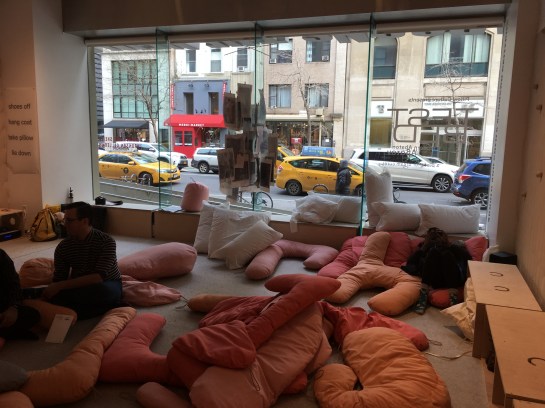
Sleep and the Interior

SATURDAY, MARCH 10, 2018 AT 4:30 PM to 6:00 PM

Aronson Gallery 66 Fifth Avenue, New York 10011

IMG_1322


From the bedroom to the psychiatrist’s couch, Pillow Culture presents an evening of dialogue exploring notions of “interior” with philosopher John Paul Ricco and psychiatrist Nathan Kravitz.

Organizers:

Natalie Fizer & Emily Stevenson co-founders of Pillow Culture

Speakers:

John Paul Ricco works on social-sexual ethics & aesthetics at the intersection of contemporary art and architecture, queer theory, and continental philosophy. He is the author of The Logic of the Lure (University of Chicago Press, 2003)—the first queer theory monograph in art history—and The Decision Between Us: art & ethics in the time of scenes (Chicago, 2014). He is currently completing a third book, The Intimacy of the Outside. He has edited issues of Parallax and Journal of Visual Culture, and recent essays have been included in Nancy and the Political, Porn Archives, and W.J.T. Mitchell’s Image Theory; as well as in the journals Qui Parle, Culture Machine, Scapegoat, Feedback, World Picture, and L’Esprit Créateur. His essay, “Drool: Liquid Fore-speech of the Fore-scene,” addresses the rarity of excessive and inassimilable forms of pre-verbal liquidity in continental philosophy from Descartes to Nancy. He is Professor of Contemporary Art, Visual Culture and Comparative Literature at the University of Toronto, where he is currently leading a Research Working Group on “Sex, Ethics and Publics.”  www.utm.utoronto.ca/dvs/john-paul-ricco

Nathan Kravis is Clinical Professor of Psychiatry at Weill Cornell Medical College where he is also Associate Director of the DeWitt Wallace Institute for the History of Psychiatry at Cornell, Training and Supervising Analyst at the Columbia University Center for Psychoanalytic Training and Research, and an Associate Editor of the Journal of the American Psychoanalytic Association. He is the author of On the Couch: A Repressed History of the Analytic Couch from Plato to Freud (MIT Press, 2017). Other recent publications include “The Analyst’s Hatred of Analysis” (Psychoanalytic Quarterly, 2013) and “Fuck Redux” (Journal of the American Psychoanalytic Association, 2013). His latest paper, “The Googled and Googling Analyst,” appeared in the October 2017 issue of the Journal of the American Psychoanalytic Association. He is the recipient of teaching awards from the psychiatry residents at Cornell and psychoanalytic candidates at Columbia, the George E. Daniels Merit Award of the Association for Psychoanalytic Medicine (2011), and the George S. Goldman Award of the Columbia Psychoanalytic Center (2015). He delivered the Liebert Memorial Award Lecture in New York in 2015. He has been in private practice in New York since 1987.

Hosted by MFA Interior Design, Parsons, The New School.


“On Queer Forgiveness,” the paper that I recently presented at “The Ethics of Apology” conference, held at the Centre for Ethics, University of Toronto, October 20, 2017, is now available at the online, open-access journal C4E: Perspectives on Ethics.

05_10_kniefall_brandt-banner-copy-2

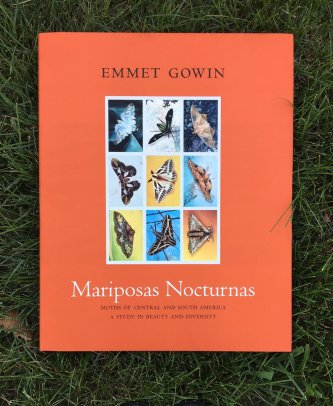
Emmet Gowin, Mariposas Nocturnas (book cover)

Below is a paper that I presented at a workshop on capitalism and photography held at the University of Toronto, September 15-16, 2017. I will be working on it for the next several months, in preparation for it being included in a collection of essays on Capitalism and the Camera that is being edited by Kevin Coleman, Daniel James, and Ariella Azoulay. Comments and suggestions are welcomed.

For the past 15 years, the American photographer Emmet Gowin has been photographing more than a thousand species of moths on visits to Bolivia, Brazil, Ecuador, French Guiana, and Panama. This month, Princeton University Press will publish a monograph of these images, titled, Mariposas Nocturnas: Moths of Central and South America, A Study in Beauty and Diversity. Since the book has yet to be released, and I did not have the opportunity to see the recent exhibition of these images at the Morgan Library, I am operating at the moment with a bit of a deficit. I was recently drawn to this photography project while exploring the figure of the moth in modern philosophy and criticism; a series of references that ranges from Part Two of Heidegger’s 1929-30 lecture course on The Fundamental Concepts of Metaphysics and his discussion of the animal as being “poor in world,” to Guy Debord’s last film (1978), the title of which, In girum imus note et consumimur igni, is the ancient phrase that, as a palindrome, reads both forward and back: “We turn in the night, consumed by fire.” Finally, to Giorgio Agamben who, in his book The Open: Man and Animal (2002), and more recently in The Use of Bodies (2014), considers Heidegger and Agamben’s uses of the figure of the moth as an emblem of captivation that is, respectively, either a non-revelatory instinctual drive or as being completely consumed by the bright light of spectacle.

Within the context of our discussion of capitalism and photography, and the specific attention that I want to direct to issues of the Anthropocene and Capitalocene theses, the moth is not only an emblematic figure for a desirous attraction that proves to be suicidal, but also of an immolation in which a body sets itself on fire in a sacrificial activist gesture of protest and refusal. As such, the moth functions as an “indicator species,” that, precisely in its beauty and diversity (taking terms from the subtitle of Gowin’s new book), not only signals the loss of those very two things (an aesthetics of bio-diversity?) due to epic and epochal species extinction, but also the auto-immune disorder of the anthropological-biological machine and its own death-drive. Gowin’s photo grids are clear reminders that this anthropological machine and its taxonomies is also an optical machine (that obviously includes photography in all of its various technological permutations and capacities).
At the same time, given that any taxonomy is always also a historiography, and given that every place on a map is also at the same time a moment in history, Gowin’s focus on the moths of Central and South America underlines the fact that the future time of extinction that humanity finds itself living today is unevenly distributed, and that the fatal affects on the global South and the global poor require a politics and ethics that absolutely resists capitalism’s general equivalence of catastrophes, as it also remains committed to a sense of equality derived from the fact of common inequivalence, our incommensurability one to another, which is say, as co-existing—geo-ontologically (to cite Beth Povinelli)—without any single, common measure.


In the phototropism of moths, that is, in their instinctual impulse to fly towards the light, we find an all-too-ready metaphor for that optical drive and its captivation that is photography. The convergence is made all the more material in Gowin’s interest in photographing the moths as living specimens. This involved him luring the insects at night by artificial light and capturing them as they landed on variously coloured surfaces that he had gathered, in many cases from reproductions of works of art by Degas and Matisse and others. It is here that the aporia of the “mariposa nocturna” (the nocturnal moth) is revealed, and thereby, in turn, the phototropic limits of photography itself.


Moths fly by night, hence they are nocturnal. Yet taxonomically classified as such, they are only rendered as epistemological objects in terms of their relation to the light. The light that attracts them and illuminates them. This is their phototropism and it is here that they might be viewed as species emblems or metaphors of photography. Photo-ontology of life, in which light = life. Light as dis-inhibitor ultimately proves to be a fatal inhibitor (it is the lure that kills). Gowin reproduces this photo-visual economy, one that, as a photographer he shares with the moths, what we might describe as the “photographic night:” illuminating and capable of capturing an image and producing a taxonomic image of the specimen including in its ornament, colour, pattern—beauty. The ground of the moth is no longer the night, but instead is an image (in many cases here: image reproductions of works of art, themselves being images made by Matisse, Degas and others. The ground of the image = [is always] an image—as this also requires us to re-conceptualize what is meant by “ground”). So without the nocturnal darkness of the night, and without the light of the flame that consumes, do we still have mariposas nocturnal? Or do we instead have the conservation, via photography, of the illuminated night—what I am calling the photographic night?


In taking up the example of the moth, Heidegger defines its distinction as light-seeking in terms of its attraction not to the intensity of the light but to its magnitude. In other words, not the light source itself, but the surface that it illuminates. It is in this way, explains Heidegger, that the moth is attracted not to the brightness of the moon but to the large surfaces that the moonlight illuminates—the shine and shimmer of its surface effects. According to Heidegger, moths fly into the flame because the candlelight does not illuminate a large surface (the attractor or dis-inhibitor for the moth), and so moths fall victim to the source of light itself, as though bereft of a surface attraction and a place to land.


But is there a way to think existence otherwise than in terms of this relational economy and its violent metaphysics of presence—of enclosure and disclosure, concealing and dis-concealing? Perhaps somewhat curiously, given commonly held assumptions, Heidegger enables us to think otherwise in this regard, and in part largely against himself and the distinctions that he argued exist between the animal and the human. It requires another way of thinking about (visual, corporeal) captivation in terms of a non-revaltory openness and intimate rapport with the outside, a conceptualization that might be located (at least partially) in Heidegger’s take on animal captivation. For Heidegger, the animal, in its driven directed-ness to- and toward, is neither ontologically tied to itself nor to its environment, but is said to be suspended. This suspension of the animal means that the animal is neither closed off from its environment, (note: Heidegger will not bestow upon the animal the sense of a world), nor disclosed as a presence in the world, but is instead “an openness for…” (Metaphysics, 248) and a being taken by…


As Agamben notes, “The difficulty arises here from the fact that the mode of being that must be grasped is neither disclosed nor closed off, so that being in relation with it cannot properly be defined as a true relationship, as a having to do with” (Open, 54). The animal is open in or to a non-disconcealment, it is exposed to the outside in a non-revelatory (i.e. non-metaphysical) way, yet that nonetheless forcefully disrupts the creature in its every fibre.


In following Heidegger when he writes that, “not-having-to-do-with…presupposes a being open…on the basis of this possession it [the animal] can do without, be poor, be determined in its being by poverty. But because this having is a being-open…the possession of being open is a not-having” we might discern not only that “the animal’s poverty in world…is nonetheless a kind of wealth” as Heidegger notes (Metaphysics, 255), but also how animal captivation can equip us to think about a non-appropriating rapport with the world, in which not having per se (“highest poverty” of the Franciscan order, for instance), is (again) the way to think otherwise about our “having to do with” the world, including perhaps to the question, “what is to be done?”


In a text with that title, originally given as a lecture in 2012, Jean-Luc Nancy points out that, “by making ‘having to do’ (devoir faire) into a question, [our history] freed it from a given order of ends [praxis without telos, production; hence beyond Kant and Marx]; by coming up with ends prescribed by an entire humanity [e.g. Anthropocene thesis], it designated the horizon of an ultimate production [eco-modernist human-techno sustainability].” However as Nancy immediately goes on to say, “that horizon has changed with the perspectives of destruction and auto-destruction: we are no longer facing a sole end with another side that brings damage, or disasters, and at times the indefinite proliferation of new ends.” In other words, at a time when human history and its modern capitalist manifestation is recognized as indelibly inscribed into the very geologic matter of the Earth, living the future time of extinction means to be bereft of one’s dis-inhibitors and inhibitors. “Completions exceed themselves; entelechies resemble entropies” as Nancy concludes (Diacritics, 2014, 42.2: 112).


Beyond Heidegger, poverty in the world is a direct result of a humanity that is poor in world (ecological, but more broadly as living in a world in which it is difficult to make sense). In his very final course on “The Beast and the Sovereign,” Derrida claimed that there is no world, only islands. But as we have known all-too-well for some time now (and well before Hurricane Irma tore through the Caribbean), there are no more islands either. Their shores have been inundated, the rising ocean levels having tempestuously reclaimed them or as we have recently seen, their shores have been extended as the hurricane takes the water out of the ocean.


Perhaps in light of this, we can better understand what Nancy means, when, in arguing that we must think doing apart from project, intention, principle or goal and author, he quotes Celan who called for “doing without a shoreline.” Nancy interprets this as “an adventurous and risk-taking boundless doing” and derives an image from the poem itself, the last lien of which calls that doing “a shimmer from the ground” (Schimmer aus dem Grund) (Nancy, 113). A shimmer that, as Nancy says, “arises from a depth that remains endless” (Nancy, 114).


It is this shimmer that I want to think further about, in terms of photography and the night. A shimmer that is to be understood less as an image or even as the surface effects of a cast light, than according to the very precise terms provided by the poem. That is: as a “shimmer from the ground.” Meaning, I want to suggest, as humus (“soil, earth, dirt,” from which the word “human” is derived). The depth of this ground from which this shimmer comes to shine, is neither the shine of solar nor lunar illumination, but what might be described as a nocturnal depth. Not the night that is opposite the day and its light, but the geological and therefore posthumous night of the humus or ground. It is Blanchot’s “other night” and Benjamin’s “saved night.” As concerns the latter, Agamben writes that, “The salvation that is at issue here does not concern something that has been lost and must be found again…it concerns, rather, the lost and the forgotten as such—that is, something unsavable” (Open, 82)—e.g. neither the moth nor the light, but the nocturnal.


Here we are confronted with that which is neither human nor animal, existing outside of bios and hence perhaps also the bio-political. It is what Eugene Thacker has recently come to refer to as “dark life,” as that which is not only beyond the two dichotomies of human/machine and human/animal, but that occupies a zone of indistinction between the living and the nonliving. It is for example, Desulfotomaculum, the bacterium that, as Thacker explains, “thrives in the darkness of radioactive rocks” existing without the benefit or need of photosynthesis. Such extremophiles (organisms that can survive extreme conditions of heat, cold, acidity, pressure, radioactivity, and darkness—meaning: at the outer reaches of what is needed to sustain life) put into question the equation between light and life, and by “feeding off of the absence of light—are an anomaly for biological science.” In other words, they exist at the limits of the optical anthro-bio-photo-machine by which life is identified and known. Inhabiting the soil, water, geothermal run-off and insect intestines, desulfotomaculum use things like dead moths to anaerobically metabolize energy, and thereby generated a posthumous shimmer from the humus.


Now, since our bodies are at least 50% bacterial matter, and since it is clear that the ability of such matter to subsist in the dark and thrive on non-living matter—including the half-lives of the radioactive fluorocarbons that organic/biological life has produced—it is equally clear that it is such anomalous forms of existence will survive the current sixth great extinction. Therefore the Desulfotomaculum, meaning the utter absence of light, suggest the need to think in terms of a desulfotography, which is not necessarily the absence of photography (indeed, these bacteria have themselves been photographed). Instead, it effects a re-thinking of life in terms of that which in-appropriable and in fact unsavable. It thus might be a way for us to question the photographic and its ontological need for light, and how that defines photography’s relation to the living and the nonliving. What might be photography’s place in the field of critical life studies, for which the concept of life is itself anomalous and in its material existence is understood to have been always already posthumous? Simply put: might photography have a relation to the unsavable, the unimaginable and thus perhaps exist or survive without image?