Patterson Scarlett, Broome Street at Broadway (Rooftop Elevator Room), 2011, from the book, Petite Mort: Recollections of a Queer Public.

I am a contributing author to Petite Mort: Recollections of a Queer Public.
Click on this link for additional information and a free PDF of this fantastic new book.
http://www.art-agenda.com/shows/forever-today-inc-presents-petite-mort-recollections-of-a-queer-public/

Public sex[*] happens. The simplicity, brevity, honesty and candor of this proposition, is, I contend, one of the most principal ways in which public sex matters. It matters because it happens, and it happens because it matters. This is no small thing. It still happens and matters, even now, after so many attempts to insure that it no longer does. Public sex is resilient and persistent, and its temporal-historical stamina lies—in large part—in its geo-spatial anonymity, itinerancy, imperceptibility and illegality.  In contemplating my response to the editors’ query, I considered the possibility of simply supplying them with a list of all of the places where I have had public sex (necessarily non-exhaustive due to the innumerable number of places over the years, as well as the limits of memory and the evanescent residuality of the encounters that it would retrace).

But as I thought back to these remembered incidents, I found it easy to recollect and draw out images of these scenes, yet nearly impossible in most instances to locate with any kind of cartographic accuracy the exact name or address of these particular spots—less punctuated locations than elliptical lines—easily returned to in memory or in actuality, yet difficult to nominally cite in a list. Herein lies the other principal way in which public sex matters: where it happens is without adequate or appropriate address. Less a place per se, than it is a non-appropriating taking place, public sex is the erotic/libidinal/desirous and pleasure-filled happening and coming together of two or more bodies in the pure exhilaration of this singular shared encounter with the space of their separation.

This text will appear in, Petite Mort: Recollections of a Queer Public, edited by Carlos Motta and Joshua Lubin-Levy, forthcoming, September 2011. The project will also include an exhibition and series of public programs at Forever & Today, Inc. (www.foreverandtoday.org) in September 2011. For more information on the project, go to: http://www.unitedstatesartists.org/project/petite_mort_recollections_of_a_queer_public


[*] Or is it to be written: Public Sex (the difference being a matter of erring on the side of the adjectival or the eidetic)?

5 January 2011

Lecture: Hides, Knots & Other Frayed Edges: Sex & Ethics in the Classroom

12 January

Philosophy on the Scene I

  • Aristotle, Poetics, in, The Basic Works of Aristotle, edited by Richard McKeon, The Modern Library, 2001, pp. 1454-1487.
  • Jean-Luc Nancy & Philippe Lacoue-Labarthe, “Scene: an exchange of letters” in Beyond Representation: philosophy and poetic imagination, edited by Richard Elridge, Cambridge, 1996, pp. 273-301.
  • Philippe Lacoue-Labarthe, “Stagings of Mimesis: an interview,” Angelaki, volume 8, number 2, August 2003, pp. 55-72.
  • Jacques Derrida, “The Theorem and the Theater,” and “The Supplement of (at) The Origin“ in Of Grammatology, Johns Hopkins, (1967/1976), pp. 302-316.
  • Additional Reading: Philippe Lacoue-Labarthe, “The Scene is Primal” in The Subject of Philosophy, pp. 99-115.

19 January

Theatrum Philosophicum

  • Walter Benjamin, “The Right to Use Force” (1921), and “Critique of Violence” (1921) in Selected Writings, volume 1, Harvard, 1996, pp. 231-234 and 236-252.
  • Jacques Derrida, “Force of Law: The ‘Mystical Foundation of Authority’” in Acts of Religion, Routledge, 2002, pp. 230-298.
  • Nancy, “L’Intrus,” CR: The New Centennial Review, volume 2, number 3, pp. 1-14.
  • Additional Readings:
  • Antonin Artaud, “Theater of Cruelty.” and “Here-lies,” in Selected Writings, Farrar, Straus, Giroux, 1976, pp. 242-239, and 540-551.
  • Jacques Derrida, “La parole soufflé,” and “Theater of Cruelty and the Closure of Representation” in Writing and Difference, University of Chicago, 1978, pp. 169-195, and 232-250.

26 January

Camp/Ground (cruising, intrusion) (Bio-political)

  • Tim Dean, Unlimited Intimacy: Reflections on the Subculture of Barebacking, University of Chicago, 2009.
  • Guy Hocquenghem, The Screwball Asses, Semiotext(e), 2010.
  • Michel Foucault, “Lives of Infamous Men” in Essential Works of Michel Foucault, 1954-1984, volume 3, Power, The New Press, 2000, pp. 157-175.
  • Additional Readings:
  • Dorian Stuber, “Patient Zero? Illness and Vulnerability in Todd Haynes’ [Safe],” Parallax, volume 11, number 2, April-June 2005, pp. 81-92.
  • Ricco, The Logic of the Lure, University of Chicago, 2002.

2 February

Primal (drive, pleasure, death, bed, bedroom) (Psychological)

  • Freud, Three Essays on the Theory of Sexuality (1905).
  • Jean-Luc Nancy, “In Statu Nascendi” in The Birth to Presence, Stanford University, 1993, pp. 211-233.
  • Maurice Blanchot (A primal scene?) in The Writing of the Disaster, University of Nebraska, (1980/1986), p. 72.
  • Lee Edelman, “The Future is Kid Stuff” in No Future: Queer Theory and the Death Drive, Duke University, 2004, pp. 1-31.
  • Tim Dean, “An Impossible Embrace: Queerness, Futurity, and the Death Drive” in A Time for the Humanities: Futurity and the Limits of Autonomy, edited by Bono, Dean and Ziarek, Fordham University, 2008, pp. 122-140.

9 February: CLASS WILL NOT MEET THIS WEEK DUE TO CAA CONFERENCE IN NYC

16 February

Things (commodity, fetish, exchange, offering, sharing) (Political Economy)

  • Mario Perniola, The Sex Appeal of Inorganic, Continuum, (2000/2004).
  • Karl Marx, Collected Works, volume 1 (and 36).
  • Jean-Luc Nancy, “The Insufficiency of ‘Values’ and Necessity of ‘Sense’” in Journal for Cultural Research, volume 9, number 4, October 2005. Pp. 437-441.
  • Jean-Luc Nancy, “The Two Secrets of the Fetish” in Diacritics, volume 31, number 2, Summer 2001, pp. 3-8.
  • Additional Reading: William Haver, “Really Bad Infinites: Queer’s Honour and the Pornographic Life” in Parallax, volume 5, number 4, 1999, pp. 9-21.

23 February: NO CLASS, READING WEEK

2 March

Primal (body, around) (Psyche)

  • Jean-Luc Nancy, “Psyche,” in The Birth to Presence, Stanford University, 1993, p. 393.
  • Jean-Luc Nancy, Corpus, Fordham University, (2006/2008).

9 March

Emptying (loss, withdrawal, finitude) (A-Theology)

  • Roland Barthes, Camera Lucida, Farrar, Straus, Giroux, 1981.
  • Jean-Luc Nancy, “An Exempting from Sense,” in Dis-Enclosure: The Deconstruction of Christianity, Fordham University, 2008.

16 March

Emptying (writing, erasing, arche-violence, shared finitude) (Aporetic Aesthetics)

  • Jacques Derrida, “Freud and the Scene of Writing,” in Writing and Difference, University of Chicago, 1978, pp. 196-231.
  • Ricco, “Name No One Man,” in Parallax, volume 11, number 2, April-June 2005, pp. 93-103.

23 March

Preparation for the Colloquium

30 March

Graduate Student Colloquium on Queer Visuality, Sexuality and Theory

Department of Visual Studies, UTM

Keynote Speaker: Prof. Tim Dean, Humanities Institute and Department of English, University at Buffalo, NY.

OPEN SPACE.

Click on the link in order to be directed to a video of my friend Stephen Hartman’s recent performance-lecture at SFMOMA, on Felix Gonzalez-Torres’ Untitled (Golden), 1996.

This is about the way in which bullying (not “teasing,” which inevitably sounds—that carries the sense of being—all too playful and almost endearing for what I am trying to talk about here), is increasingly part of a deliberate and systematic effort to exterminate the lives, not just of single individuals who are typically its direct target, but an entire generation of contemporary queer youth. This post is about the very real brutality that drives what I propose to think of as a two-fold genocidal image of queer futurity.

Forcibly and relentlessly imposed upon the psychic imagination of queer youth, the genocidal futurity that drives bullying takes the image-form of  a future that is never free of ridicule, denigration, debasement, humiliation, abandonment. It is a matter of ceaselessly creating the sense of absolute isolation that comes from being constantly ignored and incessantly scrutinized, of being rendered invisible and made to appear as the only thing visible, of being made to feel as though neither the shelter of the private nor the solidarity of the public can provide anything but the most false of assurances. In the end, of being made to feel that there is no way out, no one to turn to, in a word: no future. On the other side, in which genocidal futurity is forcibly and relentlessly imposed by the psychic imagination of societal homophobia, it takes the image-form of a future that is, once and for all, free of the difference, anti-normative, affirmative, courageous, and determined psychic-sexual-social power that has been the source of queer life for decades. It is the phobic imagination of a future with no queers.

It is precisely in this two-fold and double sense of the extermination  of futurity: of queer youth and of a future without queers, that the current and deeply pervasive campaign (and it is a concerted, endorsed, and insidiously coordinated effort) must be understood as the genocide of queer futurity.

When a society such as ours, today, manages to find ways to make its victims kill themselves, it has achieved a degree of genocidal evil that simply has not been known up until now. We can no longer say—or not simply and solely—when a queer kid takes his or her own life, that he/she has committed suicide. For while the life that has ended was singularly theirs, the death of self was not one for which they are solely responsible.* Just as much as we can speak in terms of “suicide-by-proxy,” in order to categorize the murderously warped psyche of the self-hating serial killer, I propose that we speak in terms of “genocide-by-proxy,” in order to identify a societal hatred and genocidal extermination that has become so internalized that the subject of vilification kills him/herself, not simply because of the harm that has been endured in the past, but also and perhaps even more so, because he/she is forced to envision the endless perpetuation of this brutality as the kind of life that they will endlessly endure in the future. Which is to say that the agonizing temporal relation of these deaths cannot be understood as wholly of the past, tied to prior suffering (its incidents as well as the false “lull” between attacks, and irregardless of regularity/irregularity). No. For in confronting the reality of these deaths, I think we face something much more troubling about them. Which is the way in which they can be understood as responses to suffering that has not yet happened, that is still to-come, and that in its guarantee, delivers a blow that is felt as strongly as the bludgeon that was the latest and yet in no way is felt to be the last.

Of course death, by definition, is always the preemptive appropriation of the future, and when that already violent appropriation is brutally imposed by others onto others it becomes murder, and when that murder takes the form of exterminating an entire people, in this case of a generation, it is genocide. Therefore, when the target of the genocide is young queer people, as it is here, it must be understood as the genocide of queer futurity. And when the only image that young queers are made to envision is one of past brutality extending infinitely into the future, this too must be understood as the genocide of queer futurity. So I’ll end with something that I stated above: When a society such as ours, today, manages to find ways to make the victims of its violence kill themselves, it has achieved a degree of genocidal evil that is simply unprecedented in its effective obfuscation of actual responsibility and its triggering of an auto-immune response. It cannot get any worse than that. Or can it? And is this not the reason to remain committed to the sense that it gets better, precisely as a future without guarantee?

*For a discussion of the ways in which this argument corresponds with some of the most recent psychological theories of the motivational factors of suicide (including the work of Roy Baumeister) see Jesse Bering’s blog “Bering in Mind,”on the Scientific American web site: http://www.scientificamerican.com/blog/bering-in-mind-blog/. Specifically when he writes: “Psychodynamic theorists often postulate that suicidal guilt seeks punishment, and thus suicide is a sort of self-execution. But Baumeister’s theory largely rejects this interpretation; rather, in his model, the appeal of suicide is loss of consciousness, and thus the end of psychological pain being experienced. And since cognitive therapy isn’t easily available—or seen as achievable—by most suicidal people, that leaves only three ways to escape this painful self-awareness: drugs, sleep and death. And of these, only death, nature’s great anesthesia, offers a permanent fix.”

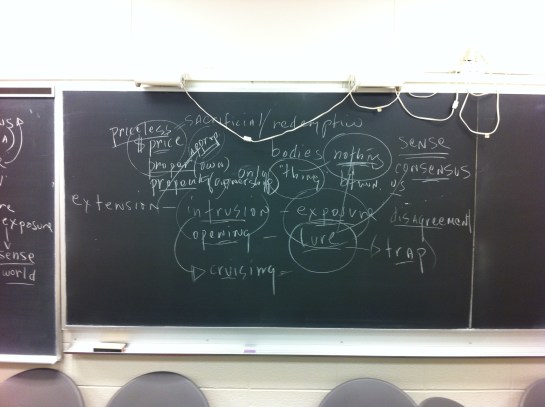
Here’s a description of the graduate seminar that I will teach next term, Spring 2011, in the Department of Art, at the University of Toronto. Based upon a major aspect of my current research, it’s an attempt to create pedagogical conditions in which a performative rather than a representational logic becomes the principle operative for advanced and collaborative thinking and writing, in which “queer theory” is a discursive space existing without overly-defined foundation or horizon. The pretense, is that this stands the chance of functioning as a space of invention, at a time when I have never been less certain of the direction (and sense) of queer theory today. The conceit is to allow this very uncertainty to serve as a (blind) guide.

Queer Sexuality, Visuality, & Theory

Focus: “Scenes of Exposure”

The work of this course is neither a cataloging of various mise en scènes (e.g. the body, identity, shame), nor a questioning of fundamental concepts (e.g. trans-), nor even a critique of internecine discussions and debates (e.g. futurity), but a matter of bringing to the fore—through a certain performative thinking and writing—the fore-scene of language, pleasure, and finite existence.

Performative: including but far from being limited to queer theories of performativity (Butler, Phelan); so also the performative—and hence non-representational—staging of a scene of thought (related yet distinct from what goes by the name of “theory”) that might be queer—and hence non-identitarian.

Praxis: the workless work and inoperativity of aesthetics of finitude without end (non-redemptive); which is to stay that we will not only study but also give ourselves over to a form-of-work that is without guiding principle or theoretical concept, and free of the imperative to pursue a project and produce knowledge (as interpretation), or sensation (as poiesis), or mediation (as technocratic utility).

Technique and Ground: of aesthetics of finitude without end, is one of withdrawal, retreat, loss, vulnerability, and death. Forces of exposure (ontological, existential, but perhaps also epistemological yet perhaps not phenomenological), that open and call to be sustained as the political and ethical space of decision and freedom. This is the potential ground of our co-existence.

So not the archival, historicist, and empirical philosophical question of “what remains” of finitude, but the performative, inassimilable, and unavowable philosophical question of “what is happening” in the shared sense of finitude here, now?* We can advance Nancy’s claim that the time of modernity is followed by the time of things, and say that the time of things has now been eclipsed by the time of scenes.

Five “scenes of exposure”

Primal—drives, fore-pleasure, death, & empty beds (Psycho-corporeal)

Things—sharing, exchange, secret offerings, commodity & fetish (Political Economic)

Ground—cruising, desert, islands, cave, camp, intrusion (Bio-geo-political)

Around—performative, envelope, halo, cave (Architectural)

Emptying—kenosis, loss, withdrawal, erasure, winks & steps (A-Theological)

Authors: Sigmund Freud, Tim Dean, Jean-Luc Nancy, William Haver, Guy Hoquenghem, Samuel Delany, Eve Sedgwick, Lauren Berlant, Georges Bataille, Maurice Blanchot, Roland Barthes, Jean Genet, Michel Foucault, Gilles Deleuze, Jacques Derrida, Mario Perniola, and, of course, Aristotle.


* For the original formulation of this methodological distinction, see Foucault, “The History of Sexuality: Interview,” (1977) in which he states: “To put it in a form as naïve as a children’s story, I’d say that for a long time the question of philosophy was: ‘In this world where everything dies, what remains? What are we, we who must die, with respect to what remains? It seems to me that since the nineteenth century, philosophy has moved steadily closer to the question: ‘What is happening now, and what are we, we who are perhaps nothing apart from what is happening now?’…That is why philosophy today is entirely political and entirely historical.”

“What if we neither began nor ended with identity?…what if we stopped looking for either a method or an object for our research and theorizing? What if we were no longer impressed by permanence, longevity, and a certain museological artifactuality rendered as evidence? What if then, in our investigations of sex and space, we did not rely upon visual-based modes of knowledge production that are intended to generate statistical mappings and models of community (i.e. presupposed zones of identity)? In the end, what if we were to substitute something like a cruising ground for an epistemological ground?”
—Ricco, The Logic of the Lure

I am Associate Professor of Contemporary Art, Media Theory, and Criticism in the Department of Visual Studies (DVS), at the University of Toronto Mississauga. My primary graduate appointment is in the Centre for Comparative Literature, on the St. George campus of the University of Toronto, where I teach graduate seminars and supervise dissertations in the fields of Continental Philosophy, Queer Theory, and Visual Culture.

I am also an Affiliated Graduate Faculty member in the Department of Art (Art History); the Cinema Studies Institute; the Centre for the Study of the United States; and the Sexual Diversity Studies Program—all at the University of Toronto. I joined the U of T Faculty in 2006, having previously taught in the Department of Art at the University of Nevada, Las Vegas; in the School of Art at Texas Tech University; the Department of Art History at the School of the Art Institute of Chicago; and at Cornell University as a Fellow at The Society for the Humanities.


Note: go to the Bio link on the homepage of this  blog for a more complete and up-to-date biography. 

Education

  • Ph.D. Department of Art History, University of Chicago (1998).
  • A.M. Department of Art History, University of Chicago (1991).
  • B.A. Department of Fine Arts (Art History), New York University (1988).

E-mail: john.ricco@utoronto.ca

Faculty Web Page: http://www.utm.utoronto.ca/dvs/john-paul-ricco

For copies of articles, reviews, talks and other publications and presentations, go to my page at Academia.edu: http://utoronto.academia.edu/JohnRicco