Introduction
Part I: Name No One
Chapter 1: Name No One Man
Chapter 2: Name No One Name
Part II: Naked
Chapter 3: Naked Sharing
Chapter 4: Naked Image
Part III: Neutral and Unbecoming
Chapter 5: Neutral Mourning
Chapter 6: Unbecoming Community
Introduction
Part I: Name No One
Chapter 1: Name No One Man
Chapter 2: Name No One Name
Part II: Naked
Chapter 3: Naked Sharing
Chapter 4: Naked Image
Part III: Neutral and Unbecoming
Chapter 5: Neutral Mourning
Chapter 6: Unbecoming Community
The difference is that between the anonymity of the creature deprived of destiny and the hero who presides over the destiny to the point of becoming his own fate.
Marguerite Duras contrasting Georges Bataille and Jean Genet, and the figures in their works, respectively. Duras, “On Georges Bataille,” Outside: Selected Writings. Boston: Beacon Press, 1986.
On March 7 & 8, 2013 I will give a lecture and lead a seminar based upon my current book project: Non-consensual futures: pornographic faith and the economy of the eve. I am honored by the invitation extended by Professor Deborah Harter and her graduate students in the Mellon Seminar:
Frames of the Beautiful, the Criminal, and the Mad: The Art and the Science of Excess
Faculty leader: Deborah Harter, associate professor of French studies
Student participants: Sarah Seewoester Cain (linguistics), Linda Ceriello (religious studies), Kristen Ray (English), Nathaniel Vlachos (anthropology), and Rachel Schneider Vlachos (religious studies).
Seminar Description
Reflecting on representations of the “excessive” in science and in art of the modern period – madness, genius, criminal, eccentric, beautiful, and pathological – this seminar welcomes students from all fields in the humanities and social sciences. We will consider the aesthetic with scientific, the ethical with the historical, and play havoc with all usual boundaries of disciplines, period, and genre.
Keynote Speaker & Call for Papers
I am one of the Keynote Speakers at this conference on Aesthetics, in Oslo at the end of May. Click on the blue text link above to go to the conference web site.
Gesture: 2013 Annual Conference of the Nordic Society for Aesthetics
The Department of Philosophy, Classics, History of Arts and Ideas welcome you to the 2013 Annual Conference of the Nordic Society for Aesthetics. The theme of the conference is “Gesture” and it will take place at the University of Oslo from May 30 – June 1, (Thursday noon through Saturday evening).
Tid og sted: 30. mai. 2013 – 1. jun. 2013, Georg Morgenstiernes hus
Legg til i kalender
The use of gesticulation has always been a means by which human beings have expressed themselves. Being bodily rather than conceptual, its logos lie outside language. Within the fields of art and aesthetics, gesture implies an opening process as a distinctive way of cognition as well as an approach to the particular qualities of artworks.
While Jean-François Lyotard associates the artwork with the processuality of gesture, Roland Barthes thinks gesture in terms of the event, and its production of effects, thus seeing gesture at once as a part of the artwork and as transgressing the work “itself”.
For Theodor Adorno the gestural in music was a central topic and Ludwig Wittgenstein spoke of architecture as a gesture. Part of our aesthetic experience and of our “answer” to artworks is always gestural.
Keynote speakers:
Gottfried Boehm, Professor of Modern Art History at Basel University: “What reveals itself. On Gesture and Image”
Julian Johnson, professor, Department of Music, Royal Holloway, University of London: “The particularity of musical gesture”
Rainer Nägele, Alfred C & Martha F Mohr Professor of Germanic Languages & Literature, Professor of Classics & Comparative Literature, Yale University: “Caesura: The Transformation of Gesticulation into the language of Gesture (Brecht, Artaud and Benjamin)”
Lilian Munk Rösing, Department of Arts and Cultural Studies, Copenhagen University: “Gesture, Colour, and Affect”
John Paul Ricco, Associate professor, Comparative Literature & Visual Studies University of Toronto: “The Separated Gesture or, The Inoperative Praxis of the Already-Unmade”
The conference calls for papers on both contemporary and historical issues: suggested topics of interest would include questions related to aesthetic experience in general as well as visual art, architecture, music, and literature.
Abstract proposals of no more than 200 words should be sent before February 15 to Bente Larsen, bente.larsen@ifikk.uio.no
N.B. Participation without paper is welcome as well – however we kindly ask that you register your participation. PhD students are strongly encouraged to submit a proposal.
the comings and goings of a child playing beside his mother, leaving her, returning to her with a pebble, a piece of string, and thereby tracing around a calm center a whole locus of play within which the pebble, the string come to matter less than the enthusiastic giving of them
—Roland Barthes, “Lecture in Inauguration of the Chair of Literary Semiology, Collège de France, January 7, 1977.”
(An abstract of an essay for a special issue on “Bodily Fluids” of the journal inter/Alia, edited by Kamillea Aghtan, Michael O’Rourke, and Karin Sellberg).
It is a preverbal stream that deposits on the pillow a barely visible trace, as if a little saliva had leaked out of that sleeping mouth.
—Jean-Luc Nancy
In a chapter titled “Self from Absence to Self” of his recent essay, The Fall of Sleep, Jean-Luc Nancy draws upon the image of a little saliva leaking out of a sleeper’s mouth in order to analogise the withdrawal of self from I, into self. A fall into self that is not so much the enunciative “I am” of either a waking consciousness or dreaming unconsciousness, but the excessive and residual trace of the fall into self that is the fall – or what we might call, the drool – of speech.
Taking its cue from Nancy’s essay, and specifically his image of the barely visible trace deposited on the pillow, my paper will theorise drool as the liquid fore-speech of what I have come to call the fore-scene. The latter, in its own right, draws upon Nancy’s readings of Freud on Vorlust (Fore-lust) as the stage/scene of exposure and the spacing of the sense of existence as shared-separated. For drool is, as we know, a common liquid metaphor for uncontainable desire. An excessivity that, as formless force and form of the ground, is nothing but the unintelligibility of the fore, “upon” which anything like erotic pleasure (including as its own kind of intelligence) might be possible. In speaking in such terms, I of course also have in mind the base materialism of George Bataille’s definition of the formless and its analogy of the universe to spit.
In this paper I continue my ongoing theoretical meditations on photographic images of the unmade (but not necessarily “empty”) bed (i.e. Felix Gonzalez-Torres’ Untitled Billboard photograph, 1992) as fore-scene of co-existence/co-exposure. Based upon Nancy’s text these images are understood to be images of the impossibility of perceiving, let alone representing, sleep. For if, as Nancy states, sleep “shows itself to itself as this appearance that appears only as non-appearing, as returning all appearing on itself and in itself,” then the image of the unmade bed lies extended there in the aesthetics of retreat, “allowing the waking phenomenologist [the one that we inevitably become in the drive to satisfy our experiential/epistemological curiosity] approaching the bed to perceive nothing but the appearance of its disappearance, the attestation of its retreat” (Fall, 13).
Drool is to the verbal what the empty bed is to the visual, yet as the fall of speech, drool is not a matter of the verbal or the oral but of the “buccal,” as this has been theorised by Nancy and further articulated by Michael O’Rourke. As the liquid fore-speech of the fore-scene/fore-lust, we might say that drool is the pre-cum of a buccal murmur and groan. With the lightest of touches, as though with the tap of a finger, this spit is extended, and in its extension traces the tenuous yet resiliently tensile line of the “with” of our shared existence. As though at that sleeping mouth a salvific path was somehow opened up, and in that fall of speech one hears the “with”, the “substance” of which is something like ex-gested spit, or drool.
“You cannot deconstruct something that belongs to someone else. If I deconstruct something of someone else’s, I simply break it.” (Retreating Religion: Deconstructing Christianity with Jean-Luc Nancy; Fordham, 2012, 316).
I am honored to serve as one of the jurors for this art prize. Checkout the work of the 10 nominated artists. Really excellent all around.
http://www.artfloor.com/ebn.ebn?pid=561
MasterCard France confirms its involvement in Contemporary Art by appointing ArtFloor to organize the second edition of the Platinum MasterCard Prize. The 2011 edition of the Platinum MasterCard prize for Contemporary Art recognizes the talent of a contemporary visual artist and the involvement of the gallery that promotes his/her work internationally. The recipient is awarded a 12,000 euro cash-prize.
The prize is given to a living artist represented by a gallery located in France. The application is submitted by the artist and its gallery. All fields of the visual arts, from painting and sculpture to installation, video and new media are eligible.
The call for applications will end on December 15, 2011. ArtFloor will then proceed to the selection of the 10 nominees that will be submitted to the Jury.
The Jury, composed of international members from the Art World will vote and announce the winner next January. The 2010 edition of the prize was presided by Maître Pierre Cornette de Saint-Cyr and awarded to Stephan Laplanche in Paris.
Abstract of a Paper in-progress
The first half of my paper is a reading of texts by French philosopher Jean-Luc Nancy on religion, the divine and the sacred, art and aesthetics, and specifically on the attention that he has given to questions of place within philosophical and theological discourses. For as early as 1985 in his essay “Of Divine Places,” Nancy has argued that the question of God is not (or no longer) a question of being, essence, and presence (what is God?) nor of temporality, messianicity, and the infinite (when is God?), but a question of place and distinct location (where is God?), and what Nancy has more recently named “dis-enclosure.”
Given that in the philosophical and religious history of the West, the gods and God have always been departing, a divine place is not a taking place but a place of withdrawing and retreating (in absconditum). According to Nancy, if there is a divine place, it is at/from the step, less a footprint than a footfall or tread, where the latter is understood to be nothing other than the separated touching of sole and ground. As Nancy writes toward the end of “Divine Wink” (2003): “The step is the divine place, the only one, the place in which the power of the passing manifests and transcends itself” (119). In addition to finding one of its homologies in “wink,” (based upon a reading of Heidegger on “the last god”), the step is, as Nancy explicates via a recourse to etymology, a vestige (vestigium) and as such is the remains of a step, not as image or perhaps even as indexical sign, but in terms of the touch of the step, its operation and its place. The latter used here by Nancy “in the strong sense of the word is always the vestige of a step” (“Vestige of Art,” 98), and hence a divine place.
In the second half of the paper, I turn to the recently opened National 9/11 Memorial at Ground Zero in lower Manhattan, in order to ask whether its deep recesses—exactly coinciding topographically with the two so-called “footprints” of the World Trade Center towers, might not be understood as a monumental securitization of the site, a hollowing out of the ground to its purported zero degree and that, less as profanation than divinization, renders it as hallowed and perhaps sacred ground, distinct from Nancy’s conception of divine place.
Finally, by drawing together Nancy’s recent writing on the empty tomb as distinct from the temple/cave, and the question that Derrida posed at the end of his 1968 lecture “The Ends of Man:” “Is there an economy of the eve?” I speculate towards a sense of spacing, aesthetics and archi-ethics as the withdrawal and retreat of architectural limits or the eves of the temple and the oikos (perhaps neither to nor from the temple but at and on its eve, that is to say, its threshold, opening, offering and infinitely finite access). And of temporality less in its coming than its passing by, like the step of the Gods, the departed, and perhaps even the ones who, in stepping from the heights of the towers on that September morning, caused so many of us witnesses to exclaim “my god!”
Following Nancy, I contend that this is the utterance of freedom as freedom unto nothing—nothing but the withdrawal and retreat from absolute destination or resurrectional return. This is at once the freedom of those who stepped out from the precipitous edge of the towers, and the utterance of those looking up at the sky and at the instant of witnessing each body falling. This is what I take it to mean when Nancy writes of “an utterance, and as ‘my’ utterance to the precise degree that it comes to me from the other who, in passing, gives me a sign, and whose Wink I respond to with ‘my god!’—without my having actually to say this word, whose ‘sense’ is to name or rather to mark, to remark, and to exclaim the passing itself and the passing not as a state but as a passerby whom I call to address, having perceived his step and the signal of that step” (“Divine Wink,” 116, original emphasis).
The economy, archi-ethics and aesthetics of the eve that I wish to think and present here, is an attempt to understand how the National 9/11 memorial, rather than staging the “zero mystery” (“Divine Places,” 140) and zero plan at ground zero, is a securitizing of the footprint, which is also to say—with a view of the water that endlessly flows into the memorial’s seemingly bottomless depths: “the baptizing [of] our abysses” (“Divine Places,” 113). Not a temple per se, but like every temple, the memorial is an attempt to guard against the departing, desertion and destitution of this kenosis from being an absolute abandonment in the form of a bare and empty place. For the “temple,” whether Greek, Jewish, Christian or Muslim, monumentalizes destitution and desertion, and provides shelter and protection not from these forces, but for them, in the finite form of architectural enclosure and spatial detention. Indeed it is remarkable to realize that the memorial at Ground Zero can be understood as a condensation of the four figures of the temple, as outlined by Nancy in his essay “The Indestructible:” Greek (contemplation of ruinous destruction and artistic metamorphosis); Jewish (twice destroyed and source of diasporic meaning, the latter in this case perverted for the purposes of waging a global war on terror); Christian (infinite construction, dome and spire, technology contemplating itself); Islamic (heart as black rock, reserved space, impenetrable and indestructible thing). Indeed, as Nancy states, this remains the current four-fold of the world, and with no small sense of regret we might agree with Martin Filler who, in his rave review of the memorial, bestows on Michael Arad, its designer, the status of “one of the signal placemakers of our time” (“A Masterpiece at Ground Zero,” New York Review of Books, October 27, 2011).
Throughout the paper, I will attend to many of the structuring tensions that Nancy’s work has focused on, including what he retains and refuses in notions of the sacred and divine (and how more recently he has thought this difference in terms of the image and the distinct); the difference in earlier work between bare place and bare thing (the latter of which will be theorized as “vestige”); tomb/grotto as opposed to temple/cave; resurrection versus the raising of the body; the ob-scene and the fore-scene; and the empty and what I have come to call the already un-made.
PURE BLOCK, TRANSPARENT
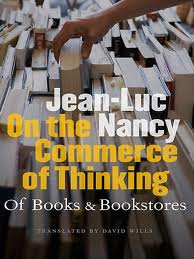
(Fordham University Press, 2008)
Multi-session workshop on Jean-Luc Nancy’s
On the Commerce of Thinking: Of Books and Bookstores,
as facilitated by John Paul Ricco. Realized in coordination
with the exhibition Sediment at G Gallery, Art Metropole
and Of Swallows, Bookshop.
The three sessions of this workshop will cumulatively
involve a close and direct reading of this short book by
Jean-Luc Nancy. Each session will begin with 3-4 sections
of On the Commerce … being read aloud by workshop
participants with subsequent group discussion of the text,
led by John Paul Ricco.
Details for the three sessions are as follows:
Session 1: January 26 2012 at G Gallery, 7-9pm (sections 1-3)
On the Commerce of Thinking, Of Books and Bookstores
The Idea and Character of the Book
The Book’s End in Itself
Session 2: February 2 2012 at Art Metropole, 7-9pm (sections 4-6)
The People of the Book
Interminable Reading
The Publication of the Unpublished
Session 3: February 16 2012 at Of Swallows, Bookshop, 7-9pm (sections 7-10)
Book Open and Closed
The Scents of the Bookstore
The Commerce of Thinking
The Matter of Books
Those interested in attending the workshop are asked to
RSVP as soon as possible as there will be a limited number
of spots. Individuals that wish to RSVP are asked to
do so with the intention of attending all three sessions in
order to provide continuity and depth to the discussions.
To RSVP and for other information, please contact
Shane Krepakevich at skrepakevich(at)gmail(dot)com
G Gallery *NEW LOCATION*
134 Ossington Street (Entrance on Foxley Pl, rear of building)
Toronto, Ontario M6J 2Z5
info@sidecentre.com
Gallery Hours: Friday to Sunday 12 – 5pm
G Gallery location
G Gallery and sidecentre.com are generously supported by the College of Arts
and the School of Fine Arts and Music at the University of Guelph.
 unbecoming community