The Boys of Collodion

The young bare-chested men in this series of portraits, with their free flowng dark hair and their wide-opened stares, seem to harken back to the first decades of photography, as much as having been pulled from the local skateboard park. Glued to whatever it is that is confronting them head-on, their fixated gazes might betray the name of the place that they mythically hail from: Collodion, from the Greek kollōdēs, meaning “gluelike.” Looking as though they have become suddenly entranced by the song of the sirens, or nearly petrified by the head of the gorgon, the boys of collodion are our modern day kouroi. Stripped of colour except for a single red badge—medal and scar—they are glued and unglued at once.

Christa Blackwood, Sam from the Boys of Collodion series, hand pulled duo mono print, 2014.
University of Chicago Press, March 2014.

University of Chicago Press, March 2014.

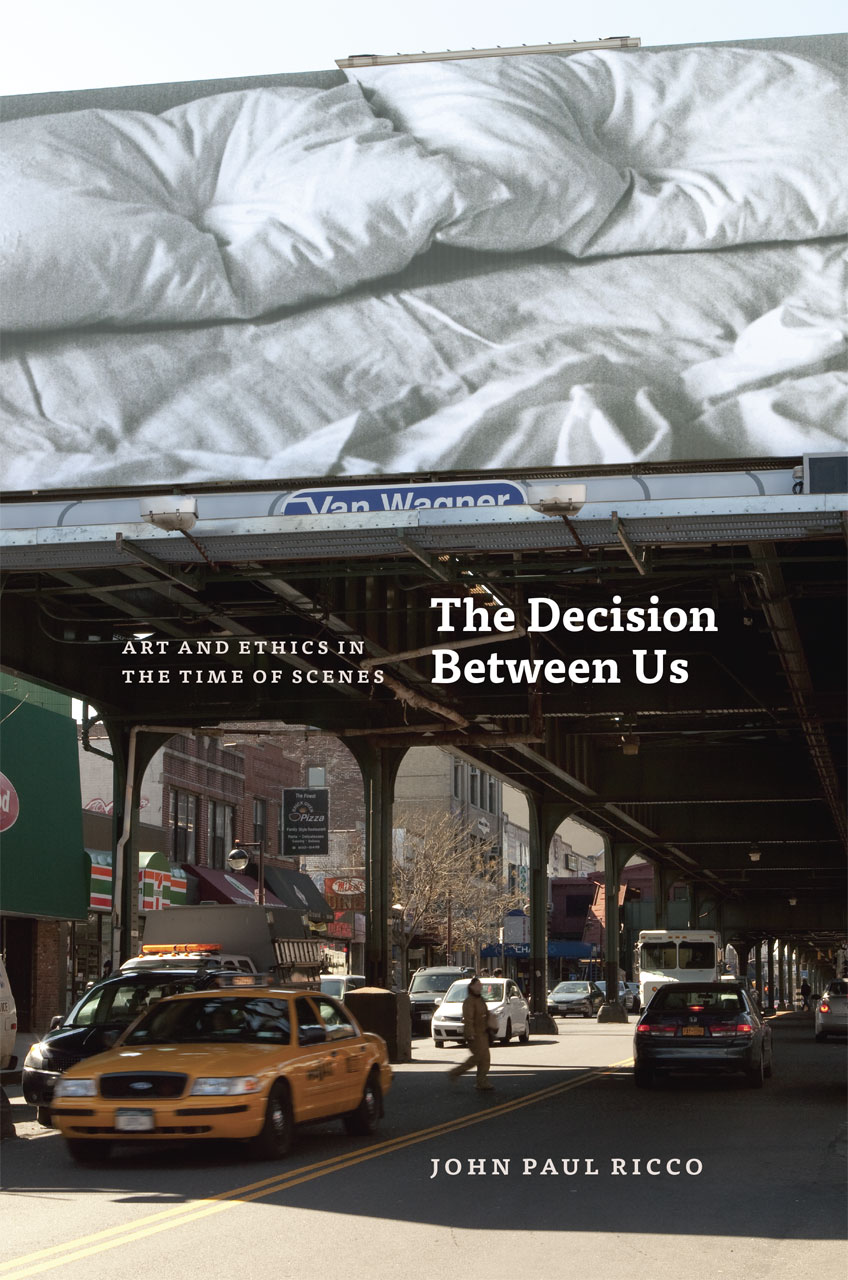
The Decision Between Us combines an inventive reading of Jean-Luc Nancy with queer theoretical concerns to argue that while scenes of intimacy are spaces of sharing, they are also spaces of separation. John Paul Ricco shows that this tension informs our efforts to coexist ethically and politically, an experience of sharing and separation that informs any decision. Using this incongruous relation of intimate separation, Ricco goes on to propose that “decision” is as much an aesthetic as it is an ethical construct, and one that is always defined in terms of our relations to loss, absence, departure, and death.

Laying out this theory of “unbecoming community” in modern and contemporary art, literature, and philosophy, and calling our attention to such things as blank sheets of paper, images of unmade beds, and the spaces around bodies, The Decision Between Us opens in 1953, when Robert Rauschenberg famously erased a drawing by Willem de Kooning, and Roland Barthes published Writing Degree Zero, then moves to 1980 and the “neutral mourning” of Barthes’ Camera Lucida, and ends in the early 1990s with installations by Felix Gonzalez-Torres. Offering surprising new considerations of these and other seminal works of art and theory by Jean Genet, Marguerite Duras, and Catherine Breillat, The Decision Between Us is a highly original and unusually imaginative exploration of the spaces between us, arousing and evoking an infinite and profound sense of sharing in scenes of passionate, erotic pleasure, as well as deep loss and mourning.

“Through a compelling, lucid, and wonderfully suggestive reading of Nancy’s writings, we are exposed throughout The Decision Between Us to numerous scenes of seduction and abandoned existence, scenes at once erotic and funerary, intimate and desolate. An incisive contribution to the ways in which Nancy’s writings might be read today, the sense of sharing at the heart of the argument is both transformative and intensely ethical.”

Philip Armstrong, Ohio State University

“Ricco’s The Decision Between Us is a beautifully executed book on the execution and extension of being-in-relation. Its articulation of sexuality theory, deconstructive philosophy, and queer art opens up different idioms to each other the way lovers open to each other—excitedly, productively, and yet always enigmatically, pointing beyond what seems present. Ricco is also a brilliant close reader. An enrapturing read.”

Lauren Berlant, University of Chicago

“Reopening ground broken by Jean-Luc Nancy, The Decision Between Us traces the paradoxes of relational being across a range of artistic, literary, and philosophical ‘scenes.’ Through a series of startling juxtapositions, Ricco weaves together scenes of exposure, erasure, and unmaking to reveal the inseparability of aesthetics from ethics.  This is an original and challenging work by one of our most brilliant philosophers of visuality.”

Tim Dean, State University of New York at Buffalo


I have decided to change the appearance of my blog, so as to facilitate easier reading of my posts. Hope you find the site more legible. In the meantime, I will try to keep it interesting, and with an upcoming year-long research sabbatical, and plenty of new publications and projects, I hope to be able to post much more regularly. So please sign-up for email notifications below.

Enter your email address to subscribe to this blog and receive notifications of new posts by email.

“The Separated Gesture: Partaking in the Inoperative Praxis of the Already-Unmade” an essay to be published in: Jean-Luc Nancy and the Political. Edited by Sanja Dejanovic, Critical Connections Series, Edinburgh University Press, forthcoming, 2014.

My essay is about the ways in which Jean-Luc Nancy has conceived of the relation between the political and the aesthetic. It is in large part based upon my reading of his essay important recent essay, “The Truth of Democracy,” in order first to underline that the aesthetic, art and the artistic are not political as such, meaning that they are neither the ground upon which a “politics” can be articulated, nor are they the materialized product and result of some political determination. Instead, I am guided by what Nancy argues to be a political necessity, namely: “to think the manner in which these spheres [art, friendship, knowledge, etc.] are heterogeneous to the properly political sphere” and yet, without which, the space opened up by the political would not be affirmed.

To do so, I turn to the work of the artist Felix Gonzalez-Torres, and argue that his work (quoting from my essay) “enables the affirmation of the political as a spacing that is not a pre-given readymade ground, but instead is always the taking place—or better, a partaking place—that is already-unmade.” Meaning: kept open and sustained as an exposure to the infinite, which is the space formed by the political.

“A Space Formed for the Infinite” is the title of one of the chapters of Nancy’s text on democracy, and it opens with the following statement:

The condition of nonequivalent affirmation is political inasmuch as politics must prepare the space for it. But the affirmation itself is not political. It can be almost anything you like—existential, artistic, literary, dreamy, amorous, scientific, thoughtful, leisurely, playful, friendly, gastronomic, urban, and so on: politics subsumes none of these registers; it only gives them their space and possibility.

In stating that the condition of nonequivalent affirmation is not political, I understand Nancy to mean that it is not an archē/ground/origin and rule/law/principle, upon which any or all subsequent action (praxis) is determined and dictated.

For unlike the ancient Greek conception of the condition of the political (and the space of the polis), in which the architect and the legislator “make” (poietically) the walls and laws of the polis, by simply executing the model or blueprint created and provided by the “philosopher-king” (master planner), such that this poietic production is not political but is understood as prior to political praxis, for Nancy, the political is—as Nancy makes clear in this chapter—this very drawing and sketching of the outline and contour of space. A sketching that as drawing is poiesis that is also praxis, and a praxis that is also poietic.

In other words, the political for Nancy, as I understand him, is a praxis that is as much mise-en-scene as mise-en-acte, in which the political act is staging the scene of nonequivalence (the non-mimetic, non-productive fabrication of model) that is affirmed by art, friendship, knowledge, etc. as the sharing in this incommensurability.

Yet as I argue, to affirm this nonequivalence, and to sustain and stand in this (political) space formed for the infinite, calls for a non-poietic aesthetic praxis, the manner and technique of which is inoperative, and as such, affirms that that which is taken to be readymade, is already-unmade. It is the separated gesture (and gesture of separation) that is the gesture that affirms the political by underlining the patency of the political. Patency, which literally means: the condition of being open, expanded and unobstructed. A patency that we might further qualify, as infinitely open in its exposure as finite—right on the contour and outline that is the spacing of finitude.

I was recently asked for a list of five of the best books I read in 2013. I say “of the best” and not “the best” because of course I read many more than five truly excellent books last year. But these are some of the ones that made particular impressions, and that I thought were especially worthy of noting and sharing here.

  1. Jamie Quatro, I Want to Show You More (Grove, 2013). This debut collection of stories–mostly taking place on the border of Tennesee and Georgia–truly captures the rawness and realness of American culture—where and when experiences of Christianity, faith, adultery and sex are no longer distinguishable. In reading Quatro, I find narratives of what I have been theorizing in my own writing as “pornographic faith.”
  2. George Saunders, Tenth of December (Random House, 2013). Who hasn’t read Saunders’ latest collection of stories?! Like Quatro, he impeccably takes the beat of beaten-down and humiliated Americans. In most of these stories, the setting is central New York State—its own northern Appalachia. Having grown up in Utica, I know. So does Saunders; who teaches at Syracuse and who writes so tenderly about the absurd yet indefatigible dignity of life “upstate.”
  3. Hilton Als, White Girls (McSweeney’s, 2013). With beautifully and variously styled essays on Truman Capote, Michael Jackson, Eminem, Richard Pryor and Malcom X, Als completely gets us to detach racial and gender signifiers from their typical identities. Who’s a white girl? Who desires, idolizes, mimics, betrays and befriends white girls? See the list above.
  4. Kathleen Winter, Annabel (Anansi, 2010). Given to me as a gift this past Christmas, I finally got to read this celebrated novel. I most appreciated the simplicity of the story’s telling, and the remarkable ways in which trans-gender identity and the villages and forests of Labrador are made to resonate, in a mutual foregrounding of the other.
  5. Stacey D’Erasmo, The Art of Intimacy: The Space Between (Greywolf Press, 2013). Part of a series of short books on the art, craft and technique of writing, D’Erasmo writes beautifully, poetically and with tremendous theoretical insight about the distance that structures any sense intimacy and the spaces of shared encounter. Having just completed my own monograph on the space of ethical and aesthetic separation that is “the decision between us,” reading this book felt like it own rendezvous with intimacy in writing.

Transmission Annual (2013)

LABOUR, WORK, ACTION
Edited by Michael Corris, Jaspar Joseph-Lester, Sharon Kivland
With guest editors Maureen Connor and Elizabeth Legge

Taking up Hannah Arendt’s reflections on three important human activities – labour, work, action – this book addresses the role that might be played by artist or work of art, and how this makes for agents and agency.

Contributors: Ivana Bago, Jordan Bear, Pascal Beausse, Bernard Brunon, Pavel Büchler, Armin Chodzinski, Annie Coll, Michael Corris, Janeil Engelstad, Francesco Finizio, Charlie Gere, Jerome Harrington, David Hopkins, Shannon Jackson, Vincent Victor Jouffe, the Pedagogy Group, Elizabeth Legge, Dale MacFarlane, Roberto Martinez, Mary-Lou Lobsinger, Hester Reeve, Oliver Ressler, John Paul Ricco, Abigail Satinsky, Juliet Steyn.

Transmission is a project that has encompassed an annual journal, a series of related publications, a lecture series, symposia and other events. Transmission Annual is a yearly publication, now in four volumes, edited by Jaspar Joseph-Lester (Royal College of Art, London), Sharon Kivland (Sheffield Hallam University), Michael Corris (The Meadows School of the Arts, SMU, Dallas, Texas), who were joined for 2012 by Noah Simblist (The Meadows School of the Arts, SMU, Dallas, Texas).

The Decision Between Us: Art and Ethics in the Time of Scenes

(University of Chicago Press, 2014)

John Paul Ricco


The Decision Between Us combines an inventive reading of Jean-Luc Nancy with queer theoretical concerns to argue that while scenes of intimacy are spaces of sharing, they are also spaces of separation. John Paul Ricco shows that this tension informs our efforts to coexist ethically and politically, an experience of sharing and separation that informs any decision. Using this incongruous relation of intimate separation, Ricco goes on to propose that “decision” is as much an aesthetic as it is an ethical proposition, and one that is always defined in terms of our relations to loss, absence, departure, and death.

            Laying out this theory of “unbecoming community” in modern and contemporary art, literature, and philosophy, and calling our attention to such things as blank sheets of paper, images of unmade beds, and the spaces around bodies, The Decision Between Us opens in 1953, when Robert Rauschenberg famously erased a drawing by Willem de Kooning, and Roland Barthes published Writing Degree Zero, then moves to 1980 and the “neutral mourning” of Barthes’ Camera Lucida, and ends in the early-1990s and installations by Felix Gonzalez-Torres. Offering surprising new considerations of these and other seminal works of art and theory by Jean Genet, Marguerite Duras, and Catherine Breillat, The Decision Between Us is a highly original and unusually imaginative exploration of the spaces between us, arousing and evoking scenes of both passionate, erotic pleasure as well as deep loss and mourning.

Scapegoat: Architecture Landscape Political Economy 05 Excess

Editorial Preview:
Ours is unquestionably a time of excess. While currencies and commodities continue to circulate, reifying segregation and inequality throughout the global political economy, excess leaks out in all directions, sometimes fostering movements of resistance, other times permitting improvisational opportunism among often neglected actors, and still at other moments irrevocably damaging ecologies and environments which we humans precariously but ruthlessly inhabit. The pleasures and perils of excess cross divisions of class, race, gender and sexuality, while also reinforcing aspects of these and other identities.

Can we design for, or among, the excesses of contemporary culture? How do practices of architecture and landscape architecture, as well as adjacent practices of art, curation, philosophy, and typography, suggest ways to amplify, capture, or redirect excess?

In EXCESS-Scapegoat’s sixth issue-we explore the productive, resistant, and imperiling aspects of excess as an attempt to advance our project of emboldening theoretical and historical modes of inquiry, scholarly research, and design practice. It is a vast conceptual terrain, but one that offers many compelling perspectives.

Contributors to EXCESS include: Ariella AZOULAY, Georges BATAILLE, Jean BAUDRILLARD, Alex BERCEANU, Diana BERESFORD-KROEGER, James BRIDLE, Melissa CATE CHRIST, Tings CHAK, Steven CHODORIWSKY, Vicki DASILVA, Heather DAVIS, Sara DEAN, Amanda DE LISIO, Seth DENIZEN, EMIL, ÉPOPÉE, FALA ATELIER, Valeria FEDERIGHI, Natasha GINWALA, HEBBEL AM UFER, Lisa HIRMER, Gary HUSTWIT, David HUTAMA, Kate HUTCHENS, Jennifer JACQUET, Martti KALLIALA, Prachi KAMDAR, Stuart KENDALL, Chris KRAUS, Abidin KUSNO, Emily KUTIL, Clint LANGEVIN, Justin LANGLOIS, Sam LEACH, Stanisław LEM, Sylvère LOTRINGER, Filipe MAGALHAES, Danielle MCDONNOUGH, Meredith MILLER, Srimoyee MITRA, Jeffrey MONAGHAN, Jon PACK, Keith PEIFFER, Rich PELL, pHgH, Rick PRELINGER, Thomas PROVOST, raumlaborberlin, John Paul RICCO, Erin SCHNEIDER, Ana Luisa SOARES, Scott SØRLI, Raphael SPERRY, Anna-Sophie SPRINGER, Antonio STOPPANI, Maria TAYLOR, Eugene THACKER, Kika THORNE, Emily VANDERPOL, Kevin WALBY, Eyal WEIZMAN, Jason YOUNG, Vivian ZIHERL, and Joanna ZYLINSKA.


There is a whole bunch of my writing that is scheduled to be published in the next 6-9 months, and so I thought I might post a list so that you can keep an eye out for each of these articles.

1. “Pornographic Faith: Two Sources of Naked Sense at the Limits of Belief and Humiliation,” in Porn Archives, edited by Tim Dean, Steven Ruszczycky, and David Squires (Duke University Press).
2. “Parasol, Setas, Parasite,” in a forthcoming book on the work of Berlin-based architect Juergen Mayer H., my essay is on his recently completed Metropol Parasol, Seville, Spain.
3. “The Separated Gesture: Partaking in the Inoperative Praxis of the Already-Unmade,” in Jean-Luc Nancy and the Political, edited by Sanja Dejanovic, Critical Connection Series, Edinburgh University Press.
4. “The Inoperative Praxis of the Already-Unmade,” in Transmission. Art, Labour, Work, edited by Elizabeth Legge (Artwords Press). This is a much shorter version of the essay listed above.
5. “Drool: Liquid Fore-speech of the Fore-scene,” in the journal inter/Alia, a special issue on “Bodily Fluids,” edited by Kamillea Aghtan, Michael O’Rourke, and Karin Sellberg.
6. “Drool: Liquid Fore-speech of the Fore-scene,” in the journal Scapegoat, issue 5 on “Excess,” edited by Etienne Turpin. This is a much shorter version of the essay listed above.
7. “Queer Theory & Aesthetics,” in The Encyclopedia of Aesthetics, (Oxford University Press).

PLUS: my monograph: The Decision Between Us: art & ethics in the time of scenes (University of Chicago Press, scheduled release in January 2014).