Archive

Uncategorized

art-in-the-anthropocene_cover_150x225

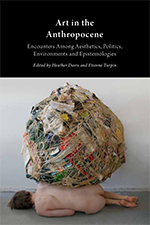
Published in the recently released book, Art in the Anthropocene: Encounters Among Aesthetics, Politics, Environments and Epistemologies. Edited by Heather Davis and Etienne Turpin (Open Humanities Press, Critical Climate Change Series, 2015).

You can read and download the entire 400+ page volume here:

Art in the Anthropocene

A seminar (panel) for the American Comparative Literature Association annual conference. Seattle, Washington, March 26-29, 2015.

Co-organized with Etienne Turpin

After Acéphale: Politics & Poetics of Assemblage in the Decapitated Economy

             Human life is exhausted from serving as the head of, or the reason for,

            the universe. To the extent that it becomes this head and this reason,

            to the extent that it becomes necessary to the universe, it accepts servitude.

— Georges Bataille

With Franco “Bifo” Berardi’s book The Uprising: On Poetry and Finance, the early-21st-century species of “indebted man” as outlined by Maurizio Lazzarato, and the severed heads that are the iconic and accursed remnants in Julia Kirsteva’s meditation on “capital visions,” leading theorists of political economy have articulated the inextricable relations between language and capital, sovereignty and guilt, representation and instrumental reason, insurrection and occupation.

In light of these developments, and in the city where the anti-globalization movement was launched into public consciousness fifteen years ago, this seminar seeks to draw upon lessons that we might still take from one of the major philosophical and literary precursors: Georges Bataille’s general economy of excess expenditure and waste, and his phantasmology of sovereignty without debt or servitude, as presented in La Part Maudite (1967, The Accursed Share), and in such literary works as Madame Edwarda (1956), Le Coupable (1944; Guilty), and La Tombe de Louis XXX (various dates).

In doing so, this panel explores the links that Bataille made between non-knowledge and rebellion (as in his eponymous lecture from 1952), and draws out from close readings of Bataille, the image of an acéphalic body of the general intellect, and its political and poetic assemblage. To acquit ourselves of the rational servitude that Bataille correctly identified as endemic to capitalist economies, we may need, finally, to lose our heads and pursue what might be properly called “acephalic reason” in pleasure, literature, philosophy, and politics.

“You cannot deconstruct something that belongs to someone else. If I deconstruct something of someone else’s, I simply break it.”

(from an interview with Jean-Luc Nancy, published in, Retreating Religion: Deconstructing Christianity with Jean-Luc Nancy. Fordham University Press, 2012, 316).

The Boys of Collodion

The young bare-chested men in this series of portraits, with their free flowng dark hair and their wide-opened stares, seem to harken back to the first decades of photography, as much as having been pulled from the local skateboard park. Glued to whatever it is that is confronting them head-on, their fixated gazes might betray the name of the place that they mythically hail from: Collodion, from the Greek kollōdēs, meaning “gluelike.” Looking as though they have become suddenly entranced by the song of the sirens, or nearly petrified by the head of the gorgon, the boys of collodion are our modern day kouroi. Stripped of colour except for a single red badge—medal and scar—they are glued and unglued at once.

Christa Blackwood, Sam from the Boys of Collodion series, hand pulled duo mono print, 2014.

I have decided to change the appearance of my blog, so as to facilitate easier reading of my posts. Hope you find the site more legible. In the meantime, I will try to keep it interesting, and with an upcoming year-long research sabbatical, and plenty of new publications and projects, I hope to be able to post much more regularly. So please sign-up for email notifications below.

Enter your email address to subscribe to this blog and receive notifications of new posts by email.

“The Separated Gesture: Partaking in the Inoperative Praxis of the Already-Unmade” an essay to be published in: Jean-Luc Nancy and the Political. Edited by Sanja Dejanovic, Critical Connections Series, Edinburgh University Press, forthcoming, 2014.

My essay is about the ways in which Jean-Luc Nancy has conceived of the relation between the political and the aesthetic. It is in large part based upon my reading of his essay important recent essay, “The Truth of Democracy,” in order first to underline that the aesthetic, art and the artistic are not political as such, meaning that they are neither the ground upon which a “politics” can be articulated, nor are they the materialized product and result of some political determination. Instead, I am guided by what Nancy argues to be a political necessity, namely: “to think the manner in which these spheres [art, friendship, knowledge, etc.] are heterogeneous to the properly political sphere” and yet, without which, the space opened up by the political would not be affirmed.

To do so, I turn to the work of the artist Felix Gonzalez-Torres, and argue that his work (quoting from my essay) “enables the affirmation of the political as a spacing that is not a pre-given readymade ground, but instead is always the taking place—or better, a partaking place—that is already-unmade.” Meaning: kept open and sustained as an exposure to the infinite, which is the space formed by the political.

“A Space Formed for the Infinite” is the title of one of the chapters of Nancy’s text on democracy, and it opens with the following statement:

The condition of nonequivalent affirmation is political inasmuch as politics must prepare the space for it. But the affirmation itself is not political. It can be almost anything you like—existential, artistic, literary, dreamy, amorous, scientific, thoughtful, leisurely, playful, friendly, gastronomic, urban, and so on: politics subsumes none of these registers; it only gives them their space and possibility.

In stating that the condition of nonequivalent affirmation is not political, I understand Nancy to mean that it is not an archē/ground/origin and rule/law/principle, upon which any or all subsequent action (praxis) is determined and dictated.

For unlike the ancient Greek conception of the condition of the political (and the space of the polis), in which the architect and the legislator “make” (poietically) the walls and laws of the polis, by simply executing the model or blueprint created and provided by the “philosopher-king” (master planner), such that this poietic production is not political but is understood as prior to political praxis, for Nancy, the political is—as Nancy makes clear in this chapter—this very drawing and sketching of the outline and contour of space. A sketching that as drawing is poiesis that is also praxis, and a praxis that is also poietic.

In other words, the political for Nancy, as I understand him, is a praxis that is as much mise-en-scene as mise-en-acte, in which the political act is staging the scene of nonequivalence (the non-mimetic, non-productive fabrication of model) that is affirmed by art, friendship, knowledge, etc. as the sharing in this incommensurability.

Yet as I argue, to affirm this nonequivalence, and to sustain and stand in this (political) space formed for the infinite, calls for a non-poietic aesthetic praxis, the manner and technique of which is inoperative, and as such, affirms that that which is taken to be readymade, is already-unmade. It is the separated gesture (and gesture of separation) that is the gesture that affirms the political by underlining the patency of the political. Patency, which literally means: the condition of being open, expanded and unobstructed. A patency that we might further qualify, as infinitely open in its exposure as finite—right on the contour and outline that is the spacing of finitude.

I was recently asked for a list of five of the best books I read in 2013. I say “of the best” and not “the best” because of course I read many more than five truly excellent books last year. But these are some of the ones that made particular impressions, and that I thought were especially worthy of noting and sharing here.

  1. Jamie Quatro, I Want to Show You More (Grove, 2013). This debut collection of stories–mostly taking place on the border of Tennesee and Georgia–truly captures the rawness and realness of American culture—where and when experiences of Christianity, faith, adultery and sex are no longer distinguishable. In reading Quatro, I find narratives of what I have been theorizing in my own writing as “pornographic faith.”
  2. George Saunders, Tenth of December (Random House, 2013). Who hasn’t read Saunders’ latest collection of stories?! Like Quatro, he impeccably takes the beat of beaten-down and humiliated Americans. In most of these stories, the setting is central New York State—its own northern Appalachia. Having grown up in Utica, I know. So does Saunders; who teaches at Syracuse and who writes so tenderly about the absurd yet indefatigible dignity of life “upstate.”
  3. Hilton Als, White Girls (McSweeney’s, 2013). With beautifully and variously styled essays on Truman Capote, Michael Jackson, Eminem, Richard Pryor and Malcom X, Als completely gets us to detach racial and gender signifiers from their typical identities. Who’s a white girl? Who desires, idolizes, mimics, betrays and befriends white girls? See the list above.
  4. Kathleen Winter, Annabel (Anansi, 2010). Given to me as a gift this past Christmas, I finally got to read this celebrated novel. I most appreciated the simplicity of the story’s telling, and the remarkable ways in which trans-gender identity and the villages and forests of Labrador are made to resonate, in a mutual foregrounding of the other.
  5. Stacey D’Erasmo, The Art of Intimacy: The Space Between (Greywolf Press, 2013). Part of a series of short books on the art, craft and technique of writing, D’Erasmo writes beautifully, poetically and with tremendous theoretical insight about the distance that structures any sense intimacy and the spaces of shared encounter. Having just completed my own monograph on the space of ethical and aesthetic separation that is “the decision between us,” reading this book felt like it own rendezvous with intimacy in writing.

There is a whole bunch of my writing that is scheduled to be published in the next 6-9 months, and so I thought I might post a list so that you can keep an eye out for each of these articles.

1. “Pornographic Faith: Two Sources of Naked Sense at the Limits of Belief and Humiliation,” in Porn Archives, edited by Tim Dean, Steven Ruszczycky, and David Squires (Duke University Press).
2. “Parasol, Setas, Parasite,” in a forthcoming book on the work of Berlin-based architect Juergen Mayer H., my essay is on his recently completed Metropol Parasol, Seville, Spain.
3. “The Separated Gesture: Partaking in the Inoperative Praxis of the Already-Unmade,” in Jean-Luc Nancy and the Political, edited by Sanja Dejanovic, Critical Connection Series, Edinburgh University Press.
4. “The Inoperative Praxis of the Already-Unmade,” in Transmission. Art, Labour, Work, edited by Elizabeth Legge (Artwords Press). This is a much shorter version of the essay listed above.
5. “Drool: Liquid Fore-speech of the Fore-scene,” in the journal inter/Alia, a special issue on “Bodily Fluids,” edited by Kamillea Aghtan, Michael O’Rourke, and Karin Sellberg.
6. “Drool: Liquid Fore-speech of the Fore-scene,” in the journal Scapegoat, issue 5 on “Excess,” edited by Etienne Turpin. This is a much shorter version of the essay listed above.
7. “Queer Theory & Aesthetics,” in The Encyclopedia of Aesthetics, (Oxford University Press).

PLUS: my monograph: The Decision Between Us: art & ethics in the time of scenes (University of Chicago Press, scheduled release in January 2014).

Introduction

Part I: Name No One

     Chapter 1: Name No One Man

     Chapter 2: Name No One Name

Part II: Naked

     Chapter 3: Naked Sharing

     Chapter 4: Naked Image

Part III: Neutral and Unbecoming

     Chapter 5: Neutral Mourning

     Chapter 6: Unbecoming Community


The difference is that between the anonymity of the creature deprived of destiny and the hero who presides over the destiny to the point of becoming his own fate.

Marguerite Duras contrasting Georges Bataille and Jean Genet, and the figures in their works, respectively. Duras, “On Georges Bataille,” Outside: Selected Writings. Boston: Beacon Press, 1986.