Archive

The Decision Between Us

Since the 12th-century, there has been in Christian moral theology a notion of taking pleasure in “expectantly waiting (Lat. moratur) in the desire for an object that remains absent because it is inaccessible or prohibited” (Dictionary of Untranslatables, 792). It is not a delay of pleasure, but rather of pleasure in the delay of satisfied desire, that is enjoyed by and in the imagination. In other words, it is the pleasure that one derives from desiring, and it is this pleasure-in-desiring that affirms that there is pleasure inherent in desire itself—and thus not only in desire’s fulfillment (a point that was clear to Lacan in his reading of the “paradox of fore-pleasures” in Freud).

It is important to underline that this “morose delectation” is not the postponement or infinite deferral of pleasure, nor is it entirely divorced from desire. Rather, it is the pleasure that is enjoyed in the very relation to desire. Neither the negation nor the positive presence of the object of desire, delectatio morosa is what we might describe as a neutral yet wholly pleasurable relation to desire.

I am interested in this Scholastic notion because it strikes me that it provides us with a way to think about the “neutral mourning” that I have theorized in my recent reading of Roland Barthes as its own form of pleasure. What I suggested in that chapter of The Decision Between Us dedicated to Barthes, is that in the midst and in the wake of mourning the recent death of his mother, Barthes sought what he had described as “a desire for the neutral,” and that this desire was, at the same time, a desire for a vita nova (“new life”—the eponymous name for the “novel” that he had begun to outline just before he died).

Drawing from his knowledge of Zen Buddhism, his fascination with Rousseau’s far niente (doing nothing), and his memory of a young Moroccan boy sitting on a low wall, I argued that Barthes imagined the neutral (and mourning) as a scene of just sitting, doing nothing. “To be idle, without master, and yes, perhaps even to be without guide (mother), and finally to be able to just sit without equivocation, without profit or debt, sin, prostration, or will-to-possess…something like the neutral sitting of a neutral mourning.”  Drawing further upon the etymology of the Latin word morosus, we can now understand this scene of neutral mourning as a scene of pleasure—of delectatio morosa. “In Italian…morosita means ‘delay’ (particularly in acquitting oneself of a debt or an obligation)…and where the English “moroseness” is rendered by malinconia [“melancholy”]…and in Spanish, where…moroso means ‘lazy'” (Untranslatables, 792).

When mourning is the act of the imagination enjoying its waiting in desire, it is neutral. It is in this way that neutral mourning is neither morbidly morose mourning nor melancholia, but instead is a desire for the neutral and its own form of neutral pleasure.


Last week, as I was preparing a public lecture on “The Commerce of Anonymity,” I began to think more about the conceptual relations between anonymity and the neutral, and in particular the ways in which together they might bear upon acts of mourning.

At once drawing me back to ideas that I recently presented in chapter 5 of my book, The Decision Between Us, on Roland Barthes’ neutral mourning, and also closer to more recent events in which many of us find ourselves mourning the deaths of largely unknown or anonymous others, I returned not only to Barthes’ work, but also to Maurice Blanchot’s, in order to try to think about how a politics and ethics of the anonymous and neutral might disrupt or refuse some of the more dominant and prevailing responses to such violent atrocities and mass deaths.

In his book, The Step Not Beyond, Blanchot writes that,

The anonymous after the name is not the nameless anonymous. The anonymous does not consist in refusing the name in withdrawing from it. [Thus we might say that the anonymous is the withdrawal of the name through (as) the name of the nameless]. The anonymous puts the name in place, leaves it empty, as if the name were there only to let itself be passed through because the name does not name, but is the non-unity and non-presence of the nameless (34-35).

The name is the passage through which the anonymous passes. And in its passing/withdrawing through the name, the anonymous leaves the place of the name empty, as if the anonymous were the place-name (if not place-holder) for the name.

What I want to suggest is that as the neutral name (neuter) of the name, the anonymous, when mourned, calls for an equally neutral mourning. For Barthes, there is indeed a form of mourning that is without codification and assimilation, and without any one proper place. Hence, it is not only without memorial or monument, it is, Barthes argues, therefore also socially untenable. Moving away from the will-to-possess toward the will-to-love, this neutral mourning represents the second type of “neutral” that Barthes is (more) interested in. It is differentiated from the first-degree neutral (i.e. the suspension of conflicts), while at the same time being distinct from the “desperate vitality” (a phrase that he derives from Pasolini), that he takes to be equivalent to a hatred of death. Thus while Barthes does not use the phrase, I think we find here what amounts to a conception of neutral mourning. Within the context of my current thinking and writing, I want to suggest that such neutral mourning is at the same time, anonymous mourning, specifically the mourning of those who go by anonymous names (in the departure of the departed, in passing).

For just as for Blanchot, “the anonymous puts the name in place” yet only to be the place of passage for the name and its emptying out of nomination, so with Barthes, the temporality of the neutral is nothing more than a moment or instant, specifically an opportune opening—what we might think of as the kairos to Blanchot’s anonymous topos.

This itinerancy of the anonymous and the neutral is what makes them both operate as lures, yet not in terms of a name, but as predicates or adjectives. Which is to say, as a certain kind of aesthetic provocation and attraction, and an opening of the ethical. For what Barthes more fully says about the kairos of the neutral is that “perhaps the Neutral is that: to accept the predicate as nothing more than a moment: a time” (Neutral, 61). The kairos (or opportune moment) of the neutral, is the non-nominalizable singularity (of space and of time) that is anonymity (as in the German neuter form Das Moment: cause, force, momentum).

Neutral mourning is the will-to-love that moment of departure that passes between the anonymous and the predicate—between any one name and passing quality. The neutral and the anonymous are thus not the names (or not only the names) but the adjectives or predicates of an originary movement, force and temporality of the momentums and moments of being together (i.e. the commerce of anonymity).

In light of recent events, this is what we must respond to, counter-sign (“not in our names”), and thus begin to take responsibility for—prior to and in excess of political and theological sovereignty. It is in this way that we might affirm, as Michael Naas has argued, “that there can be no sovereign last word [or name] to put an end to the violence or the endless discussion” (The End of the World and Other Teachable Moments, 167).


In his remarkable review essay [PDF] of my book, The Decision Between Us, Jacques Khalip (Professor of English, Brown University) beautifully illuminates the ways in which something as ordinary as a blank sheet of paper is—for me, in my thinking and in this work—an aesthetic event and an ethical scene. Not a place or product in the service of judgment, but the spacing of decision. The measure of which lies in the separation or apartness that sustains the between-ness of our being-together.

With great care Khalip attends to the aesthetic and ethical dimensions of my argument, and makes evident how “art and art’s ethical deliberation are…of a piece in this study,” and how “art measures (even if it is measureless) the infinite demands of an ethos that appears and disappears under our feet.”

Of the many, many things that I appreciate about Khalip’s reading, I especially value his foregrounding of my chapter on Roland Barthes, “Neutral Mourning,” and its reading of Camera Lucida alongside Barthes’ lectures at the Collège de France and the mourning diary that Barthes kept immediately following his mother’s death. For here is where a Roland Barthes emerges whom I believe is so deeply informed by Maurice Blanchot and Blanchot’s own philosophy of the neutral. It is also here where we truly begin to gain a sense of what it means for Khalip to cast my work as its own form of “queer neutrality” and what import this might have, not only for queer theory, politics and ethics, but also for the study of the work of Barthes and Blanchot.

As the concluding paragraph, Khalip writes,

If The Decision Between Us impresses upon us an ethics that is not coterminous with the self-possessed subject, the galvanizing effect of this reasoning is to bring into view an awareness that art is the intensification of an ethics-beyond-ethics, a kind of thinking that occurs beyond mere identity, narration or historical contextualization. Among the various illuminating moves in Ricco’s book is its immersion in the various environments it evokes and theorizes, at once setting up scenes while at the same time distancing the reader from them, page after page. As readers, we cannot help but waver between decision and indecision with each of Ricco’s arguments—every movement forward compels a further critique and judgment. Indeed, the book is buoyed by the anonymous, aesthetic power between decision and indecision, not as a choice between positions but as a contamination in the very space of the two that propels unending, queer deliberations.

I am deeply and sincerely grateful for this review, and as my work continues to move on, I will remain indebted to Jacques Khalip’s reading.

I am very pleased to receive this review of my book by art historian Tom McDonough, that was recently published in the journal Critical Inquiry. Click on the link below to access the complete review.

Tom McDonough review in Critical Inquiry

The other day I read Michael Wood’s review of Caroline Levine’s new book, Forms: Whole, Rhythm, Hierarchy, Network (Princeton, 2015) in the London Review of Books (27 August 2015), and now I am curious to read Levine. Not because the four principal forms that she focuses on (listed as the book’s subtitle), are the kind of forms that I am interested in, but primarily for two other reasons.

The first, as Wood describes it, is Levine’s “suggestion that forms are never alone, that they get in each other’s way.” To think about forms as non-autonomous, is of course to completely re-define what we mean when we speak of forms. Here, forms are less stable, self-contained, and isolated entities, than they are understood to be  mobile, touching, overlapping, colliding and contaminating formative and “de-formative” forces. Their boundaries and limits are permeable or fluid, extending and overflowing. Contrary to conventional meaning and understanding, forms are not closed, but open. In a sense, we might say that it is at the place, zone, line or contour of the formative force of collision (for instance), that form is formed—as always singular plural. This leads me to want to make the claim not that there is (or are) a form of co-existence or being-with (formalism of the social and of form), but that the spacing of the “with” is what form means—both form’s source and sense.

Which leads to the second, equally if not more so, provocative and enticing theoretical approach of Levine’s, the one that Wood thinks “it’s worth pausing over…since it’s quite rare, and very promising.” At which point he hands the floor over to the author, who he quotes as stating:

The point here is less to use formalist methods to read Dickens than to use Dickens to throw light on the operations of social form. If this seems like literary criticism turned upside down, that is certainly part of my purpose. I have not understood literary texts in this book as reflections or expressions of prior social forms, but rather as sites, like social situations, where multiple forms cross and collide.

I too regard this as an extremely promising critical/theoretical approach to works of art, in no small part because in Levine’s self-description of it, I see something that closely resembles the approach that I have taken in my writing on contemporary art, literature and theory, most recently in my book, The Decision Between Us: art and ethics in the time of scenes. Whether this makes Wood’s sense of its rarity any more or less the case, I am heartened to encounter his estimation of it, and what appears to be a very compelling deployment. One that does not read the social back into the work of literature or art, or even reads the work outward onto the social, but that understands works of art—their forms—as social sites, or what, in my book, I mean by “scenes.”

In their attempts to think the relation of art and the social, aesthetics and the ethical, formalist methods operate with the assumption that one or the other exists prior to the other, and as a form separate from the other holds the potential to shape or inform the other. Whereas a non-formalist approach distinguishes itself by asserting that any notion of literary, artistic or social form is only possible to the extent that one attends to the scene where as Levine writes: “forms cross and collide.” To which I would go on to argue that it is “in” or “at” the coming-together and apart where forms are formed—where and how form happens—and neither before nor after.

Forms are thus re-conceived as needing to be sustained as the open and extended spaces that they are, in order to “remain” or persist as forms. Forms are incredibly fragile things, if not always, then often. Such that we might conclude that it is precisely such impermanent scenes that are the most worth trying to sustain, in and as the impossibility of their obdurate formal permanence. Therein lies the inseparability of aesthetics and ethics.

THESE SCENES OF UNBECOMING

A conversation with John Paul Ricco, Nasrin Himada and Etienne Turpin

Tuesday, the 31st of March 2015

6-8PM

Poetic Research Bureau

951 Chung King Road

Los Angeles, CA 90012

To celebrate the release of our recent respective publications, I will join Nasrin Himada and Etienne Turpin in a discussion of the ethics and politics of unbecoming. Within this theoretical framework, and in relation to various scenes, topics for engagement will include: violence, sex, death, brutality, sharing, extinction, pleasure, animality, mourning, confinement, and bodies. Copies of the publications will be available for purchase.

Nasrin Himada currently holds a post-doctoral research fellowship in Communications at the Université de Montréal, and is a visiting scholar in the Aesthetics and Politics program at Cal Arts. She is co-editor (with Chris Lee) of issue number 7 (Fall/Winter 2014 of the journal Scapegoat: Architecture/Landscape/Political Economy, on the theme of “Incarceration.”

Etienne Turpin is a philosopher living and working in Jakarta, Indonesia, where is the director of anexact office. He is the co-editor (with Anna-Sophie Springer) of the two-volume Intercalations: Volume 1 Fantasies of the Library; and Volume 2 Land & Animal & Nonanimal; both published by K. Verlag and Haus der Kulturen Welt, 2015.

An emphasis on the “interpersonal” and interactive in contemporary art is often considered a riposte to what Bourriaud has termed “imposed” or institutionalized social relations. Ricco’s close investigation of the non-relational aspects of relationality—the manner in which we do not come together—is, therefore, a crucial intervention into the aesthetic and ethical impasse that is ever-present in discussions of art after the participatory turn…In substituting the act of decision for a more common art historical/critical activity like “evaluation,” Ricco shows that the promise of a truly relational practice lies in maintaining a shared space that we do not stand apart from or in judgment of.

From: Christa Noel Robbins, “Together Apart,” Art in America, January 2014.

U of T’s John Ricco is an associate professor of contemporary art, media theory, and criticism. His work focuses on Jean-Luc Nancy’s philosophies of politics, among other things, as discussed in his latest monograph, The Decision Between Us. His latest work is billed as an “exploration of the spaces between us”, including “scenes of passionate, erotic pleasure as well as deep loss and mourning”. Ricco took some time to talk to The Medium about his new monograph and his inspiration to write it, and provided a preview of his current project.

The Medium: What inspired this desire to conceptualize the staging of the space of decision in 20th-century art?

John Ricco: I have always been interested in thinking about social relations, and the spaces and forms of being together. In my first book, The Logic of the Lure, I focused on scenes of social sexual attraction. In the new book, I was interested in moving from questions of attraction and what lures one out toward other places and people, to the spaces that are shared between us in our social relations and encounters—spaces that are ones of separation. I argue that the extent to which we partake in the social pleasures is the extent to which we sustain this separated spacing. “Decision” is one name for how we participate in this space of shared separation. In the six chapters of my book, I look at works by various late-20th-century artists, writers, and theorists as examples of such scenes of decision in drawing, photography, and installation art, amongst other art forms and genres. One might argue that such staging of the scene of decision is present in art across the centuries, but my study is limited to examples from 1953 to the present, in part because this is the art historical period that I specialize in, but also because many of the works from this period foreground the participatory role of the audience or reader in his or her encounter with works of art, texts, etc. To decide to partake in the work, and thus immediately to be confronted with questions as to how and why to partake, is another way in which I think of these as scenes of aesthetic and ethical decisions.

TM: What was it about Jean-Luc Nancy’s theories specifically that drew you to his works more than anyone else’s?

JR: There are so many things about Nancy’s work that I find compelling and useful for my own. First and foremost is the way in which he is committed to conceiving such essential philosophical questions of existence and being, not in terms of the individual subject or ego, but as always shared. For Nancy, being is always “being with”. If that is so—and I completely think it is—then obviously the ethical is inseparable from the ontological because the ethical is the question of how to be and coexist with others.

TM: How long did this book take to complete considering your busy academic schedule?

JR: A book like this is almost always a long time in the making. It requires several years of reading, research, and conceptualization, along with many stages of writing and rewriting. Along the way, I presented parts of it at academic conferences, workshops, and public lectures, and/or as articles in journals. I finished the first draft of the complete manuscript and submitted it to the press right around the end of 2011. It then took a little more than two years for it to be proofread and edited, and for it to go from manuscript to a fully designed, formatted, indexed, and printed book. This entire process from conception to publication took about five years to complete and many hands were involved in addition to my own.

In terms of my academic work, essentially whatever time is not allocated for my teaching or administrative duties is devoted to my research and writing. I try to strike a balance between all three aspects of my job, and to set aside time nearly every day to work on whatever research or writing projects I am currently engaged in. It is easier during the summer, when I am not teaching, to make significant progress on my own work—and, of course, sabbaticals, such as the one I am on right now, provide incredibly valuable uninterrupted time to focus on a long-term project.

TM: Tim Dean called you “one of our most brilliant philosophers of visuality”. Does praise like that influence how you write?

JR: Well, I can easily return the compliment and say, unequivocally, that Tim Dean is one of our most brilliant philosophers of sexuality. Everyone should read his book Unlimited Intimacy: Reflections on the Subculture of Barebacking, which is hands-down the best book on sex and sexuality out there. So when someone whose work you admire and have learned so much from says something like that about you, you cannot help but be completely honored and deeply humbled at once. As far as influencing the way I write… well, it certainly raises the stakes, doesn’t it!

TM: Can you tell me a little more about Non-Consensual Futures? How do you feel the use of violence has altered neo-liberalism?

JR: You are referring to my current research and book project, which I had been calling Non-Consensual Futures, but which now carries the title The Outside Not Beyond: Pornographic Faith and the Economy of the Eve. It is the third book in a trilogy, following upon The Logic of the Lure and The Decision Between Us. As I mentioned earlier, the first book was about attraction and the second was about decision, and now the third is about departure and abandonment. It grows out of two areas of research: one on the images of bodies falling from the World Trade Centre towers on 9/11, and the other on various instances of excess and the overflowing of corporeal limits. What ties them together are the ways in which bodies come to be defined in terms of their exposure to the outside, a spacing that does not lie in some abstract or transcendent realm “beyond”, but rather is right there in such ordinary and everyday instances as the step of a foot, or the partial opening of the mouth. “Pornographic faith” is my way of naming the thoroughly corporeal comportment and exposure to this radical uncertainty, the pleasure, and of abandoning the sense of one possessing a secure ground from which to act, or a definite end toward which one will eventually reach. I argue that another name for this is “freedom”.

Much of my work on neo-liberalism’s use of violence originally emerged from two undergraduate visual culture seminars that I regularly teach in the Department of Visual Studies at UTM, one called “Capital, Spectacle, War” and the other “Architectures of Vision”. In my classes, we are interested in the ways in which images and visual spectacle are deployed by the militarized neo-liberal state to shock its subjects into states of fear and anxiety, as evidenced, for example, in the Bush administration’s use of such images of violence as part of its “war on terror”.

This interview has been edited for length.

Published: Monday, September 29th, 2014

University of Chicago Press, March 2014.

University of Chicago Press, March 2014.

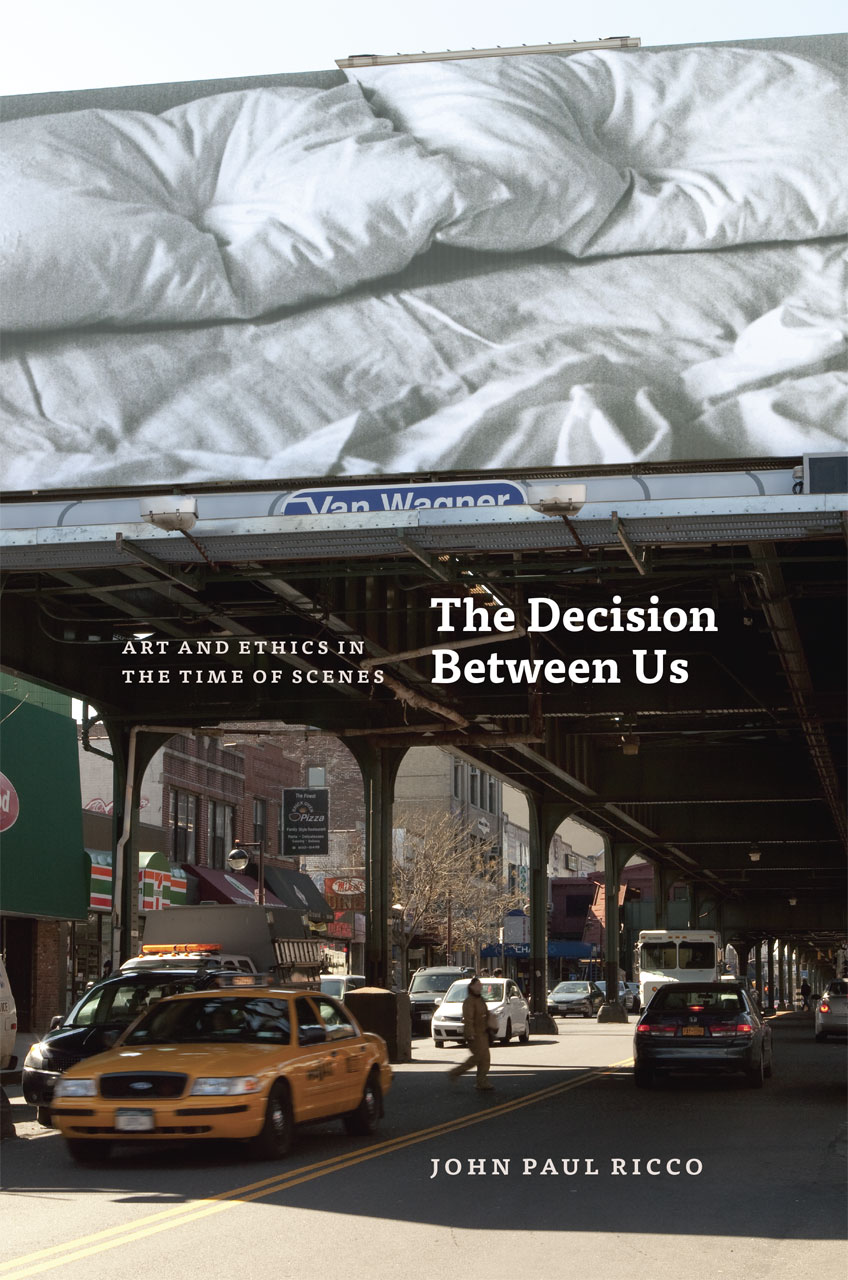
The Decision Between Us combines an inventive reading of Jean-Luc Nancy with queer theoretical concerns to argue that while scenes of intimacy are spaces of sharing, they are also spaces of separation. John Paul Ricco shows that this tension informs our efforts to coexist ethically and politically, an experience of sharing and separation that informs any decision. Using this incongruous relation of intimate separation, Ricco goes on to propose that “decision” is as much an aesthetic as it is an ethical construct, and one that is always defined in terms of our relations to loss, absence, departure, and death.

Laying out this theory of “unbecoming community” in modern and contemporary art, literature, and philosophy, and calling our attention to such things as blank sheets of paper, images of unmade beds, and the spaces around bodies, The Decision Between Us opens in 1953, when Robert Rauschenberg famously erased a drawing by Willem de Kooning, and Roland Barthes published Writing Degree Zero, then moves to 1980 and the “neutral mourning” of Barthes’ Camera Lucida, and ends in the early 1990s with installations by Felix Gonzalez-Torres. Offering surprising new considerations of these and other seminal works of art and theory by Jean Genet, Marguerite Duras, and Catherine Breillat, The Decision Between Us is a highly original and unusually imaginative exploration of the spaces between us, arousing and evoking an infinite and profound sense of sharing in scenes of passionate, erotic pleasure, as well as deep loss and mourning.

“Through a compelling, lucid, and wonderfully suggestive reading of Nancy’s writings, we are exposed throughout The Decision Between Us to numerous scenes of seduction and abandoned existence, scenes at once erotic and funerary, intimate and desolate. An incisive contribution to the ways in which Nancy’s writings might be read today, the sense of sharing at the heart of the argument is both transformative and intensely ethical.”

Philip Armstrong, Ohio State University

“Ricco’s The Decision Between Us is a beautifully executed book on the execution and extension of being-in-relation. Its articulation of sexuality theory, deconstructive philosophy, and queer art opens up different idioms to each other the way lovers open to each other—excitedly, productively, and yet always enigmatically, pointing beyond what seems present. Ricco is also a brilliant close reader. An enrapturing read.”

Lauren Berlant, University of Chicago

“Reopening ground broken by Jean-Luc Nancy, The Decision Between Us traces the paradoxes of relational being across a range of artistic, literary, and philosophical ‘scenes.’ Through a series of startling juxtapositions, Ricco weaves together scenes of exposure, erasure, and unmaking to reveal the inseparability of aesthetics from ethics.  This is an original and challenging work by one of our most brilliant philosophers of visuality.”

Tim Dean, State University of New York at Buffalo


Transmission Annual (2013)

LABOUR, WORK, ACTION
Edited by Michael Corris, Jaspar Joseph-Lester, Sharon Kivland
With guest editors Maureen Connor and Elizabeth Legge

Taking up Hannah Arendt’s reflections on three important human activities – labour, work, action – this book addresses the role that might be played by artist or work of art, and how this makes for agents and agency.

Contributors: Ivana Bago, Jordan Bear, Pascal Beausse, Bernard Brunon, Pavel Büchler, Armin Chodzinski, Annie Coll, Michael Corris, Janeil Engelstad, Francesco Finizio, Charlie Gere, Jerome Harrington, David Hopkins, Shannon Jackson, Vincent Victor Jouffe, the Pedagogy Group, Elizabeth Legge, Dale MacFarlane, Roberto Martinez, Mary-Lou Lobsinger, Hester Reeve, Oliver Ressler, John Paul Ricco, Abigail Satinsky, Juliet Steyn.

Transmission is a project that has encompassed an annual journal, a series of related publications, a lecture series, symposia and other events. Transmission Annual is a yearly publication, now in four volumes, edited by Jaspar Joseph-Lester (Royal College of Art, London), Sharon Kivland (Sheffield Hallam University), Michael Corris (The Meadows School of the Arts, SMU, Dallas, Texas), who were joined for 2012 by Noah Simblist (The Meadows School of the Arts, SMU, Dallas, Texas).