Archive

Social Ethics

U of T’s John Ricco is an associate professor of contemporary art, media theory, and criticism. His work focuses on Jean-Luc Nancy’s philosophies of politics, among other things, as discussed in his latest monograph, The Decision Between Us. His latest work is billed as an “exploration of the spaces between us”, including “scenes of passionate, erotic pleasure as well as deep loss and mourning”. Ricco took some time to talk to The Medium about his new monograph and his inspiration to write it, and provided a preview of his current project.

The Medium: What inspired this desire to conceptualize the staging of the space of decision in 20th-century art?

John Ricco: I have always been interested in thinking about social relations, and the spaces and forms of being together. In my first book, The Logic of the Lure, I focused on scenes of social sexual attraction. In the new book, I was interested in moving from questions of attraction and what lures one out toward other places and people, to the spaces that are shared between us in our social relations and encounters—spaces that are ones of separation. I argue that the extent to which we partake in the social pleasures is the extent to which we sustain this separated spacing. “Decision” is one name for how we participate in this space of shared separation. In the six chapters of my book, I look at works by various late-20th-century artists, writers, and theorists as examples of such scenes of decision in drawing, photography, and installation art, amongst other art forms and genres. One might argue that such staging of the scene of decision is present in art across the centuries, but my study is limited to examples from 1953 to the present, in part because this is the art historical period that I specialize in, but also because many of the works from this period foreground the participatory role of the audience or reader in his or her encounter with works of art, texts, etc. To decide to partake in the work, and thus immediately to be confronted with questions as to how and why to partake, is another way in which I think of these as scenes of aesthetic and ethical decisions.

TM: What was it about Jean-Luc Nancy’s theories specifically that drew you to his works more than anyone else’s?

JR: There are so many things about Nancy’s work that I find compelling and useful for my own. First and foremost is the way in which he is committed to conceiving such essential philosophical questions of existence and being, not in terms of the individual subject or ego, but as always shared. For Nancy, being is always “being with”. If that is so—and I completely think it is—then obviously the ethical is inseparable from the ontological because the ethical is the question of how to be and coexist with others.

TM: How long did this book take to complete considering your busy academic schedule?

JR: A book like this is almost always a long time in the making. It requires several years of reading, research, and conceptualization, along with many stages of writing and rewriting. Along the way, I presented parts of it at academic conferences, workshops, and public lectures, and/or as articles in journals. I finished the first draft of the complete manuscript and submitted it to the press right around the end of 2011. It then took a little more than two years for it to be proofread and edited, and for it to go from manuscript to a fully designed, formatted, indexed, and printed book. This entire process from conception to publication took about five years to complete and many hands were involved in addition to my own.

In terms of my academic work, essentially whatever time is not allocated for my teaching or administrative duties is devoted to my research and writing. I try to strike a balance between all three aspects of my job, and to set aside time nearly every day to work on whatever research or writing projects I am currently engaged in. It is easier during the summer, when I am not teaching, to make significant progress on my own work—and, of course, sabbaticals, such as the one I am on right now, provide incredibly valuable uninterrupted time to focus on a long-term project.

TM: Tim Dean called you “one of our most brilliant philosophers of visuality”. Does praise like that influence how you write?

JR: Well, I can easily return the compliment and say, unequivocally, that Tim Dean is one of our most brilliant philosophers of sexuality. Everyone should read his book Unlimited Intimacy: Reflections on the Subculture of Barebacking, which is hands-down the best book on sex and sexuality out there. So when someone whose work you admire and have learned so much from says something like that about you, you cannot help but be completely honored and deeply humbled at once. As far as influencing the way I write… well, it certainly raises the stakes, doesn’t it!

TM: Can you tell me a little more about Non-Consensual Futures? How do you feel the use of violence has altered neo-liberalism?

JR: You are referring to my current research and book project, which I had been calling Non-Consensual Futures, but which now carries the title The Outside Not Beyond: Pornographic Faith and the Economy of the Eve. It is the third book in a trilogy, following upon The Logic of the Lure and The Decision Between Us. As I mentioned earlier, the first book was about attraction and the second was about decision, and now the third is about departure and abandonment. It grows out of two areas of research: one on the images of bodies falling from the World Trade Centre towers on 9/11, and the other on various instances of excess and the overflowing of corporeal limits. What ties them together are the ways in which bodies come to be defined in terms of their exposure to the outside, a spacing that does not lie in some abstract or transcendent realm “beyond”, but rather is right there in such ordinary and everyday instances as the step of a foot, or the partial opening of the mouth. “Pornographic faith” is my way of naming the thoroughly corporeal comportment and exposure to this radical uncertainty, the pleasure, and of abandoning the sense of one possessing a secure ground from which to act, or a definite end toward which one will eventually reach. I argue that another name for this is “freedom”.

Much of my work on neo-liberalism’s use of violence originally emerged from two undergraduate visual culture seminars that I regularly teach in the Department of Visual Studies at UTM, one called “Capital, Spectacle, War” and the other “Architectures of Vision”. In my classes, we are interested in the ways in which images and visual spectacle are deployed by the militarized neo-liberal state to shock its subjects into states of fear and anxiety, as evidenced, for example, in the Bush administration’s use of such images of violence as part of its “war on terror”.

This interview has been edited for length.

Published: Monday, September 29th, 2014
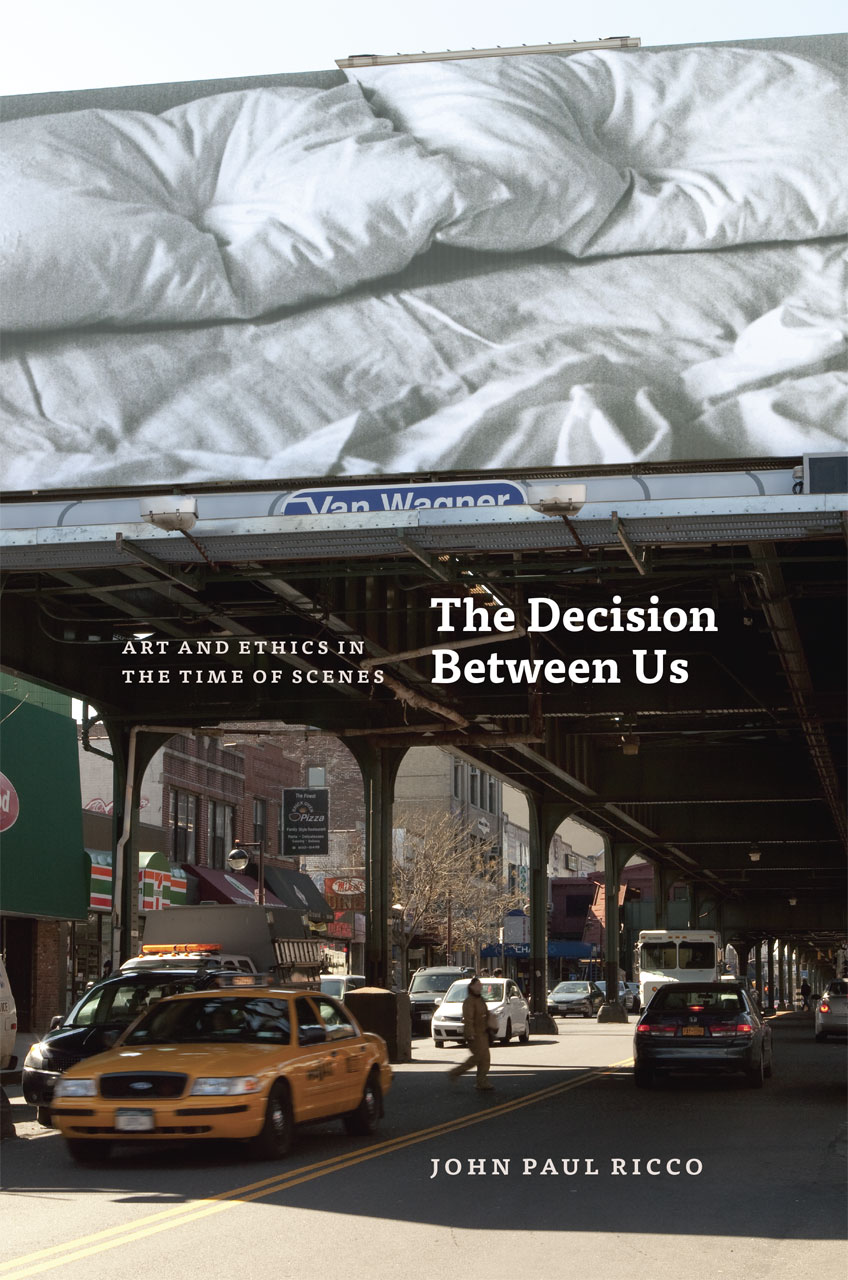
University of Chicago Press, March 2014.

University of Chicago Press, March 2014.

The Decision Between Us combines an inventive reading of Jean-Luc Nancy with queer theoretical concerns to argue that while scenes of intimacy are spaces of sharing, they are also spaces of separation. John Paul Ricco shows that this tension informs our efforts to coexist ethically and politically, an experience of sharing and separation that informs any decision. Using this incongruous relation of intimate separation, Ricco goes on to propose that “decision” is as much an aesthetic as it is an ethical construct, and one that is always defined in terms of our relations to loss, absence, departure, and death.

Laying out this theory of “unbecoming community” in modern and contemporary art, literature, and philosophy, and calling our attention to such things as blank sheets of paper, images of unmade beds, and the spaces around bodies, The Decision Between Us opens in 1953, when Robert Rauschenberg famously erased a drawing by Willem de Kooning, and Roland Barthes published Writing Degree Zero, then moves to 1980 and the “neutral mourning” of Barthes’ Camera Lucida, and ends in the early 1990s with installations by Felix Gonzalez-Torres. Offering surprising new considerations of these and other seminal works of art and theory by Jean Genet, Marguerite Duras, and Catherine Breillat, The Decision Between Us is a highly original and unusually imaginative exploration of the spaces between us, arousing and evoking an infinite and profound sense of sharing in scenes of passionate, erotic pleasure, as well as deep loss and mourning.

“Through a compelling, lucid, and wonderfully suggestive reading of Nancy’s writings, we are exposed throughout The Decision Between Us to numerous scenes of seduction and abandoned existence, scenes at once erotic and funerary, intimate and desolate. An incisive contribution to the ways in which Nancy’s writings might be read today, the sense of sharing at the heart of the argument is both transformative and intensely ethical.”

Philip Armstrong, Ohio State University

“Ricco’s The Decision Between Us is a beautifully executed book on the execution and extension of being-in-relation. Its articulation of sexuality theory, deconstructive philosophy, and queer art opens up different idioms to each other the way lovers open to each other—excitedly, productively, and yet always enigmatically, pointing beyond what seems present. Ricco is also a brilliant close reader. An enrapturing read.”

Lauren Berlant, University of Chicago

“Reopening ground broken by Jean-Luc Nancy, The Decision Between Us traces the paradoxes of relational being across a range of artistic, literary, and philosophical ‘scenes.’ Through a series of startling juxtapositions, Ricco weaves together scenes of exposure, erasure, and unmaking to reveal the inseparability of aesthetics from ethics.  This is an original and challenging work by one of our most brilliant philosophers of visuality.”

Tim Dean, State University of New York at Buffalo


Transmission Annual (2013)

LABOUR, WORK, ACTION
Edited by Michael Corris, Jaspar Joseph-Lester, Sharon Kivland
With guest editors Maureen Connor and Elizabeth Legge

Taking up Hannah Arendt’s reflections on three important human activities – labour, work, action – this book addresses the role that might be played by artist or work of art, and how this makes for agents and agency.

Contributors: Ivana Bago, Jordan Bear, Pascal Beausse, Bernard Brunon, Pavel Büchler, Armin Chodzinski, Annie Coll, Michael Corris, Janeil Engelstad, Francesco Finizio, Charlie Gere, Jerome Harrington, David Hopkins, Shannon Jackson, Vincent Victor Jouffe, the Pedagogy Group, Elizabeth Legge, Dale MacFarlane, Roberto Martinez, Mary-Lou Lobsinger, Hester Reeve, Oliver Ressler, John Paul Ricco, Abigail Satinsky, Juliet Steyn.

Transmission is a project that has encompassed an annual journal, a series of related publications, a lecture series, symposia and other events. Transmission Annual is a yearly publication, now in four volumes, edited by Jaspar Joseph-Lester (Royal College of Art, London), Sharon Kivland (Sheffield Hallam University), Michael Corris (The Meadows School of the Arts, SMU, Dallas, Texas), who were joined for 2012 by Noah Simblist (The Meadows School of the Arts, SMU, Dallas, Texas).

Scapegoat: Architecture Landscape Political Economy 05 Excess

Editorial Preview:
Ours is unquestionably a time of excess. While currencies and commodities continue to circulate, reifying segregation and inequality throughout the global political economy, excess leaks out in all directions, sometimes fostering movements of resistance, other times permitting improvisational opportunism among often neglected actors, and still at other moments irrevocably damaging ecologies and environments which we humans precariously but ruthlessly inhabit. The pleasures and perils of excess cross divisions of class, race, gender and sexuality, while also reinforcing aspects of these and other identities.

Can we design for, or among, the excesses of contemporary culture? How do practices of architecture and landscape architecture, as well as adjacent practices of art, curation, philosophy, and typography, suggest ways to amplify, capture, or redirect excess?

In EXCESS-Scapegoat’s sixth issue-we explore the productive, resistant, and imperiling aspects of excess as an attempt to advance our project of emboldening theoretical and historical modes of inquiry, scholarly research, and design practice. It is a vast conceptual terrain, but one that offers many compelling perspectives.

Contributors to EXCESS include: Ariella AZOULAY, Georges BATAILLE, Jean BAUDRILLARD, Alex BERCEANU, Diana BERESFORD-KROEGER, James BRIDLE, Melissa CATE CHRIST, Tings CHAK, Steven CHODORIWSKY, Vicki DASILVA, Heather DAVIS, Sara DEAN, Amanda DE LISIO, Seth DENIZEN, EMIL, ÉPOPÉE, FALA ATELIER, Valeria FEDERIGHI, Natasha GINWALA, HEBBEL AM UFER, Lisa HIRMER, Gary HUSTWIT, David HUTAMA, Kate HUTCHENS, Jennifer JACQUET, Martti KALLIALA, Prachi KAMDAR, Stuart KENDALL, Chris KRAUS, Abidin KUSNO, Emily KUTIL, Clint LANGEVIN, Justin LANGLOIS, Sam LEACH, Stanisław LEM, Sylvère LOTRINGER, Filipe MAGALHAES, Danielle MCDONNOUGH, Meredith MILLER, Srimoyee MITRA, Jeffrey MONAGHAN, Jon PACK, Keith PEIFFER, Rich PELL, pHgH, Rick PRELINGER, Thomas PROVOST, raumlaborberlin, John Paul RICCO, Erin SCHNEIDER, Ana Luisa SOARES, Scott SØRLI, Raphael SPERRY, Anna-Sophie SPRINGER, Antonio STOPPANI, Maria TAYLOR, Eugene THACKER, Kika THORNE, Emily VANDERPOL, Kevin WALBY, Eyal WEIZMAN, Jason YOUNG, Vivian ZIHERL, and Joanna ZYLINSKA.


On March 7 & 8, 2013 I will give a lecture and lead a seminar based upon my current book project: Non-consensual futures: pornographic faith and the economy of the eve. I am honored by the invitation extended by Professor Deborah Harter and her graduate students in the Mellon Seminar:

Frames of the Beautiful, the Criminal, and the Mad: The Art and the Science of Excess

Faculty leader: Deborah Harter, associate professor of French studies

Student participants: Sarah Seewoester Cain (linguistics), Linda Ceriello (religious studies), Kristen Ray (English), Nathaniel Vlachos (anthropology), and Rachel Schneider Vlachos (religious studies).

Seminar Description
Reflecting on representations of the “excessive” in science and in art of the modern period – madness, genius, criminal, eccentric, beautiful, and pathological – this seminar welcomes students from all fields in the humanities and social sciences. We will consider the aesthetic with scientific, the ethical with the historical, and play havoc with all usual boundaries of disciplines, period, and genre.