Archive

Sex & Sexuality

University of Chicago Press, March 2014.

University of Chicago Press, March 2014.

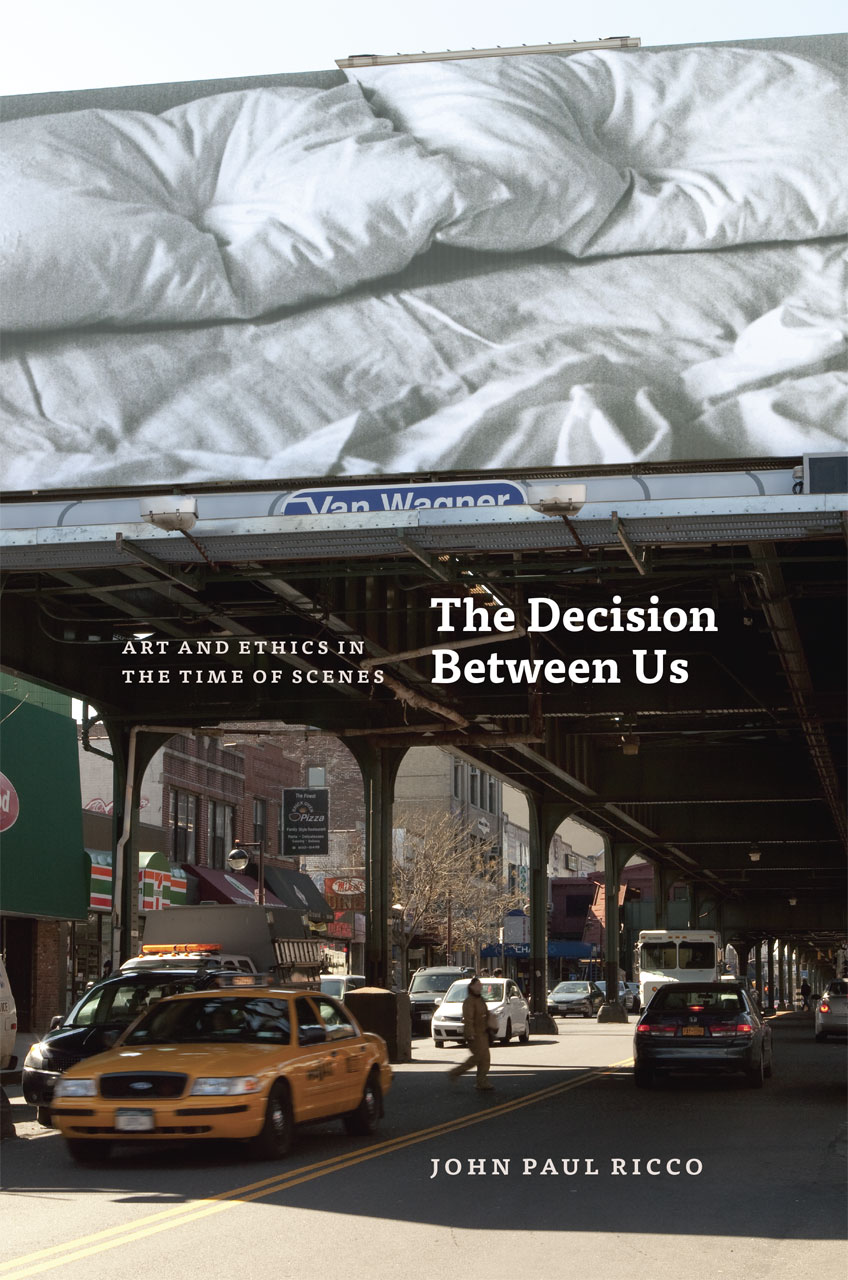
The Decision Between Us combines an inventive reading of Jean-Luc Nancy with queer theoretical concerns to argue that while scenes of intimacy are spaces of sharing, they are also spaces of separation. John Paul Ricco shows that this tension informs our efforts to coexist ethically and politically, an experience of sharing and separation that informs any decision. Using this incongruous relation of intimate separation, Ricco goes on to propose that “decision” is as much an aesthetic as it is an ethical construct, and one that is always defined in terms of our relations to loss, absence, departure, and death.

Laying out this theory of “unbecoming community” in modern and contemporary art, literature, and philosophy, and calling our attention to such things as blank sheets of paper, images of unmade beds, and the spaces around bodies, The Decision Between Us opens in 1953, when Robert Rauschenberg famously erased a drawing by Willem de Kooning, and Roland Barthes published Writing Degree Zero, then moves to 1980 and the “neutral mourning” of Barthes’ Camera Lucida, and ends in the early 1990s with installations by Felix Gonzalez-Torres. Offering surprising new considerations of these and other seminal works of art and theory by Jean Genet, Marguerite Duras, and Catherine Breillat, The Decision Between Us is a highly original and unusually imaginative exploration of the spaces between us, arousing and evoking an infinite and profound sense of sharing in scenes of passionate, erotic pleasure, as well as deep loss and mourning.

“Through a compelling, lucid, and wonderfully suggestive reading of Nancy’s writings, we are exposed throughout The Decision Between Us to numerous scenes of seduction and abandoned existence, scenes at once erotic and funerary, intimate and desolate. An incisive contribution to the ways in which Nancy’s writings might be read today, the sense of sharing at the heart of the argument is both transformative and intensely ethical.”

Philip Armstrong, Ohio State University

“Ricco’s The Decision Between Us is a beautifully executed book on the execution and extension of being-in-relation. Its articulation of sexuality theory, deconstructive philosophy, and queer art opens up different idioms to each other the way lovers open to each other—excitedly, productively, and yet always enigmatically, pointing beyond what seems present. Ricco is also a brilliant close reader. An enrapturing read.”

Lauren Berlant, University of Chicago

“Reopening ground broken by Jean-Luc Nancy, The Decision Between Us traces the paradoxes of relational being across a range of artistic, literary, and philosophical ‘scenes.’ Through a series of startling juxtapositions, Ricco weaves together scenes of exposure, erasure, and unmaking to reveal the inseparability of aesthetics from ethics.  This is an original and challenging work by one of our most brilliant philosophers of visuality.”

Tim Dean, State University of New York at Buffalo


Scapegoat: Architecture Landscape Political Economy 05 Excess

Editorial Preview:
Ours is unquestionably a time of excess. While currencies and commodities continue to circulate, reifying segregation and inequality throughout the global political economy, excess leaks out in all directions, sometimes fostering movements of resistance, other times permitting improvisational opportunism among often neglected actors, and still at other moments irrevocably damaging ecologies and environments which we humans precariously but ruthlessly inhabit. The pleasures and perils of excess cross divisions of class, race, gender and sexuality, while also reinforcing aspects of these and other identities.

Can we design for, or among, the excesses of contemporary culture? How do practices of architecture and landscape architecture, as well as adjacent practices of art, curation, philosophy, and typography, suggest ways to amplify, capture, or redirect excess?

In EXCESS-Scapegoat’s sixth issue-we explore the productive, resistant, and imperiling aspects of excess as an attempt to advance our project of emboldening theoretical and historical modes of inquiry, scholarly research, and design practice. It is a vast conceptual terrain, but one that offers many compelling perspectives.

Contributors to EXCESS include: Ariella AZOULAY, Georges BATAILLE, Jean BAUDRILLARD, Alex BERCEANU, Diana BERESFORD-KROEGER, James BRIDLE, Melissa CATE CHRIST, Tings CHAK, Steven CHODORIWSKY, Vicki DASILVA, Heather DAVIS, Sara DEAN, Amanda DE LISIO, Seth DENIZEN, EMIL, ÉPOPÉE, FALA ATELIER, Valeria FEDERIGHI, Natasha GINWALA, HEBBEL AM UFER, Lisa HIRMER, Gary HUSTWIT, David HUTAMA, Kate HUTCHENS, Jennifer JACQUET, Martti KALLIALA, Prachi KAMDAR, Stuart KENDALL, Chris KRAUS, Abidin KUSNO, Emily KUTIL, Clint LANGEVIN, Justin LANGLOIS, Sam LEACH, Stanisław LEM, Sylvère LOTRINGER, Filipe MAGALHAES, Danielle MCDONNOUGH, Meredith MILLER, Srimoyee MITRA, Jeffrey MONAGHAN, Jon PACK, Keith PEIFFER, Rich PELL, pHgH, Rick PRELINGER, Thomas PROVOST, raumlaborberlin, John Paul RICCO, Erin SCHNEIDER, Ana Luisa SOARES, Scott SØRLI, Raphael SPERRY, Anna-Sophie SPRINGER, Antonio STOPPANI, Maria TAYLOR, Eugene THACKER, Kika THORNE, Emily VANDERPOL, Kevin WALBY, Eyal WEIZMAN, Jason YOUNG, Vivian ZIHERL, and Joanna ZYLINSKA.


(An abstract of an essay for a special issue on “Bodily Fluids” of the journal inter/Alia, edited by Kamillea Aghtan, Michael O’Rourke, and Karin Sellberg).

It is a preverbal stream that deposits on the pillow a barely visible trace, as if a little saliva had leaked out of that sleeping mouth.
—Jean-Luc Nancy

In a chapter titled “Self from Absence to Self” of his recent essay, The Fall of Sleep, Jean-Luc Nancy draws upon the image of a little saliva leaking out of a sleeper’s mouth in order to analogise the withdrawal of self from I, into self. A fall into self that is not so much the enunciative “I am” of either a waking consciousness or dreaming unconsciousness, but the excessive and residual trace of the fall into self that is the fall – or what we might call, the drool – of speech.

Taking its cue from Nancy’s essay, and specifically his image of the barely visible trace deposited on the pillow, my paper will theorise drool as the liquid fore-speech of what I have come to call the fore-scene. The latter, in its own right, draws upon Nancy’s readings of Freud on Vorlust (Fore-lust) as the stage/scene of exposure and the spacing of the sense of existence as shared-separated. For drool is, as we know, a common liquid metaphor for uncontainable desire. An excessivity that, as formless force and form of the ground, is nothing but the unintelligibility of the fore, “upon” which anything like erotic pleasure (including as its own kind of intelligence) might be possible. In speaking in such terms, I of course also have in mind the base materialism of George Bataille’s definition of the formless and its analogy of the universe to spit.

In this paper I continue my ongoing theoretical meditations on photographic images of the unmade (but not necessarily “empty”) bed (i.e. Felix Gonzalez-Torres’ Untitled Billboard photograph, 1992) as fore-scene of co-existence/co-exposure. Based upon Nancy’s text these images are understood to be images of the impossibility of perceiving, let alone representing, sleep. For if, as Nancy states, sleep “shows itself to itself as this appearance that appears only as non-appearing, as returning all appearing on itself and in itself,” then the image of the unmade bed lies extended there in the aesthetics of retreat, “allowing the waking phenomenologist [the one that we inevitably become in the drive to satisfy our experiential/epistemological curiosity] approaching the bed to perceive nothing but the appearance of its disappearance, the attestation of its retreat” (Fall, 13).

Drool is to the verbal what the empty bed is to the visual, yet as the fall of speech, drool is not a matter of the verbal or the oral but of the “buccal,” as this has been theorised by Nancy and further articulated by Michael O’Rourke. As the liquid fore-speech of the fore-scene/fore-lust, we might say that drool is the pre-cum of a buccal murmur and groan. With the lightest of touches, as though with the tap of a finger, this spit is extended, and in its extension traces the tenuous yet resiliently tensile line of the “with” of our shared existence. As though at that sleeping mouth a salvific path was somehow opened up, and in that fall of speech one hears the “with”, the “substance” of which is something like ex-gested spit, or drool.

Patterson Scarlett, Broome Street at Broadway (Rooftop Elevator Room), 2011, from the book, Petite Mort: Recollections of a Queer Public.

I am a contributing author to Petite Mort: Recollections of a Queer Public.
Click on this link for additional information and a free PDF of this fantastic new book.
http://www.art-agenda.com/shows/forever-today-inc-presents-petite-mort-recollections-of-a-queer-public/

Public sex[*] happens. The simplicity, brevity, honesty and candor of this proposition, is, I contend, one of the most principal ways in which public sex matters. It matters because it happens, and it happens because it matters. This is no small thing. It still happens and matters, even now, after so many attempts to insure that it no longer does. Public sex is resilient and persistent, and its temporal-historical stamina lies—in large part—in its geo-spatial anonymity, itinerancy, imperceptibility and illegality.  In contemplating my response to the editors’ query, I considered the possibility of simply supplying them with a list of all of the places where I have had public sex (necessarily non-exhaustive due to the innumerable number of places over the years, as well as the limits of memory and the evanescent residuality of the encounters that it would retrace).

But as I thought back to these remembered incidents, I found it easy to recollect and draw out images of these scenes, yet nearly impossible in most instances to locate with any kind of cartographic accuracy the exact name or address of these particular spots—less punctuated locations than elliptical lines—easily returned to in memory or in actuality, yet difficult to nominally cite in a list. Herein lies the other principal way in which public sex matters: where it happens is without adequate or appropriate address. Less a place per se, than it is a non-appropriating taking place, public sex is the erotic/libidinal/desirous and pleasure-filled happening and coming together of two or more bodies in the pure exhilaration of this singular shared encounter with the space of their separation.

This text will appear in, Petite Mort: Recollections of a Queer Public, edited by Carlos Motta and Joshua Lubin-Levy, forthcoming, September 2011. The project will also include an exhibition and series of public programs at Forever & Today, Inc. (www.foreverandtoday.org) in September 2011. For more information on the project, go to: http://www.unitedstatesartists.org/project/petite_mort_recollections_of_a_queer_public


[*] Or is it to be written: Public Sex (the difference being a matter of erring on the side of the adjectival or the eidetic)?