Archive

Queer Theory

I recently led a discussion amongst all of the Fellows at the Jackman Humanities Institute (University of Toronto) of William Haver’s essay, “The Art of Dirty Old Men: Rembrandt, Giacometti, Genet,” published in Parallax, in a special issue that I edited on “unbecoming,” (vol. 11, no. 2, 2005). Here are my introductory remarks.

One of the principal assertions in the study of Visual Culture, including what WJT Mitchell, one of the founders of the field has elaborated as “picture theory,” entails the philosophical reclamation of “picture thinking”—the kind of thinking that Hegel had attempted to thoroughly denigrate. At the same time, such methods that for awhile comprised what was referred to as the “visual turn,” entails an embrace of Kant’s notion of the schema, precisely in order to think in non-symbolic and non-representational ways not only whatever the word “culture,” designates in “visual culture,”  but also “visuality,” of which “images” are just one of the many “things” in question. But as these names imply, “picture thinking” or “picture theory” are also ways to engage in thinking and the practice of thought, and not only through pictures (as though images were merely forms of mediation between the mind and the world), but more deeply and perhaps more philosophically, about thought “itself:” its source, its practice, its durations and its interruptions. In the wake of our reading of Deleuze, we can speak of “the image of thought,” in which that image might be a thing in addition to possibly being a conceptual personae or an affective perception or intuition. This is of serious consequence, since there is an inextricable relation between thought and things (to quote the title of Leo Bersani’s most recent book), and needless to say, it this relation that resides at the heart of our theme at the Jackman Humanities Institute this year, and our common theme of “things that matter.”

As we begin to parse the relation between thought and things, we might turn to Jean-Luc Nancy, who states—in one of his books on Hegel, in fact—that “thought sinks into things only to the extent that it sinks into itself—which is its own act of thought” (Restlessness, 15). Thus the ways in which thought sinks or penetrates into things, or simply acts in the vicinity of things, is the way in which thought thinks. This image of thought is the intuition of sense—its literality and visuality—in which the Kantian schema proves to be nothing other than an image. As Fredric Jameson has recently pointed out, this is what Einstein’s thought experiments consisted of, and, we might add, how quantum theory thinks about things. Namely: through non-representational yet still referential pictures, including diagrams. As Jameson explains, in all of these instances, it is the signifier that determines the signified, and the effect determines the cause. These are formulas that we are utterly familiar with, in our various engagements with post-structuralism and deconstruction.

This is also the inverse temporality that I am interested in, and that motivates the research project that I am pursuing here at the JHI on the collective afterlife of things. It is a temporality that does not only track the effects of the present on the past, but of the future on the present. This temporality is rendered literary and is visualized in the science fiction sub-genre of the time-travel narrative; and in fact it is in a recent review of a new theoretical study of this genre, where Jameson, in the very last sentence of his article, draws the stunning conclusion that “temporality is then nothing but a time-travel narrative.” (“In Hyperspace,” review of Time Travel: The Popular Philosophy of Narrative, by David Wittenberg, Fordham; London Review of Books, 10 September 2015).

This is where I think William Haver’s essay on “The Art of Dirty Old Men,” enters the discussion, and its provocation not about the history but about the historicity of thought, which is to say, thought’s sinking into things/into itself, which in turn is to speak of thought’s image. For whereas in these sci-fi  time-travel narratives there is, as Jameson explains, “the transcendental necessity of superspace in any narrative rendering of time,” Haver argues that due to the force of finitude, meaning “non-transcedence,” such narrative renderings of time are interrupted (including in the disciplinary discourses of “history” or “art history” and their own aspirations toward a transcendental perspective in the form of explanation, interpretation and understanding). Further, it is not so much that time-travel becomes impossible, but more precisely that it now must be thought as generating not temporality, but what Haver describes as “a-temporal disjunct simultaneity,” or more simply: the sense of finitude—finitude’s historicity. Yet to all of this we must ask: why is this case?

Haver’s answer is that it is because of the material impasse of existence, the fact that existence, or what he describes as the “identity and equality of sentient being” is abject in its non-transcendence. Meaning, the finitude of bodies, thoughts and things, in their incommensurable singularity and sheer exteriority: things that is, other than in terms of the instrumental, meaning or significance, the calculable or the numerable. In other words: the dirty old man whose look butted against Genet’s own non-contemplative and impersonal seeing. “Material impasse” describes the impasse or essential insufficiency of thought to its objects (in a word: materiality) and that which in its materiality is irreducible to a thing.

In “On the Solitude of Things,” a chapter of an unpublished book on Genet and the political, Haver at one point makes clear that “it is not…simply a matter of resigning or refusing one’s transcendence, of abandoning the distance of perspective. Rather it is a matter of sustaining the syncopations every historicization elides, of inhabiting the infinite yet absolutely proximate distance between evidence and experience, between interpretation and evidence, between transcendence and finitude” (Solitude, 10).

Genet speaks to this interruption of the time-travel narrative and thus of temporality, in a way that underlines how this experience—which Haver will go on to theorize as not only the conviction of the aesthetic, but also the experience of the ethical and the political—when he (Genet) writes (first block quote on page 29) about the sensuous pleasure of his hand in a boy’s hair, and how even though he (Genet) “shall die, nothing else will.”

 A little while ago I wrote that though I shall die, nothing else will. And I must make my meaning clear. Wonder at the sight of a cornflower, at a rock, at the touch of a rough hand –all the millions of emotions of which I’m made –they won’t disappear even though I shall. Other men will experience them, and they’ll still be there because of them. More and more I believe I exist in order to be the terrain and proof which show other men that life consists in the uninterrupted emotions flowing through all creation. The happiness my hand knows in a boy’s hair will be known by another hand, is already known. And although I shall die, this happiness will live on. ‘I’ may die, but what made that ‘I’ possible, what made possible the joy of being, will make the joy of being live on without me.

(Genet, The Prisoner of Love, NYRB, 2003 translated by Barbara Bray, 361)

This is not a transcendental time-travel narrative, in which one travels back to (or from) the future, but is instead what I wish to theorize as the collective afterlife of things, in which the abject non-transcendence of our finitude is what we share between us (the fact and condition of “social ontology”), and not in some future end of times, but here, now when we see a clothespin left behind on a line, or look at a Rembrandt, a Giacometti, or in our encounters with any number of other things. As Haver argues, the “thing” of painting or of seeing provokes an accidental intuition of the identity and equality of sentient being as that which is predicated upon nothing (no sufficient principle or reason) and thus is absolutely unjustifiable. To give ourselves over to this unjustifiable existence, would be to begin to do justice to things and each other.

I am very pleased to receive this review of my book by art historian Tom McDonough, that was recently published in the journal Critical Inquiry. Click on the link below to access the complete review.

Tom McDonough review in Critical Inquiry


  1. “The Inoperative Praxis of the Already-Unmade,” in Labour, Work, Action, edited by Michael Corris, Jaspar Joseph-Lester, and Sharon Kivland, Artwords Press, 2013. 
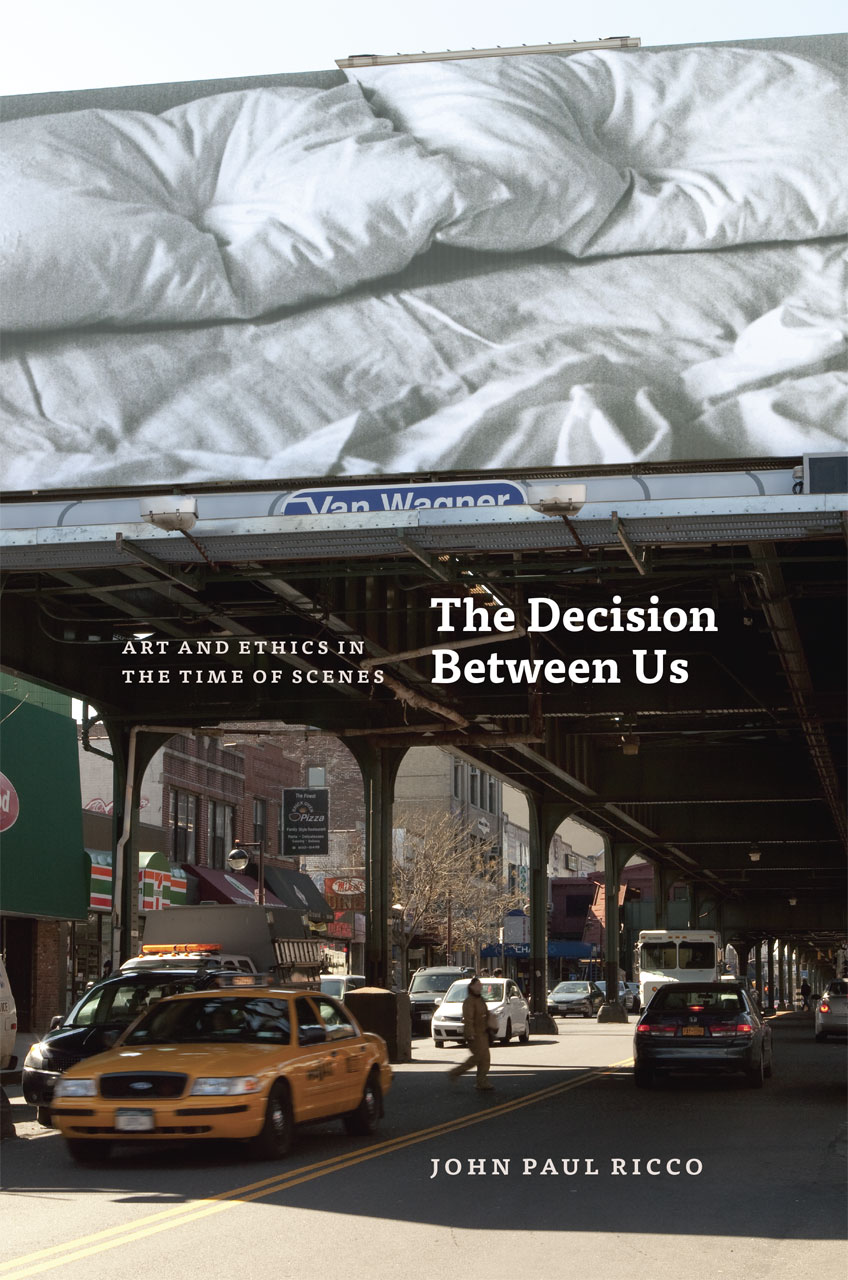
  2. John Paul Ricco, The Decision Between Us: art and ethics in the time of scenes, University of Chicago Press, 2014. 
  3. “Pornographic Faith: Two Sources of Naked Sense at the Limits of Belief and Humiliation,” in Porn Archives, edited by Tim Dean, Steven Ruszczycky, and David Squires, Duke University Press, 2014. 
  4. “The Existence of the World is Always Unexpected: Jean-Luc Nancy in conversation with John Paul Ricco,” in Art and the Anthropocene: Encounters Among Aesthetics, Politics, Environments and Epistemologies, edited by Heather Davis and Etienne Turpin, Open Humanities Press, 2015.
  5. “The Separated Gesture: Partaking in the Inoperative Praxis of the Already-Unmade,” in Nancy and the Political, edited by Sanja Dejanovic, Edinburgh University Press, 2015.
  6. “Parasol, Setas, Parasite, Peasant,” in J. Mayer H.: Could Should Would, Hatje Cantz, 2015. 
  7. PLUS: “Drool: liquid fore-speech of the fore-scene,” in World Picture, issue on “Abandon,” summer 2015 ( available online). 

Published in the latest issue of the online, open-access journal World Picture, on the theme of abandon. You can read and download my essay and the others in the volume, here: World Picture 10: Abandon

An emphasis on the “interpersonal” and interactive in contemporary art is often considered a riposte to what Bourriaud has termed “imposed” or institutionalized social relations. Ricco’s close investigation of the non-relational aspects of relationality—the manner in which we do not come together—is, therefore, a crucial intervention into the aesthetic and ethical impasse that is ever-present in discussions of art after the participatory turn…In substituting the act of decision for a more common art historical/critical activity like “evaluation,” Ricco shows that the promise of a truly relational practice lies in maintaining a shared space that we do not stand apart from or in judgment of.

From: Christa Noel Robbins, “Together Apart,” Art in America, January 2014.

U of T’s John Ricco is an associate professor of contemporary art, media theory, and criticism. His work focuses on Jean-Luc Nancy’s philosophies of politics, among other things, as discussed in his latest monograph, The Decision Between Us. His latest work is billed as an “exploration of the spaces between us”, including “scenes of passionate, erotic pleasure as well as deep loss and mourning”. Ricco took some time to talk to The Medium about his new monograph and his inspiration to write it, and provided a preview of his current project.

The Medium: What inspired this desire to conceptualize the staging of the space of decision in 20th-century art?

John Ricco: I have always been interested in thinking about social relations, and the spaces and forms of being together. In my first book, The Logic of the Lure, I focused on scenes of social sexual attraction. In the new book, I was interested in moving from questions of attraction and what lures one out toward other places and people, to the spaces that are shared between us in our social relations and encounters—spaces that are ones of separation. I argue that the extent to which we partake in the social pleasures is the extent to which we sustain this separated spacing. “Decision” is one name for how we participate in this space of shared separation. In the six chapters of my book, I look at works by various late-20th-century artists, writers, and theorists as examples of such scenes of decision in drawing, photography, and installation art, amongst other art forms and genres. One might argue that such staging of the scene of decision is present in art across the centuries, but my study is limited to examples from 1953 to the present, in part because this is the art historical period that I specialize in, but also because many of the works from this period foreground the participatory role of the audience or reader in his or her encounter with works of art, texts, etc. To decide to partake in the work, and thus immediately to be confronted with questions as to how and why to partake, is another way in which I think of these as scenes of aesthetic and ethical decisions.

TM: What was it about Jean-Luc Nancy’s theories specifically that drew you to his works more than anyone else’s?

JR: There are so many things about Nancy’s work that I find compelling and useful for my own. First and foremost is the way in which he is committed to conceiving such essential philosophical questions of existence and being, not in terms of the individual subject or ego, but as always shared. For Nancy, being is always “being with”. If that is so—and I completely think it is—then obviously the ethical is inseparable from the ontological because the ethical is the question of how to be and coexist with others.

TM: How long did this book take to complete considering your busy academic schedule?

JR: A book like this is almost always a long time in the making. It requires several years of reading, research, and conceptualization, along with many stages of writing and rewriting. Along the way, I presented parts of it at academic conferences, workshops, and public lectures, and/or as articles in journals. I finished the first draft of the complete manuscript and submitted it to the press right around the end of 2011. It then took a little more than two years for it to be proofread and edited, and for it to go from manuscript to a fully designed, formatted, indexed, and printed book. This entire process from conception to publication took about five years to complete and many hands were involved in addition to my own.

In terms of my academic work, essentially whatever time is not allocated for my teaching or administrative duties is devoted to my research and writing. I try to strike a balance between all three aspects of my job, and to set aside time nearly every day to work on whatever research or writing projects I am currently engaged in. It is easier during the summer, when I am not teaching, to make significant progress on my own work—and, of course, sabbaticals, such as the one I am on right now, provide incredibly valuable uninterrupted time to focus on a long-term project.

TM: Tim Dean called you “one of our most brilliant philosophers of visuality”. Does praise like that influence how you write?

JR: Well, I can easily return the compliment and say, unequivocally, that Tim Dean is one of our most brilliant philosophers of sexuality. Everyone should read his book Unlimited Intimacy: Reflections on the Subculture of Barebacking, which is hands-down the best book on sex and sexuality out there. So when someone whose work you admire and have learned so much from says something like that about you, you cannot help but be completely honored and deeply humbled at once. As far as influencing the way I write… well, it certainly raises the stakes, doesn’t it!

TM: Can you tell me a little more about Non-Consensual Futures? How do you feel the use of violence has altered neo-liberalism?

JR: You are referring to my current research and book project, which I had been calling Non-Consensual Futures, but which now carries the title The Outside Not Beyond: Pornographic Faith and the Economy of the Eve. It is the third book in a trilogy, following upon The Logic of the Lure and The Decision Between Us. As I mentioned earlier, the first book was about attraction and the second was about decision, and now the third is about departure and abandonment. It grows out of two areas of research: one on the images of bodies falling from the World Trade Centre towers on 9/11, and the other on various instances of excess and the overflowing of corporeal limits. What ties them together are the ways in which bodies come to be defined in terms of their exposure to the outside, a spacing that does not lie in some abstract or transcendent realm “beyond”, but rather is right there in such ordinary and everyday instances as the step of a foot, or the partial opening of the mouth. “Pornographic faith” is my way of naming the thoroughly corporeal comportment and exposure to this radical uncertainty, the pleasure, and of abandoning the sense of one possessing a secure ground from which to act, or a definite end toward which one will eventually reach. I argue that another name for this is “freedom”.

Much of my work on neo-liberalism’s use of violence originally emerged from two undergraduate visual culture seminars that I regularly teach in the Department of Visual Studies at UTM, one called “Capital, Spectacle, War” and the other “Architectures of Vision”. In my classes, we are interested in the ways in which images and visual spectacle are deployed by the militarized neo-liberal state to shock its subjects into states of fear and anxiety, as evidenced, for example, in the Bush administration’s use of such images of violence as part of its “war on terror”.

This interview has been edited for length.

Published: Monday, September 29th, 2014

University of Chicago Press, March 2014.

University of Chicago Press, March 2014.

The Decision Between Us combines an inventive reading of Jean-Luc Nancy with queer theoretical concerns to argue that while scenes of intimacy are spaces of sharing, they are also spaces of separation. John Paul Ricco shows that this tension informs our efforts to coexist ethically and politically, an experience of sharing and separation that informs any decision. Using this incongruous relation of intimate separation, Ricco goes on to propose that “decision” is as much an aesthetic as it is an ethical construct, and one that is always defined in terms of our relations to loss, absence, departure, and death.

Laying out this theory of “unbecoming community” in modern and contemporary art, literature, and philosophy, and calling our attention to such things as blank sheets of paper, images of unmade beds, and the spaces around bodies, The Decision Between Us opens in 1953, when Robert Rauschenberg famously erased a drawing by Willem de Kooning, and Roland Barthes published Writing Degree Zero, then moves to 1980 and the “neutral mourning” of Barthes’ Camera Lucida, and ends in the early 1990s with installations by Felix Gonzalez-Torres. Offering surprising new considerations of these and other seminal works of art and theory by Jean Genet, Marguerite Duras, and Catherine Breillat, The Decision Between Us is a highly original and unusually imaginative exploration of the spaces between us, arousing and evoking an infinite and profound sense of sharing in scenes of passionate, erotic pleasure, as well as deep loss and mourning.

“Through a compelling, lucid, and wonderfully suggestive reading of Nancy’s writings, we are exposed throughout The Decision Between Us to numerous scenes of seduction and abandoned existence, scenes at once erotic and funerary, intimate and desolate. An incisive contribution to the ways in which Nancy’s writings might be read today, the sense of sharing at the heart of the argument is both transformative and intensely ethical.”

Philip Armstrong, Ohio State University

“Ricco’s The Decision Between Us is a beautifully executed book on the execution and extension of being-in-relation. Its articulation of sexuality theory, deconstructive philosophy, and queer art opens up different idioms to each other the way lovers open to each other—excitedly, productively, and yet always enigmatically, pointing beyond what seems present. Ricco is also a brilliant close reader. An enrapturing read.”

Lauren Berlant, University of Chicago

“Reopening ground broken by Jean-Luc Nancy, The Decision Between Us traces the paradoxes of relational being across a range of artistic, literary, and philosophical ‘scenes.’ Through a series of startling juxtapositions, Ricco weaves together scenes of exposure, erasure, and unmaking to reveal the inseparability of aesthetics from ethics.  This is an original and challenging work by one of our most brilliant philosophers of visuality.”

Tim Dean, State University of New York at Buffalo


Transmission Annual (2013)

LABOUR, WORK, ACTION
Edited by Michael Corris, Jaspar Joseph-Lester, Sharon Kivland
With guest editors Maureen Connor and Elizabeth Legge

Taking up Hannah Arendt’s reflections on three important human activities – labour, work, action – this book addresses the role that might be played by artist or work of art, and how this makes for agents and agency.

Contributors: Ivana Bago, Jordan Bear, Pascal Beausse, Bernard Brunon, Pavel Büchler, Armin Chodzinski, Annie Coll, Michael Corris, Janeil Engelstad, Francesco Finizio, Charlie Gere, Jerome Harrington, David Hopkins, Shannon Jackson, Vincent Victor Jouffe, the Pedagogy Group, Elizabeth Legge, Dale MacFarlane, Roberto Martinez, Mary-Lou Lobsinger, Hester Reeve, Oliver Ressler, John Paul Ricco, Abigail Satinsky, Juliet Steyn.

Transmission is a project that has encompassed an annual journal, a series of related publications, a lecture series, symposia and other events. Transmission Annual is a yearly publication, now in four volumes, edited by Jaspar Joseph-Lester (Royal College of Art, London), Sharon Kivland (Sheffield Hallam University), Michael Corris (The Meadows School of the Arts, SMU, Dallas, Texas), who were joined for 2012 by Noah Simblist (The Meadows School of the Arts, SMU, Dallas, Texas).

Scapegoat: Architecture Landscape Political Economy 05 Excess

Editorial Preview:
Ours is unquestionably a time of excess. While currencies and commodities continue to circulate, reifying segregation and inequality throughout the global political economy, excess leaks out in all directions, sometimes fostering movements of resistance, other times permitting improvisational opportunism among often neglected actors, and still at other moments irrevocably damaging ecologies and environments which we humans precariously but ruthlessly inhabit. The pleasures and perils of excess cross divisions of class, race, gender and sexuality, while also reinforcing aspects of these and other identities.

Can we design for, or among, the excesses of contemporary culture? How do practices of architecture and landscape architecture, as well as adjacent practices of art, curation, philosophy, and typography, suggest ways to amplify, capture, or redirect excess?

In EXCESS-Scapegoat’s sixth issue-we explore the productive, resistant, and imperiling aspects of excess as an attempt to advance our project of emboldening theoretical and historical modes of inquiry, scholarly research, and design practice. It is a vast conceptual terrain, but one that offers many compelling perspectives.

Contributors to EXCESS include: Ariella AZOULAY, Georges BATAILLE, Jean BAUDRILLARD, Alex BERCEANU, Diana BERESFORD-KROEGER, James BRIDLE, Melissa CATE CHRIST, Tings CHAK, Steven CHODORIWSKY, Vicki DASILVA, Heather DAVIS, Sara DEAN, Amanda DE LISIO, Seth DENIZEN, EMIL, ÉPOPÉE, FALA ATELIER, Valeria FEDERIGHI, Natasha GINWALA, HEBBEL AM UFER, Lisa HIRMER, Gary HUSTWIT, David HUTAMA, Kate HUTCHENS, Jennifer JACQUET, Martti KALLIALA, Prachi KAMDAR, Stuart KENDALL, Chris KRAUS, Abidin KUSNO, Emily KUTIL, Clint LANGEVIN, Justin LANGLOIS, Sam LEACH, Stanisław LEM, Sylvère LOTRINGER, Filipe MAGALHAES, Danielle MCDONNOUGH, Meredith MILLER, Srimoyee MITRA, Jeffrey MONAGHAN, Jon PACK, Keith PEIFFER, Rich PELL, pHgH, Rick PRELINGER, Thomas PROVOST, raumlaborberlin, John Paul RICCO, Erin SCHNEIDER, Ana Luisa SOARES, Scott SØRLI, Raphael SPERRY, Anna-Sophie SPRINGER, Antonio STOPPANI, Maria TAYLOR, Eugene THACKER, Kika THORNE, Emily VANDERPOL, Kevin WALBY, Eyal WEIZMAN, Jason YOUNG, Vivian ZIHERL, and Joanna ZYLINSKA.


(An abstract of an essay for a special issue on “Bodily Fluids” of the journal inter/Alia, edited by Kamillea Aghtan, Michael O’Rourke, and Karin Sellberg).

It is a preverbal stream that deposits on the pillow a barely visible trace, as if a little saliva had leaked out of that sleeping mouth.
—Jean-Luc Nancy

In a chapter titled “Self from Absence to Self” of his recent essay, The Fall of Sleep, Jean-Luc Nancy draws upon the image of a little saliva leaking out of a sleeper’s mouth in order to analogise the withdrawal of self from I, into self. A fall into self that is not so much the enunciative “I am” of either a waking consciousness or dreaming unconsciousness, but the excessive and residual trace of the fall into self that is the fall – or what we might call, the drool – of speech.

Taking its cue from Nancy’s essay, and specifically his image of the barely visible trace deposited on the pillow, my paper will theorise drool as the liquid fore-speech of what I have come to call the fore-scene. The latter, in its own right, draws upon Nancy’s readings of Freud on Vorlust (Fore-lust) as the stage/scene of exposure and the spacing of the sense of existence as shared-separated. For drool is, as we know, a common liquid metaphor for uncontainable desire. An excessivity that, as formless force and form of the ground, is nothing but the unintelligibility of the fore, “upon” which anything like erotic pleasure (including as its own kind of intelligence) might be possible. In speaking in such terms, I of course also have in mind the base materialism of George Bataille’s definition of the formless and its analogy of the universe to spit.

In this paper I continue my ongoing theoretical meditations on photographic images of the unmade (but not necessarily “empty”) bed (i.e. Felix Gonzalez-Torres’ Untitled Billboard photograph, 1992) as fore-scene of co-existence/co-exposure. Based upon Nancy’s text these images are understood to be images of the impossibility of perceiving, let alone representing, sleep. For if, as Nancy states, sleep “shows itself to itself as this appearance that appears only as non-appearing, as returning all appearing on itself and in itself,” then the image of the unmade bed lies extended there in the aesthetics of retreat, “allowing the waking phenomenologist [the one that we inevitably become in the drive to satisfy our experiential/epistemological curiosity] approaching the bed to perceive nothing but the appearance of its disappearance, the attestation of its retreat” (Fall, 13).

Drool is to the verbal what the empty bed is to the visual, yet as the fall of speech, drool is not a matter of the verbal or the oral but of the “buccal,” as this has been theorised by Nancy and further articulated by Michael O’Rourke. As the liquid fore-speech of the fore-scene/fore-lust, we might say that drool is the pre-cum of a buccal murmur and groan. With the lightest of touches, as though with the tap of a finger, this spit is extended, and in its extension traces the tenuous yet resiliently tensile line of the “with” of our shared existence. As though at that sleeping mouth a salvific path was somehow opened up, and in that fall of speech one hears the “with”, the “substance” of which is something like ex-gested spit, or drool.