Archive

Publications

The special issue of the online journal Postmodern Culture I co-edited (with Austin Svedjan) on “Afterlives of the Antisocial Thesis” is now live and available for free. https://muse.jhu.edu/pub/1/issue/52747

The issue includes introductory essays by each of us two editors, an interview with Lee Edelman, and an Afterword by Tim Dean. Along with articles by Bobby Benedicto, John Paul Ricco, Tom Roach, Mikko Tuhkanen, and Robyn Weigman—each of which engages with the work of Leo Bersani in new and insightful ways, as they also situate Bersani’s work in relation other notable queer theorists and the legacy of the antisocial thesis in queer theory.

Here’s an excerpt from my Editor’s Introduction, “Not Just Antisocial, Inhuman:”

My article, “Incongruity,” in the latest issue of the journal differences, has been selected by Duke University Press as this week’s “Weekly Read.” This means that you can freely access and download the article here https://dukeupress.wordpress.com until October 31st.

You can also purchase a copy of the entire issue (all 300 pages, with 35 essays) at a 30% discount, at the web page linked above.

Here is a link to my article, “Incongruity,” recently published in the special issue of the journal differences that I co-edited with Jacques Khalip. Free-access is available until October 31, 2023.

https://read.dukeupress.edu/differences/article/34/1/156/378504/Incongruity

The article considers Leo Bersani’s concept of “incongruity” as a key term in his thinking of ethical relation. Specifically, as a description of the desynchronized movement and impersonal configuration of bodies, psyches, thoughts, and things, in which the formal mobilization of aesthetic perceptions of sameness replace the immobilizing forces of desirous knowing and difference. 

Highlighted is the way in which sameness is not based on a single predicate of commonality, but instead obtains in similar forms of movement and/or stillness that inaugurate correspondences with others and the world. This sheds light on Bersani’s familiar notions of inaccurate replication and homo-narcissism within his broader exploration of potential intimacies pleasurably discovered via a sense of universal sameness, as opposed to the often-murderous fixation on identity and difference. 

My jumping off point is the following sentence from Bersani’s book, Thoughts and Things (66):

Incongruity institutes virtualities that have no intrinsic reason to be actualized. This retreat from the actual creates a freedom that might be defined as a kind of being to which no predicate can be attached.

Here is a free-access link to the article I co-wrote with Jacques Khalip, as the Introduction to the special issue of the journal differences that we edited. Access will be available until October 2023.

https://read.dukeupress.edu/differences/article/34/1/1/378497/Homoverse?guestAccessKey=931b6969-ab4f-40e3-89ed-12bceaa5c72f

Differences, volume 34, number 1, May 2023

I am thrilled to announce that the special issue of the journal Differences that I co-edited with Jacques Khalip, is now out from Duke University Press.

“Syntax of Thought: Reading Leo Bersani” includes short essays by 35 contributors, covering every period of Bersani’s long career, and nearly every aspect of his incredibly diverse range of topics and fields, from modern French literature to the theory of sexuality, aesthetics, critical readings of psychoanalytic theory, film, art, ethics, and sociality. 

Each author was asked to choose a sentence by Bersani that spoke to them and has informed their work. And to write an essay that elaborates on the conceptual formulation and ramifications borne by the sentence, while also attesting to the inimitable style and syntax of Bersani’s thinking. 

At close to 300-pages, this is not only the largest issue ever published by the journal, but also stands as the most extensive inter-disciplinary and trans-generational engagement with Leo Bersani’s work, as well as the many essays and books he co-authored with Ulysse Dutoit. Published just a bit more than a year after Leo’s passing, the volume provides multiple pathways back into his work, and the experience of “re-registering” the currency of Bersani’s thought today. 

I think you will find the essays to be revelatory, insightful, inspired, and beautifully crafted.

Differences: a journal of feminist cultural studies

On 31 May 2023, a special issue of the journal differences, will be published, that I co-edited with Jacques Khalip, titled: “Syntax of Thought: Reading Leo Bersani.”

The volume brings together 35 scholars from a wide-range of disciplines and fields, each of whom has written a short essay based upon a sentence or two that they have selected from Bersani’s work. The volume covers the span of Bersani’s career, from his early work on Proust, Balzac, Baudelaire and other authors in the French modern canon; to his many collaborations with Ulysse Dutoit; to his work on sex and sexuality; and his late work on aesthetic subjectivity.

My own essay, “Incongruity,” considers the central role that this concept plays in Bersani’s radical rethinking of sociality in terms of sameness. I find inspiration and a jumping off point, in this sentence from Bersani’s essay, “I Can Dream, Can’t I?” originally published in Critical Inquiry and later in his book, Thoughts and Things:

“Incongruity institutes virtualities that have no intrinsic reason to be actualized. This retreat from the actual creates a freedom that might be defined as a kind of being to which no predicate can be attached.” (Bersani, Thoughts and Things 66)

Postmodern Culture (journal)

Austin Svedjan (PhD student, University of Pennsylvania) and I are co-editing a special issue of the journal Postmodern Culture, titled, “Afterlives of the Anti-Social.” It will feature essays by Grace Lavery, Mikko Tuhkanen, Tom Roach, Bobby Benedicto, Robyn Weigman, and me, plus an interview with Lee Edelman. Expected date of publication: 2024.

My essay, “Unlovable Oneness,” is structured by the “incongruous coupling” of Eimear McBride’s masterpiece debut novel, A Girl is a Half-formed Thing, and Ellsworth Kelly’s painted aluminum panels for the Pulitzer Arts Foundation, in St. Louis, Blue Black. In the essay, and my reading of Leo Bersani and Ulysses Dutoit’s work (from their early writing on Pasolini’s film, Salò, to their later work on Kelly), I consider the ethical virtue of going along with the unlovable and how literature and art provide us with an aesthetic training as to how to do so, and in ways that avoid reproducing the world’s violence in which we are all implicated.

Through Kelly’s monochromes, the essay also thinks about Bersani’s notion of “oneness,” in terms of chromatics, and how such incongruous oneness as Blue Black enables us to move out of a racial/racist chromatics and toward a different sense of being together. Something that artist Glenn Ligon explored in his curating of “Blue Black,” an exhibition in 2017 at the Pulitzer, that took Kelly’s work as inspiration and jumping off point.

New Formations (journal)

For a special issue of the journal New Formations, edited by Jessica Cotton on the topic of “Loneliness,” I have written an essay titled, “Solitude and the Time that Remains in Adania Shibli’s Minor Detail.” The essay is an extended close reading of Shibli’s remarkable novel. It considers the ways in which the book works with solitude and minor details as two key modalities in which the time that remains—as a non-enclosed temporality, not entirely circumscribed by the historical past, present, or future—opens for the anonymous Palestinian female narrator in the second part of the novel, as she travels through the contemporary Israeli apartheid state, in search of information about a young anonymous Bedouin girl who was brutally raped and murdered by Israeli soldiers decades earlier in the Negev desert. Expected date of publication: 2024.

Sex and the Pandemic

“Sex and Exclusion” is my essay for this collection of essays edited by Ricky Varghese, to be published by University of Regina Press. In it, I theorize the relation between sex and exclusion, partly in dialogue with recent work by Adam Phillips and also Maurice Blanchot, and in relation to artist Dean Sameshima’s photographic series, being alone, which he shot in sex clubs and bathhouses in Berlin during the pandemic. This essays continues writing that I have done on Dean’s work, that has recently been published in the journals, A/R and The Large Glass, both in 2021 (see related posts on this web site).

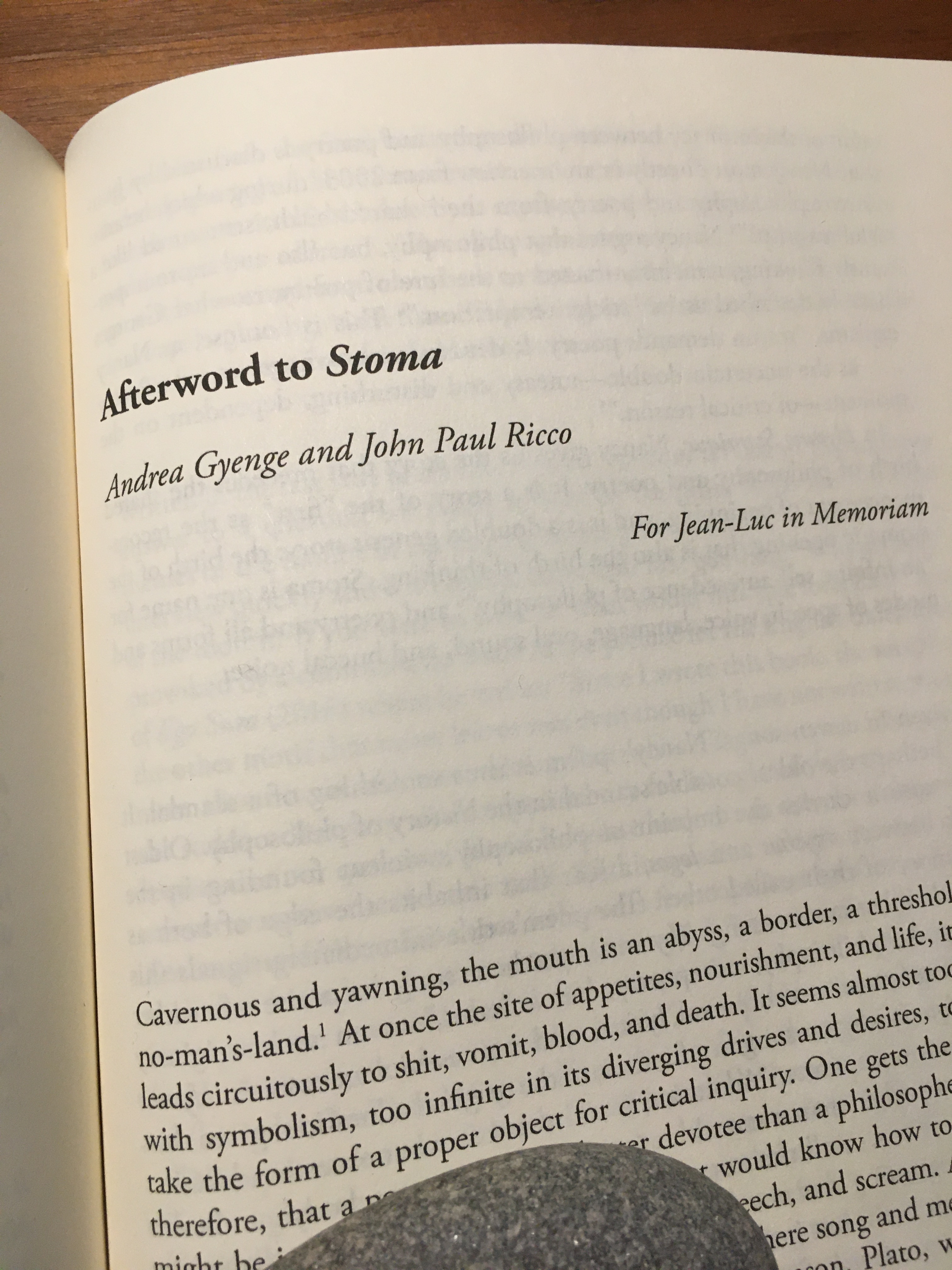
I am excited to announce that Corpus III, the third volume in Jean-Luc Nancy’s writing on the body, has just been published by Fordham University Press. The book features an eleven-part poem by Nancy, titled, “Stoma: A Hymn.”

It is a poem that he wrote in response to an inquiry that I and Andrea Gyenge made to him, regarding a comment that he had made in his Preface to the English edition of his early book on Descartes, Ego Sum. There he said that he has always wanted to write an “epic of the mouth.”

In a series of email exchanges back in late-autumn 2020, we asked him what such an “epic” would look like. Just a few weeks later, we received the poem, the hymn to stoma (small corporeal opening such as a mouth).

It is an extraordinary work of poetic philosophy and philosophical poetics; a meditation on the origin of the mouth as the originary opening that is the origin of human being. There are three places in the poem where “the mouth responds” to the ode that is being sung to it in the other parts of the poem.

In the final words of the mouth’s third response—which are also the words with which the poem ends—the mouth says:

It is me who alternates you

Me who shakes you

Me who agitates you

Me who troubles you

Stirs you opens you and closes you

It is me who rocks you and cradles

It is me who rhythms you and who thinks you

As we write in our commentary: “the subject, ego, or I, does not preexist the mouth’s opening, including in the form of enunciation, constative or performative speech, or even breath, but instead is born from out of this abyss and its rhythmic gaping. Indeed by the eleventh and last song, which joyously opens: ‘Stoma, it is you who swallows us! Stoma, it is you who speaks us!’ we arrive at the insight that the mouth makes us, and realize that Nancy’s poem has been, all along, a hymn to stoma in praise of and gratitude for what of us is stomatic.”

A new article in The Brooklyn Rail

https://brooklynrail.org/2021/12/criticspage/Muse-ecology-on-birds-and-other-tuning-forks

Appearing in the December 2021-January 2022 issue of The Brooklyn Rail, my article was commissioned by WJT Mitchell for the Critic’s Page that the magazine invited him to curate and edit. Tom’s chosen theme was “Sounding the Idols,” inspired by Nietzsche’s Preface to Twilight of the Idols where the philosopher advocates approaching the idols with a tuning-fork, thereby not smashing them with a hammer, but tapping them so that they are made to emit music.

My essay is part of my current book project on “extinction aesthetics” wherein ethical and aesthetic responses to species extinction—such as the ongoing loss of millions of birds and their birdsong—are argued to involve being attuned to these ensuing silences, to this mute music.

Featured in the new book, Pause.Fervour: Reflections on a Pandemic, jointly published by the Journal of Visual Culture and the Harun Farocki Institute, and edited by Manca Bajec, Tom Holert, and Marquard Smith. A free downloadable copy is available here.

Click on any of the images below to get a larger view.

It is a beautifully-designed publication, featuring short texts and artworks by over 50 writers and artists. The book is divided into four sections:

  • COVID-19, or the Pandemic Logic of Very Late Capitalism
  • Lockdown Life: Distance/Proximity
  • Biopolitics and Governmentality
  • New Ways of Caring

Click on the image of the article below, to open a larger view of the text.