Archive

Continental Philosophy

When it comes to theory, friendship, and the conversation that can ensue between and through the two, the question(s) of what we wish to hold on to (terms, words, concepts), which we want to abandon, is always fundamental to their shared sustaining. In particular, words of and from the other, including and perhaps especially when that other is for you, someone like a brother. This is what we might refer to as a “fraternization (or not) of terms.”

These thoughts occurred to me recently, as I was reading a draft of a current essay by my friend Philip Armstrong, on fraternity and friendship in the work of (and between) Jacques Derrida and Jean-Luc Nancy. (Philip’s piece is forthcoming in an issue of the journal Diacritics; it is outstanding, so be sure to track it down).

As a partial response to the question as to which words or terms we wish to hold on to, to retain, to willingly inherit, or to distinguish oneself from, we might say that it is always a matter of “more than one” and “less than one” which, as Derrida curiously suggests, at the opening of his lecture and what was to become the first part of his important late book Rogues, is a relation that is more elliptical than aporetic. For Derrida, the ellipsis is a figure for “minus one” and “more than one”—excess and withdrawal, at once.

This is something like the rhythm of originary abandonment and perhaps also of friendship, fraternity, or love. Not only an abandonment “from” identity, the proper, and self-same (or, conversely, abandonment by or of the other, in alterity), but as Philip so strongly argues, an abandonment “to”…the elliptical sense of shared existence in its sustaining (e.g. decision) of the spacing of separation (e.g. decision).

“Love” would be one of those “technical measures of equality” that Nancy speaks of in The Experience of Freedom, and that leaves Derrida—in the text cited above—so perplexed. Such measures are, for Nancy, forms of praxis that are “affirmations of the political.” Meaning, affirmations of the spacing of incommensurable sharing and sharing of the incommensurable, that is opened up and given access to, by the political. Each time, measured against nothing (this is “freedom” as Nancy defines it). It is this freedom, measured against nothing and not returning to itself, that renders this rhythm syncopated and overflowing (and hence perhaps something other than “aporetic”).

In Rogues, what Derrida says he cannot understand, is the way in which the incommensurable can be thought of as a measure, and a common measure at that. This also means that he cannot understand why Nancy would want to have retained the notion of fraternity, in his thinking of freedom, and as the name for partaking in this measure. Which is to say that for Nancy, what commonly goes by the name of “common measure” is the incommensurable, to the extent that sharing or being-in-common is always a sharing in that which is in excess of any general measure or equivalence (again, this, for Nancy, is “freedom”). It is as though the measure is not, nor can never be shared in common, since as measurable it will deny or appropriate the separated spacing that must remain incommensurable in order to be shared in its sense, and not say, simply exchanged in its value (according to a measure of general equivalence). Therefore, being-in-common is sharing, and sharing is partaking in the incommensurable, which is, in turn, the only measure of being-in-common.

Nancy gives the name “fraternity” to the gathering of those who partake in common in this incommensurable measure, as in the Christian and Freudian figures of brothers without fathers. Hence this emptying out (or dismembering) of the Father into the body, is part of what Nancy has called the deconstruction of Christianity. Yet we might ask whether this fraternity is a partaking/sharing in deconstruction, as well. That is, to the extent that the latter may be understood as a partaking in the dismembered body of the father, the law, the logos, and any other common substance and measure. It is in this regard that Nancy’s deconstruction of Christianity may also be a way of thinking about partaking in (by deconstructing) deconstruction. If Derrida was the first (and last?) deconstructionist, is Nancy the first to deconstruct deconstruction?
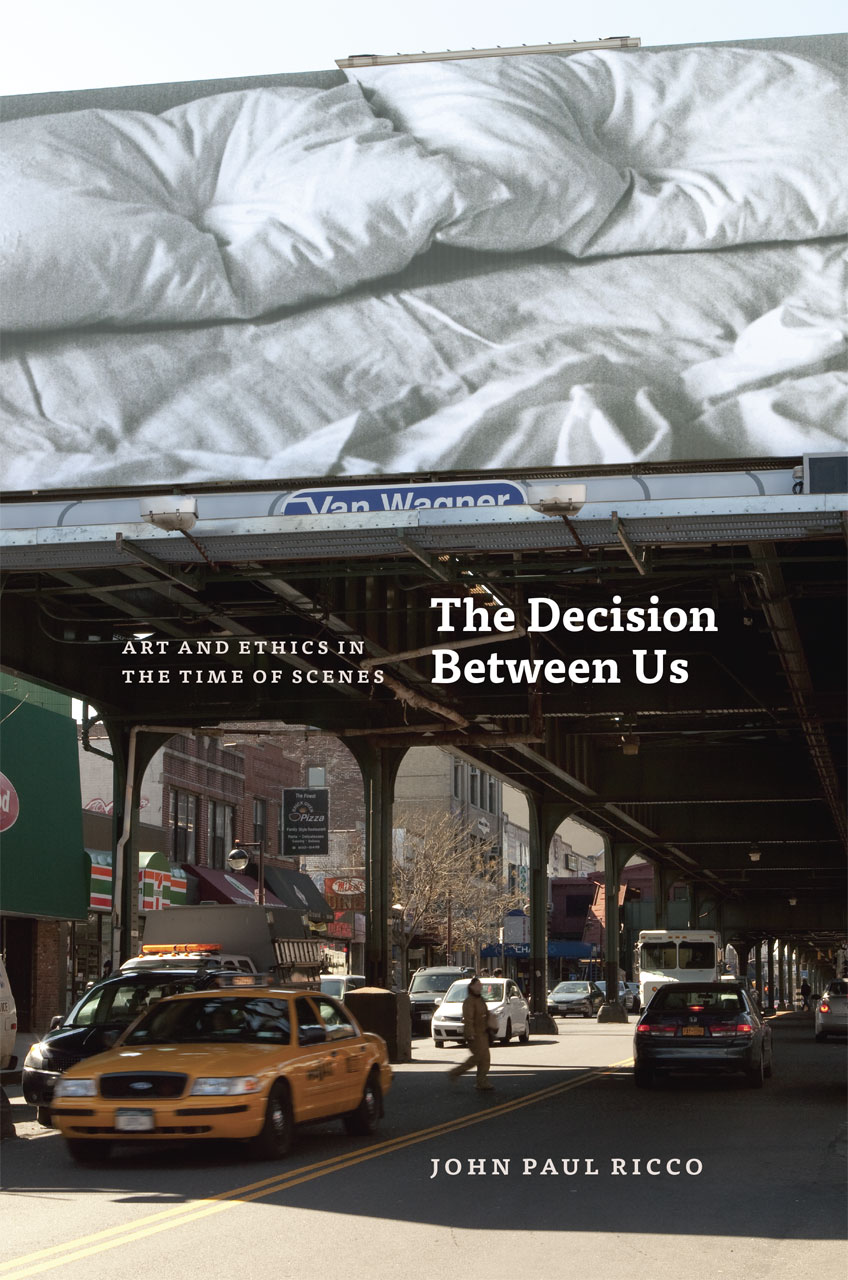
University of Chicago Press, March 2014.

University of Chicago Press, March 2014.

The Decision Between Us combines an inventive reading of Jean-Luc Nancy with queer theoretical concerns to argue that while scenes of intimacy are spaces of sharing, they are also spaces of separation. John Paul Ricco shows that this tension informs our efforts to coexist ethically and politically, an experience of sharing and separation that informs any decision. Using this incongruous relation of intimate separation, Ricco goes on to propose that “decision” is as much an aesthetic as it is an ethical construct, and one that is always defined in terms of our relations to loss, absence, departure, and death.

Laying out this theory of “unbecoming community” in modern and contemporary art, literature, and philosophy, and calling our attention to such things as blank sheets of paper, images of unmade beds, and the spaces around bodies, The Decision Between Us opens in 1953, when Robert Rauschenberg famously erased a drawing by Willem de Kooning, and Roland Barthes published Writing Degree Zero, then moves to 1980 and the “neutral mourning” of Barthes’ Camera Lucida, and ends in the early 1990s with installations by Felix Gonzalez-Torres. Offering surprising new considerations of these and other seminal works of art and theory by Jean Genet, Marguerite Duras, and Catherine Breillat, The Decision Between Us is a highly original and unusually imaginative exploration of the spaces between us, arousing and evoking an infinite and profound sense of sharing in scenes of passionate, erotic pleasure, as well as deep loss and mourning.

“Through a compelling, lucid, and wonderfully suggestive reading of Nancy’s writings, we are exposed throughout The Decision Between Us to numerous scenes of seduction and abandoned existence, scenes at once erotic and funerary, intimate and desolate. An incisive contribution to the ways in which Nancy’s writings might be read today, the sense of sharing at the heart of the argument is both transformative and intensely ethical.”

Philip Armstrong, Ohio State University

“Ricco’s The Decision Between Us is a beautifully executed book on the execution and extension of being-in-relation. Its articulation of sexuality theory, deconstructive philosophy, and queer art opens up different idioms to each other the way lovers open to each other—excitedly, productively, and yet always enigmatically, pointing beyond what seems present. Ricco is also a brilliant close reader. An enrapturing read.”

Lauren Berlant, University of Chicago

“Reopening ground broken by Jean-Luc Nancy, The Decision Between Us traces the paradoxes of relational being across a range of artistic, literary, and philosophical ‘scenes.’ Through a series of startling juxtapositions, Ricco weaves together scenes of exposure, erasure, and unmaking to reveal the inseparability of aesthetics from ethics.  This is an original and challenging work by one of our most brilliant philosophers of visuality.”

Tim Dean, State University of New York at Buffalo


Transmission Annual (2013)

LABOUR, WORK, ACTION
Edited by Michael Corris, Jaspar Joseph-Lester, Sharon Kivland
With guest editors Maureen Connor and Elizabeth Legge

Taking up Hannah Arendt’s reflections on three important human activities – labour, work, action – this book addresses the role that might be played by artist or work of art, and how this makes for agents and agency.

Contributors: Ivana Bago, Jordan Bear, Pascal Beausse, Bernard Brunon, Pavel Büchler, Armin Chodzinski, Annie Coll, Michael Corris, Janeil Engelstad, Francesco Finizio, Charlie Gere, Jerome Harrington, David Hopkins, Shannon Jackson, Vincent Victor Jouffe, the Pedagogy Group, Elizabeth Legge, Dale MacFarlane, Roberto Martinez, Mary-Lou Lobsinger, Hester Reeve, Oliver Ressler, John Paul Ricco, Abigail Satinsky, Juliet Steyn.

Transmission is a project that has encompassed an annual journal, a series of related publications, a lecture series, symposia and other events. Transmission Annual is a yearly publication, now in four volumes, edited by Jaspar Joseph-Lester (Royal College of Art, London), Sharon Kivland (Sheffield Hallam University), Michael Corris (The Meadows School of the Arts, SMU, Dallas, Texas), who were joined for 2012 by Noah Simblist (The Meadows School of the Arts, SMU, Dallas, Texas).

Scapegoat: Architecture Landscape Political Economy 05 Excess

Editorial Preview:
Ours is unquestionably a time of excess. While currencies and commodities continue to circulate, reifying segregation and inequality throughout the global political economy, excess leaks out in all directions, sometimes fostering movements of resistance, other times permitting improvisational opportunism among often neglected actors, and still at other moments irrevocably damaging ecologies and environments which we humans precariously but ruthlessly inhabit. The pleasures and perils of excess cross divisions of class, race, gender and sexuality, while also reinforcing aspects of these and other identities.

Can we design for, or among, the excesses of contemporary culture? How do practices of architecture and landscape architecture, as well as adjacent practices of art, curation, philosophy, and typography, suggest ways to amplify, capture, or redirect excess?

In EXCESS-Scapegoat’s sixth issue-we explore the productive, resistant, and imperiling aspects of excess as an attempt to advance our project of emboldening theoretical and historical modes of inquiry, scholarly research, and design practice. It is a vast conceptual terrain, but one that offers many compelling perspectives.

Contributors to EXCESS include: Ariella AZOULAY, Georges BATAILLE, Jean BAUDRILLARD, Alex BERCEANU, Diana BERESFORD-KROEGER, James BRIDLE, Melissa CATE CHRIST, Tings CHAK, Steven CHODORIWSKY, Vicki DASILVA, Heather DAVIS, Sara DEAN, Amanda DE LISIO, Seth DENIZEN, EMIL, ÉPOPÉE, FALA ATELIER, Valeria FEDERIGHI, Natasha GINWALA, HEBBEL AM UFER, Lisa HIRMER, Gary HUSTWIT, David HUTAMA, Kate HUTCHENS, Jennifer JACQUET, Martti KALLIALA, Prachi KAMDAR, Stuart KENDALL, Chris KRAUS, Abidin KUSNO, Emily KUTIL, Clint LANGEVIN, Justin LANGLOIS, Sam LEACH, Stanisław LEM, Sylvère LOTRINGER, Filipe MAGALHAES, Danielle MCDONNOUGH, Meredith MILLER, Srimoyee MITRA, Jeffrey MONAGHAN, Jon PACK, Keith PEIFFER, Rich PELL, pHgH, Rick PRELINGER, Thomas PROVOST, raumlaborberlin, John Paul RICCO, Erin SCHNEIDER, Ana Luisa SOARES, Scott SØRLI, Raphael SPERRY, Anna-Sophie SPRINGER, Antonio STOPPANI, Maria TAYLOR, Eugene THACKER, Kika THORNE, Emily VANDERPOL, Kevin WALBY, Eyal WEIZMAN, Jason YOUNG, Vivian ZIHERL, and Joanna ZYLINSKA.


On March 7 & 8, 2013 I will give a lecture and lead a seminar based upon my current book project: Non-consensual futures: pornographic faith and the economy of the eve. I am honored by the invitation extended by Professor Deborah Harter and her graduate students in the Mellon Seminar:

Frames of the Beautiful, the Criminal, and the Mad: The Art and the Science of Excess

Faculty leader: Deborah Harter, associate professor of French studies

Student participants: Sarah Seewoester Cain (linguistics), Linda Ceriello (religious studies), Kristen Ray (English), Nathaniel Vlachos (anthropology), and Rachel Schneider Vlachos (religious studies).

Seminar Description
Reflecting on representations of the “excessive” in science and in art of the modern period – madness, genius, criminal, eccentric, beautiful, and pathological – this seminar welcomes students from all fields in the humanities and social sciences. We will consider the aesthetic with scientific, the ethical with the historical, and play havoc with all usual boundaries of disciplines, period, and genre.

(An abstract of an essay for a special issue on “Bodily Fluids” of the journal inter/Alia, edited by Kamillea Aghtan, Michael O’Rourke, and Karin Sellberg).

It is a preverbal stream that deposits on the pillow a barely visible trace, as if a little saliva had leaked out of that sleeping mouth.
—Jean-Luc Nancy

In a chapter titled “Self from Absence to Self” of his recent essay, The Fall of Sleep, Jean-Luc Nancy draws upon the image of a little saliva leaking out of a sleeper’s mouth in order to analogise the withdrawal of self from I, into self. A fall into self that is not so much the enunciative “I am” of either a waking consciousness or dreaming unconsciousness, but the excessive and residual trace of the fall into self that is the fall – or what we might call, the drool – of speech.

Taking its cue from Nancy’s essay, and specifically his image of the barely visible trace deposited on the pillow, my paper will theorise drool as the liquid fore-speech of what I have come to call the fore-scene. The latter, in its own right, draws upon Nancy’s readings of Freud on Vorlust (Fore-lust) as the stage/scene of exposure and the spacing of the sense of existence as shared-separated. For drool is, as we know, a common liquid metaphor for uncontainable desire. An excessivity that, as formless force and form of the ground, is nothing but the unintelligibility of the fore, “upon” which anything like erotic pleasure (including as its own kind of intelligence) might be possible. In speaking in such terms, I of course also have in mind the base materialism of George Bataille’s definition of the formless and its analogy of the universe to spit.

In this paper I continue my ongoing theoretical meditations on photographic images of the unmade (but not necessarily “empty”) bed (i.e. Felix Gonzalez-Torres’ Untitled Billboard photograph, 1992) as fore-scene of co-existence/co-exposure. Based upon Nancy’s text these images are understood to be images of the impossibility of perceiving, let alone representing, sleep. For if, as Nancy states, sleep “shows itself to itself as this appearance that appears only as non-appearing, as returning all appearing on itself and in itself,” then the image of the unmade bed lies extended there in the aesthetics of retreat, “allowing the waking phenomenologist [the one that we inevitably become in the drive to satisfy our experiential/epistemological curiosity] approaching the bed to perceive nothing but the appearance of its disappearance, the attestation of its retreat” (Fall, 13).

Drool is to the verbal what the empty bed is to the visual, yet as the fall of speech, drool is not a matter of the verbal or the oral but of the “buccal,” as this has been theorised by Nancy and further articulated by Michael O’Rourke. As the liquid fore-speech of the fore-scene/fore-lust, we might say that drool is the pre-cum of a buccal murmur and groan. With the lightest of touches, as though with the tap of a finger, this spit is extended, and in its extension traces the tenuous yet resiliently tensile line of the “with” of our shared existence. As though at that sleeping mouth a salvific path was somehow opened up, and in that fall of speech one hears the “with”, the “substance” of which is something like ex-gested spit, or drool.

“You cannot deconstruct something that belongs to someone else. If I deconstruct something of someone else’s, I simply break it.” (Retreating Religion: Deconstructing Christianity with Jean-Luc Nancy; Fordham, 2012, 316).

Abstract of a Paper in-progress

The first half of my paper is a reading of texts by French philosopher Jean-Luc Nancy on religion, the divine and the sacred, art and aesthetics, and specifically on the attention that he has given to questions of place within philosophical and theological discourses. For as early as 1985 in his essay “Of Divine Places,” Nancy has argued that the question of God is not (or no longer) a question of being, essence, and presence (what is God?) nor of temporality, messianicity, and the infinite (when is God?), but a question of place and distinct location (where is God?), and what Nancy has more recently named “dis-enclosure.”

                  Given that in the philosophical and religious history of the West, the gods and God have always been departing, a divine place is not a taking place but a place of withdrawing and retreating (in absconditum). According to Nancy, if there is a divine place, it is at/from the step, less a footprint than a footfall or tread, where the latter is understood to be nothing other than the separated touching of sole and ground. As Nancy writes toward the end of “Divine Wink” (2003): “The step is the divine place, the only one, the place in which the power of the passing manifests and transcends itself” (119).  In addition to finding one of its homologies in “wink,” (based upon a reading of Heidegger on “the last god”), the step is, as Nancy explicates via a recourse to etymology, a vestige (vestigium) and as such is the remains of a step, not as image or perhaps even as indexical sign, but in terms of the touch of the step, its operation and its place. The latter used here by Nancy “in the strong sense of the word is always the vestige of a step” (“Vestige of Art,” 98), and hence a divine place.

                  In the second half of the paper, I turn to the recently opened National 9/11 Memorial at Ground Zero in lower Manhattan, in order to ask whether its deep recesses—exactly coinciding topographically with the two so-called “footprints” of the World Trade Center towers, might not be understood as a monumental securitization of the site, a hollowing out of the ground to its purported zero degree and that, less as profanation than divinization, renders it as hallowed and perhaps sacred ground, distinct from Nancy’s conception of divine place.

                  Finally, by drawing together Nancy’s recent writing on the empty tomb as distinct from the temple/cave, and the question that Derrida posed at the end of his 1968 lecture “The Ends of Man:” “Is there an economy of the eve?” I speculate towards a sense of spacing, aesthetics and archi-ethics as the withdrawal and retreat of architectural limits or the eves of the temple and the oikos (perhaps neither to nor from the temple but at and on its eve, that is to say, its threshold, opening, offering and infinitely finite access). And of temporality less in its coming than its passing by, like the step of the Gods, the departed, and perhaps even the ones who, in stepping from the heights of the towers on that September morning, caused so many of us witnesses to exclaim “my god!”

                  Following Nancy, I contend that this is the utterance of freedom as freedom unto nothing—nothing but the withdrawal and retreat from absolute destination or resurrectional return. This is at once the freedom of those who stepped out from the precipitous edge of the towers, and the utterance of those looking up at the sky and at the instant of witnessing each body falling. This is what I take it to mean when Nancy writes of “an utterance, and as ‘my’ utterance to the precise degree that it comes to me from the other who, in passing, gives me a sign, and whose Wink I respond to with ‘my god!’—without my having actually to say this word, whose ‘sense’ is to name or rather to mark, to remark, and to exclaim the passing itself and the passing not as a state but as a passerby whom I call to address, having perceived his step and the signal of that step” (“Divine Wink,” 116, original emphasis).

                  The economy, archi-ethics and aesthetics of the eve that I wish to think and present here, is an attempt to understand how the National 9/11 memorial, rather than staging the “zero mystery” (“Divine Places,” 140) and zero plan at ground zero, is a securitizing of the footprint, which is also to say—with a view of the water that endlessly flows into the memorial’s seemingly bottomless depths: “the baptizing [of] our abysses” (“Divine Places,” 113). Not a temple per se, but like every temple, the memorial is an attempt to guard against the departing, desertion and destitution of this kenosis from being an absolute abandonment in the form of a bare and empty place. For the “temple,” whether Greek, Jewish, Christian or Muslim, monumentalizes destitution and desertion, and provides shelter and protection not from these forces, but for them, in the finite form of architectural enclosure and spatial detention. Indeed it is remarkable to realize that the memorial at Ground Zero can be understood as a condensation of the four figures of the temple, as outlined by Nancy in his essay “The Indestructible:” Greek (contemplation of ruinous destruction and artistic metamorphosis); Jewish (twice destroyed and source of diasporic meaning, the latter in this case perverted for the purposes of waging a global war on terror); Christian (infinite construction, dome and spire, technology contemplating itself); Islamic (heart as black rock, reserved space, impenetrable and indestructible thing).  Indeed, as Nancy states, this remains the current four-fold of the world, and with no small sense of regret we might agree with Martin Filler who, in his rave review of the memorial, bestows on Michael Arad, its designer, the status of “one of the signal placemakers of our time” (“A Masterpiece at Ground Zero,” New York Review of Books, October 27, 2011).

                  Throughout the paper, I will attend to many of the structuring tensions that Nancy’s work has focused on, including what he retains and refuses in notions of the sacred and divine (and how more recently he has thought this difference in terms of the image and the distinct); the difference in earlier work between bare place and bare thing (the latter of which will be theorized as “vestige”); tomb/grotto as opposed to temple/cave; resurrection versus the raising of the body; the ob-scene and the fore-scene; and the empty and what I have come to call the already un-made.


PURE BLOCK, TRANSPARENT

(Fordham University Press, 2008)

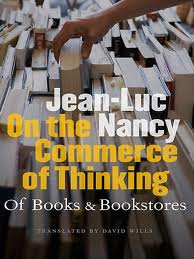
Multi-session workshop on Jean-Luc Nancy’s
On the Commerce of Thinking: Of Books and Bookstores,
as facilitated by John Paul Ricco.
Realized in coordination
with the exhibition Sediment at G Gallery, Art Metropole
and Of Swallows, Bookshop.

The three sessions of this workshop will cumulatively
involve a close and direct reading of this short book by
Jean-Luc Nancy. Each session will begin with 3-4 sections
of On the Commerce … being read aloud by workshop
participants with subsequent group discussion of the text,
led by John Paul Ricco.

Details for the three sessions are as follows:

Session 1: January 26 2012 at G Gallery, 7-9pm (sections 1-3)
On the Commerce of Thinking, Of Books and Bookstores
The Idea and Character of the Book
The Book’s End in Itself

Session 2: February 2 2012 at Art Metropole, 7-9pm (sections 4-6)
The People of the Book
Interminable Reading
The Publication of the Unpublished

Session 3: February 16 2012 at Of Swallows, Bookshop, 7-9pm (sections 7-10)
Book Open and Closed
The Scents of the Bookstore
The Commerce of Thinking
The Matter of Books

Those interested in attending the workshop are asked to
RSVP as soon as possible as there will be a limited number
of spots. Individuals that wish to RSVP are asked to
do so with the intention of attending all three sessions in
order to provide continuity and depth to the discussions.

To RSVP and for other information, please contact
Shane Krepakevich at skrepakevich(at)gmail(dot)com

G Gallery *NEW LOCATION*
134 Ossington Street (Entrance on Foxley Pl, rear of building)
Toronto, Ontario M6J 2Z5
info@sidecentre.com

Gallery Hours: Friday to Sunday 12 – 5pm

G Gallery location

G Gallery and sidecentre.com are generously supported by the College of Arts
and the School of Fine Arts and Music at the University of Guelph.

http://www.sidecentre.com/nancy.html