Archive

Continental Philosophy

I am so pleased that my essay, “The Art of the Consummate Cruise and the Essential Risk of the Common” has now been published (in two parts) by Feedback, a truly excellent online, open-access critical theory weblog/journal. Part I: The Ethics of the Pleasure. Part II: Cruising as Aesthetic Intuition of the Common.

Gay Cruising Pair Bathroom Stall

The essay originated as a paper that I presented at last year’s American Studies Association conference (Toronto, October 2015) on a panel organized by Ricky Varghese titled, “Sex, Misère, and the Redemptive: Barebacking and Historicity.” I want to thank Ricky for the invitation to participate in what was a very thoughtful, insightful and provocative discussion.

In the essay, I argue that we need to shift from a language of self and other towards one of co-exposed singularities, in order to think further about an ethics of pleasure that is not predicated upon sacrifice—either of the other or of the self. In addition, I call for the need to think sexual and other forms of risk and pleasure in terms of the common. Based upon recent work by Bill Haver, the common here is understood as always a sense of the common—including the aesthetic intuition of, and erotic inclination towards, the impossibility of the common.

I also want to thank “Joe,” the photographer of the image that I have reproduced here and that accompanies both parts of the essay, for kindly granting me the permission to reproduce his strikingly beautiful, evocative and downright sexy photograph.


Since the 12th-century, there has been in Christian moral theology a notion of taking pleasure in “expectantly waiting (Lat. moratur) in the desire for an object that remains absent because it is inaccessible or prohibited” (Dictionary of Untranslatables, 792). It is not a delay of pleasure, but rather of pleasure in the delay of satisfied desire, that is enjoyed by and in the imagination. In other words, it is the pleasure that one derives from desiring, and it is this pleasure-in-desiring that affirms that there is pleasure inherent in desire itself—and thus not only in desire’s fulfillment (a point that was clear to Lacan in his reading of the “paradox of fore-pleasures” in Freud).

It is important to underline that this “morose delectation” is not the postponement or infinite deferral of pleasure, nor is it entirely divorced from desire. Rather, it is the pleasure that is enjoyed in the very relation to desire. Neither the negation nor the positive presence of the object of desire, delectatio morosa is what we might describe as a neutral yet wholly pleasurable relation to desire.

I am interested in this Scholastic notion because it strikes me that it provides us with a way to think about the “neutral mourning” that I have theorized in my recent reading of Roland Barthes as its own form of pleasure. What I suggested in that chapter of The Decision Between Us dedicated to Barthes, is that in the midst and in the wake of mourning the recent death of his mother, Barthes sought what he had described as “a desire for the neutral,” and that this desire was, at the same time, a desire for a vita nova (“new life”—the eponymous name for the “novel” that he had begun to outline just before he died).

Drawing from his knowledge of Zen Buddhism, his fascination with Rousseau’s far niente (doing nothing), and his memory of a young Moroccan boy sitting on a low wall, I argued that Barthes imagined the neutral (and mourning) as a scene of just sitting, doing nothing. “To be idle, without master, and yes, perhaps even to be without guide (mother), and finally to be able to just sit without equivocation, without profit or debt, sin, prostration, or will-to-possess…something like the neutral sitting of a neutral mourning.”  Drawing further upon the etymology of the Latin word morosus, we can now understand this scene of neutral mourning as a scene of pleasure—of delectatio morosa. “In Italian…morosita means ‘delay’ (particularly in acquitting oneself of a debt or an obligation)…and where the English “moroseness” is rendered by malinconia [“melancholy”]…and in Spanish, where…moroso means ‘lazy'” (Untranslatables, 792).

When mourning is the act of the imagination enjoying its waiting in desire, it is neutral. It is in this way that neutral mourning is neither morbidly morose mourning nor melancholia, but instead is a desire for the neutral and its own form of neutral pleasure.


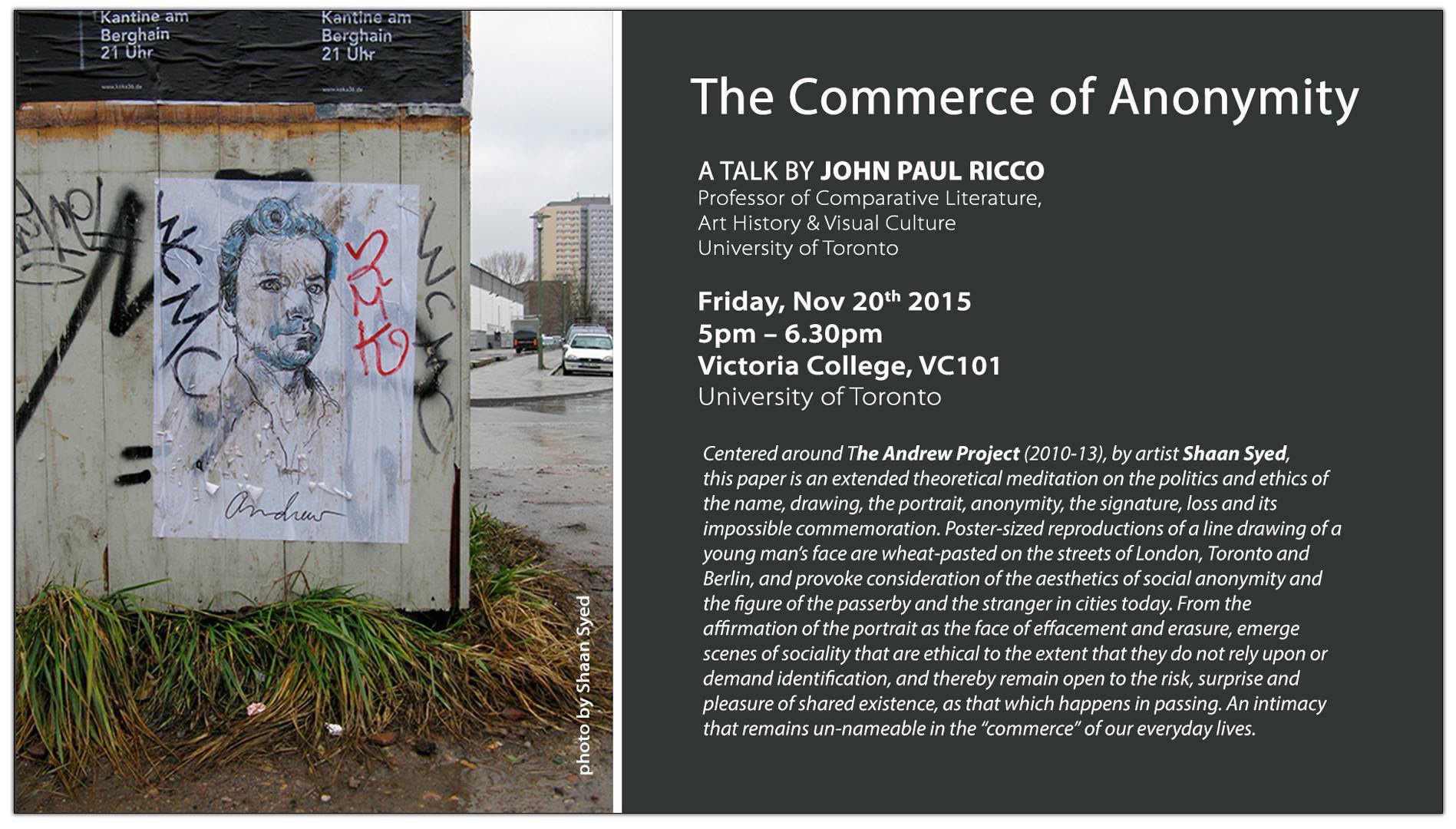
Last week, as I was preparing a public lecture on “The Commerce of Anonymity,” I began to think more about the conceptual relations between anonymity and the neutral, and in particular the ways in which together they might bear upon acts of mourning.

At once drawing me back to ideas that I recently presented in chapter 5 of my book, The Decision Between Us, on Roland Barthes’ neutral mourning, and also closer to more recent events in which many of us find ourselves mourning the deaths of largely unknown or anonymous others, I returned not only to Barthes’ work, but also to Maurice Blanchot’s, in order to try to think about how a politics and ethics of the anonymous and neutral might disrupt or refuse some of the more dominant and prevailing responses to such violent atrocities and mass deaths.

In his book, The Step Not Beyond, Blanchot writes that,

The anonymous after the name is not the nameless anonymous. The anonymous does not consist in refusing the name in withdrawing from it. [Thus we might say that the anonymous is the withdrawal of the name through (as) the name of the nameless]. The anonymous puts the name in place, leaves it empty, as if the name were there only to let itself be passed through because the name does not name, but is the non-unity and non-presence of the nameless (34-35).

The name is the passage through which the anonymous passes. And in its passing/withdrawing through the name, the anonymous leaves the place of the name empty, as if the anonymous were the place-name (if not place-holder) for the name.

What I want to suggest is that as the neutral name (neuter) of the name, the anonymous, when mourned, calls for an equally neutral mourning. For Barthes, there is indeed a form of mourning that is without codification and assimilation, and without any one proper place. Hence, it is not only without memorial or monument, it is, Barthes argues, therefore also socially untenable. Moving away from the will-to-possess toward the will-to-love, this neutral mourning represents the second type of “neutral” that Barthes is (more) interested in. It is differentiated from the first-degree neutral (i.e. the suspension of conflicts), while at the same time being distinct from the “desperate vitality” (a phrase that he derives from Pasolini), that he takes to be equivalent to a hatred of death. Thus while Barthes does not use the phrase, I think we find here what amounts to a conception of neutral mourning. Within the context of my current thinking and writing, I want to suggest that such neutral mourning is at the same time, anonymous mourning, specifically the mourning of those who go by anonymous names (in the departure of the departed, in passing).

For just as for Blanchot, “the anonymous puts the name in place” yet only to be the place of passage for the name and its emptying out of nomination, so with Barthes, the temporality of the neutral is nothing more than a moment or instant, specifically an opportune opening—what we might think of as the kairos to Blanchot’s anonymous topos.

This itinerancy of the anonymous and the neutral is what makes them both operate as lures, yet not in terms of a name, but as predicates or adjectives. Which is to say, as a certain kind of aesthetic provocation and attraction, and an opening of the ethical. For what Barthes more fully says about the kairos of the neutral is that “perhaps the Neutral is that: to accept the predicate as nothing more than a moment: a time” (Neutral, 61). The kairos (or opportune moment) of the neutral, is the non-nominalizable singularity (of space and of time) that is anonymity (as in the German neuter form Das Moment: cause, force, momentum).

Neutral mourning is the will-to-love that moment of departure that passes between the anonymous and the predicate—between any one name and passing quality. The neutral and the anonymous are thus not the names (or not only the names) but the adjectives or predicates of an originary movement, force and temporality of the momentums and moments of being together (i.e. the commerce of anonymity).

In light of recent events, this is what we must respond to, counter-sign (“not in our names”), and thus begin to take responsibility for—prior to and in excess of political and theological sovereignty. It is in this way that we might affirm, as Michael Naas has argued, “that there can be no sovereign last word [or name] to put an end to the violence or the endless discussion” (The End of the World and Other Teachable Moments, 167).


In his remarkable review essay [PDF] of my book, The Decision Between Us, Jacques Khalip (Professor of English, Brown University) beautifully illuminates the ways in which something as ordinary as a blank sheet of paper is—for me, in my thinking and in this work—an aesthetic event and an ethical scene. Not a place or product in the service of judgment, but the spacing of decision. The measure of which lies in the separation or apartness that sustains the between-ness of our being-together.

With great care Khalip attends to the aesthetic and ethical dimensions of my argument, and makes evident how “art and art’s ethical deliberation are…of a piece in this study,” and how “art measures (even if it is measureless) the infinite demands of an ethos that appears and disappears under our feet.”

Of the many, many things that I appreciate about Khalip’s reading, I especially value his foregrounding of my chapter on Roland Barthes, “Neutral Mourning,” and its reading of Camera Lucida alongside Barthes’ lectures at the Collège de France and the mourning diary that Barthes kept immediately following his mother’s death. For here is where a Roland Barthes emerges whom I believe is so deeply informed by Maurice Blanchot and Blanchot’s own philosophy of the neutral. It is also here where we truly begin to gain a sense of what it means for Khalip to cast my work as its own form of “queer neutrality” and what import this might have, not only for queer theory, politics and ethics, but also for the study of the work of Barthes and Blanchot.

As the concluding paragraph, Khalip writes,

If The Decision Between Us impresses upon us an ethics that is not coterminous with the self-possessed subject, the galvanizing effect of this reasoning is to bring into view an awareness that art is the intensification of an ethics-beyond-ethics, a kind of thinking that occurs beyond mere identity, narration or historical contextualization. Among the various illuminating moves in Ricco’s book is its immersion in the various environments it evokes and theorizes, at once setting up scenes while at the same time distancing the reader from them, page after page. As readers, we cannot help but waver between decision and indecision with each of Ricco’s arguments—every movement forward compels a further critique and judgment. Indeed, the book is buoyed by the anonymous, aesthetic power between decision and indecision, not as a choice between positions but as a contamination in the very space of the two that propels unending, queer deliberations.

I am deeply and sincerely grateful for this review, and as my work continues to move on, I will remain indebted to Jacques Khalip’s reading.

I recently led a discussion amongst all of the Fellows at the Jackman Humanities Institute (University of Toronto) of William Haver’s essay, “The Art of Dirty Old Men: Rembrandt, Giacometti, Genet,” published in Parallax, in a special issue that I edited on “unbecoming,” (vol. 11, no. 2, 2005). Here are my introductory remarks.

One of the principal assertions in the study of Visual Culture, including what WJT Mitchell, one of the founders of the field has elaborated as “picture theory,” entails the philosophical reclamation of “picture thinking”—the kind of thinking that Hegel had attempted to thoroughly denigrate. At the same time, such methods that for awhile comprised what was referred to as the “visual turn,” entails an embrace of Kant’s notion of the schema, precisely in order to think in non-symbolic and non-representational ways not only whatever the word “culture,” designates in “visual culture,”  but also “visuality,” of which “images” are just one of the many “things” in question. But as these names imply, “picture thinking” or “picture theory” are also ways to engage in thinking and the practice of thought, and not only through pictures (as though images were merely forms of mediation between the mind and the world), but more deeply and perhaps more philosophically, about thought “itself:” its source, its practice, its durations and its interruptions. In the wake of our reading of Deleuze, we can speak of “the image of thought,” in which that image might be a thing in addition to possibly being a conceptual personae or an affective perception or intuition. This is of serious consequence, since there is an inextricable relation between thought and things (to quote the title of Leo Bersani’s most recent book), and needless to say, it this relation that resides at the heart of our theme at the Jackman Humanities Institute this year, and our common theme of “things that matter.”

As we begin to parse the relation between thought and things, we might turn to Jean-Luc Nancy, who states—in one of his books on Hegel, in fact—that “thought sinks into things only to the extent that it sinks into itself—which is its own act of thought” (Restlessness, 15). Thus the ways in which thought sinks or penetrates into things, or simply acts in the vicinity of things, is the way in which thought thinks. This image of thought is the intuition of sense—its literality and visuality—in which the Kantian schema proves to be nothing other than an image. As Fredric Jameson has recently pointed out, this is what Einstein’s thought experiments consisted of, and, we might add, how quantum theory thinks about things. Namely: through non-representational yet still referential pictures, including diagrams. As Jameson explains, in all of these instances, it is the signifier that determines the signified, and the effect determines the cause. These are formulas that we are utterly familiar with, in our various engagements with post-structuralism and deconstruction.

This is also the inverse temporality that I am interested in, and that motivates the research project that I am pursuing here at the JHI on the collective afterlife of things. It is a temporality that does not only track the effects of the present on the past, but of the future on the present. This temporality is rendered literary and is visualized in the science fiction sub-genre of the time-travel narrative; and in fact it is in a recent review of a new theoretical study of this genre, where Jameson, in the very last sentence of his article, draws the stunning conclusion that “temporality is then nothing but a time-travel narrative.” (“In Hyperspace,” review of Time Travel: The Popular Philosophy of Narrative, by David Wittenberg, Fordham; London Review of Books, 10 September 2015).

This is where I think William Haver’s essay on “The Art of Dirty Old Men,” enters the discussion, and its provocation not about the history but about the historicity of thought, which is to say, thought’s sinking into things/into itself, which in turn is to speak of thought’s image. For whereas in these sci-fi  time-travel narratives there is, as Jameson explains, “the transcendental necessity of superspace in any narrative rendering of time,” Haver argues that due to the force of finitude, meaning “non-transcedence,” such narrative renderings of time are interrupted (including in the disciplinary discourses of “history” or “art history” and their own aspirations toward a transcendental perspective in the form of explanation, interpretation and understanding). Further, it is not so much that time-travel becomes impossible, but more precisely that it now must be thought as generating not temporality, but what Haver describes as “a-temporal disjunct simultaneity,” or more simply: the sense of finitude—finitude’s historicity. Yet to all of this we must ask: why is this case?

Haver’s answer is that it is because of the material impasse of existence, the fact that existence, or what he describes as the “identity and equality of sentient being” is abject in its non-transcendence. Meaning, the finitude of bodies, thoughts and things, in their incommensurable singularity and sheer exteriority: things that is, other than in terms of the instrumental, meaning or significance, the calculable or the numerable. In other words: the dirty old man whose look butted against Genet’s own non-contemplative and impersonal seeing. “Material impasse” describes the impasse or essential insufficiency of thought to its objects (in a word: materiality) and that which in its materiality is irreducible to a thing.

In “On the Solitude of Things,” a chapter of an unpublished book on Genet and the political, Haver at one point makes clear that “it is not…simply a matter of resigning or refusing one’s transcendence, of abandoning the distance of perspective. Rather it is a matter of sustaining the syncopations every historicization elides, of inhabiting the infinite yet absolutely proximate distance between evidence and experience, between interpretation and evidence, between transcendence and finitude” (Solitude, 10).

Genet speaks to this interruption of the time-travel narrative and thus of temporality, in a way that underlines how this experience—which Haver will go on to theorize as not only the conviction of the aesthetic, but also the experience of the ethical and the political—when he (Genet) writes (first block quote on page 29) about the sensuous pleasure of his hand in a boy’s hair, and how even though he (Genet) “shall die, nothing else will.”

 A little while ago I wrote that though I shall die, nothing else will. And I must make my meaning clear. Wonder at the sight of a cornflower, at a rock, at the touch of a rough hand –all the millions of emotions of which I’m made –they won’t disappear even though I shall. Other men will experience them, and they’ll still be there because of them. More and more I believe I exist in order to be the terrain and proof which show other men that life consists in the uninterrupted emotions flowing through all creation. The happiness my hand knows in a boy’s hair will be known by another hand, is already known. And although I shall die, this happiness will live on. ‘I’ may die, but what made that ‘I’ possible, what made possible the joy of being, will make the joy of being live on without me.

(Genet, The Prisoner of Love, NYRB, 2003 translated by Barbara Bray, 361)

This is not a transcendental time-travel narrative, in which one travels back to (or from) the future, but is instead what I wish to theorize as the collective afterlife of things, in which the abject non-transcendence of our finitude is what we share between us (the fact and condition of “social ontology”), and not in some future end of times, but here, now when we see a clothespin left behind on a line, or look at a Rembrandt, a Giacometti, or in our encounters with any number of other things. As Haver argues, the “thing” of painting or of seeing provokes an accidental intuition of the identity and equality of sentient being as that which is predicated upon nothing (no sufficient principle or reason) and thus is absolutely unjustifiable. To give ourselves over to this unjustifiable existence, would be to begin to do justice to things and each other.

I am very pleased to receive this review of my book by art historian Tom McDonough, that was recently published in the journal Critical Inquiry. Click on the link below to access the complete review.

Tom McDonough review in Critical Inquiry


  1. “The Inoperative Praxis of the Already-Unmade,” in Labour, Work, Action, edited by Michael Corris, Jaspar Joseph-Lester, and Sharon Kivland, Artwords Press, 2013. 
  2. John Paul Ricco, The Decision Between Us: art and ethics in the time of scenes, University of Chicago Press, 2014. 
  3. “Pornographic Faith: Two Sources of Naked Sense at the Limits of Belief and Humiliation,” in Porn Archives, edited by Tim Dean, Steven Ruszczycky, and David Squires, Duke University Press, 2014. 
  4. “The Existence of the World is Always Unexpected: Jean-Luc Nancy in conversation with John Paul Ricco,” in Art and the Anthropocene: Encounters Among Aesthetics, Politics, Environments and Epistemologies, edited by Heather Davis and Etienne Turpin, Open Humanities Press, 2015.
  5. “The Separated Gesture: Partaking in the Inoperative Praxis of the Already-Unmade,” in Nancy and the Political, edited by Sanja Dejanovic, Edinburgh University Press, 2015.
  6. “Parasol, Setas, Parasite, Peasant,” in J. Mayer H.: Could Should Would, Hatje Cantz, 2015. 
  7. PLUS: “Drool: liquid fore-speech of the fore-scene,” in World Picture, issue on “Abandon,” summer 2015 ( available online). 

The other day I read Michael Wood’s review of Caroline Levine’s new book, Forms: Whole, Rhythm, Hierarchy, Network (Princeton, 2015) in the London Review of Books (27 August 2015), and now I am curious to read Levine. Not because the four principal forms that she focuses on (listed as the book’s subtitle), are the kind of forms that I am interested in, but primarily for two other reasons.

The first, as Wood describes it, is Levine’s “suggestion that forms are never alone, that they get in each other’s way.” To think about forms as non-autonomous, is of course to completely re-define what we mean when we speak of forms. Here, forms are less stable, self-contained, and isolated entities, than they are understood to be  mobile, touching, overlapping, colliding and contaminating formative and “de-formative” forces. Their boundaries and limits are permeable or fluid, extending and overflowing. Contrary to conventional meaning and understanding, forms are not closed, but open. In a sense, we might say that it is at the place, zone, line or contour of the formative force of collision (for instance), that form is formed—as always singular plural. This leads me to want to make the claim not that there is (or are) a form of co-existence or being-with (formalism of the social and of form), but that the spacing of the “with” is what form means—both form’s source and sense.

Which leads to the second, equally if not more so, provocative and enticing theoretical approach of Levine’s, the one that Wood thinks “it’s worth pausing over…since it’s quite rare, and very promising.” At which point he hands the floor over to the author, who he quotes as stating:

The point here is less to use formalist methods to read Dickens than to use Dickens to throw light on the operations of social form. If this seems like literary criticism turned upside down, that is certainly part of my purpose. I have not understood literary texts in this book as reflections or expressions of prior social forms, but rather as sites, like social situations, where multiple forms cross and collide.

I too regard this as an extremely promising critical/theoretical approach to works of art, in no small part because in Levine’s self-description of it, I see something that closely resembles the approach that I have taken in my writing on contemporary art, literature and theory, most recently in my book, The Decision Between Us: art and ethics in the time of scenes. Whether this makes Wood’s sense of its rarity any more or less the case, I am heartened to encounter his estimation of it, and what appears to be a very compelling deployment. One that does not read the social back into the work of literature or art, or even reads the work outward onto the social, but that understands works of art—their forms—as social sites, or what, in my book, I mean by “scenes.”

In their attempts to think the relation of art and the social, aesthetics and the ethical, formalist methods operate with the assumption that one or the other exists prior to the other, and as a form separate from the other holds the potential to shape or inform the other. Whereas a non-formalist approach distinguishes itself by asserting that any notion of literary, artistic or social form is only possible to the extent that one attends to the scene where as Levine writes: “forms cross and collide.” To which I would go on to argue that it is “in” or “at” the coming-together and apart where forms are formed—where and how form happens—and neither before nor after.

Forms are thus re-conceived as needing to be sustained as the open and extended spaces that they are, in order to “remain” or persist as forms. Forms are incredibly fragile things, if not always, then often. Such that we might conclude that it is precisely such impermanent scenes that are the most worth trying to sustain, in and as the impossibility of their obdurate formal permanence. Therein lies the inseparability of aesthetics and ethics.

Published in: Art in the Anthropocene, edited by Heather Davis and Etienne Turpin (Open Humanities Press, 2015). The entire interview (included all references and notes), along with the rest of the 400+ page book, can be read and downloaded here: Art in the Anthropocene

In a recent article in The New York Times titled “Learning How to Die in the
Anthropocene,” Roy Scranton argues that the current geological, technological,
and climatic global situation has shifted the classic philosophical problem
from how to die as individuals to how to die as a civilization. Scranton
served in the United States Army from 2002 to 2006 and was stationed
in Iraq following the US invasion in 2003. A couple of years later, when
Hurricane Katrina hit New Orleans, Scranton realized that he was witnessing
“the same chaos and urban collapse I’d seen in Baghdad, the same failure of
planning and the same tide of anarchy.” It is precisely this inextricable interdependence—
and therefore the always potentially catastrophic destructive
effects—of the natural and technological that Jean-Luc Nancy refers to as
“eco-technology.” For, as Nancy is keen to remind us, “nature always contains
and offers the prime matter for technology, whereas technology alters, transforms,
and converts natural resources towards its own ends.” With “this
eco-technology that our ecologies and economies have already become,”
we are confronted with the geopolitical logic of globalization today. What is
new about the eco-technical logic currently operating is that the reciprocal
relations between the economic and ecological wed technology and nihilism
at an unprecedented worldwide scale, one that may prove to encompass the
human species. But proof for whom in that case?

As Nancy goes on to argue, “whereas until now one used to describe ends
(values, ideals, and senses) as being destitute, today ends are multiplying
indefinitely at the same time as they are showing themselves more and more
to be substitutable and of equal value.” It is based upon this understanding
of the equivalency of ends constructed by the eco-technical, that Nancy has
provided ways in which to think about the connections between the Iraq invasion
and Hurricane Katrina as at once military, geopolitical, technological,
natural catastrophes, and environmental disasters. Which is not to cast them
as equivalent catastrophes, but rather to understand them as events entirely
caught up in the catastrophic logic of general equivalence in which every
moment has become economized, as every single thing has been monetized.
In response to this, Nancy has put forth the notion of the “condition of an
ever-renewed present,” which he goes on to define as “not an immobile present
but a present within historical mobility, a living sense of each moment,
each life, each hic et nunc [here and now]. A sense that is characterized by
exposure to its own infinity, to its incompleteness”—and thus, we might add,
to its in-equivalence to every other moment and thing.

So perhaps it is not only a matter, as Roy Scranton argues, of learning to see
each day as the death of what came before, but in doing so, of seeing that
day as the birth of the present in and as its own—ever-renewed—finitude.

Meaning: no longer the projection of a future or as part of the project of
future ends. Instead, as Nancy has recently argued, “what would be decisive,
then, would be to think in the present and to think the present.” That is,
of the present not as absolute and final presence, but as appearing near,
proximate, close to, and in rapport with. As he goes on to explain, if one
wants to speak of “end” it is necessary to say that the present has its end in
itself, in both senses of goal and cessation. The finitude of each singularity
is thus incommensurable to every other, and therein exists the equality of
all singularities—their in-equivalence. It is in this way that Nancy calls for
an adoration of—or esteem for—the inestimable singularity of living beings
and things, and the equality that lies in their in-equivalence to any general
schema, measure, principle, or horizon. This is a matter of attending to the
inestimable worth of things as opposed to the appropriation of each and
every priceless experience. Therefore Nancy closes his recent book After
Fukushima: The Equivalence of Catastrophes, with the following claim: “To
demand equality for tomorrow is first of all to assert it today, and by the
same gesture to reject the catastrophic equivalence. It is to assert common
equality, common incommensurability: a communism of nonequivalence.”
For Nancy, the proliferation of so many common ordinary things today is
not only the obvious evidence of capitalist production and accumulation,
but also the fact that (as quoted above) “ends are multiplying indefinitely,”
and precisely for this reason offer “more and more motives and reasons to
discern what is incomparable and nonequivalent among ‘us.’”

Therefore, as Maurice Blanchot contended in 1959, when philosophy lays
claim to its end “it is to a measureless end,” such that “measurelessness is the
measure of all philosophical wisdom,” so too in our reading and engagement
with the work of Jean-Luc Nancy today do we come to realize that when
philosophy (or more modestly, thought) confronts the prospect of the end
of humanity, that the incommensurable remains the measure of eco-technical
wisdom. Furthermore, given the ways in which Nancy has enabled us to
understand art as “the privileged domain for an interrogation of finality,”
aesthetic praxis is one of the principle means by which we confront the
problematic of ends. It is in this way that his comments below will prove
indispensible to ongoing considerations of the interconnections between
art, aesthetics, politics, and environments in what has come to be called the
Anthropocene.